Balkhash perch
Perca schrenkii · Percidae
- Freshwater
- Predators
- Medium
- Size
50 cm
- Weight
1.5 kg
Where to fish
- Estuary
- Lake
- River
Habitat icons: Flaticon
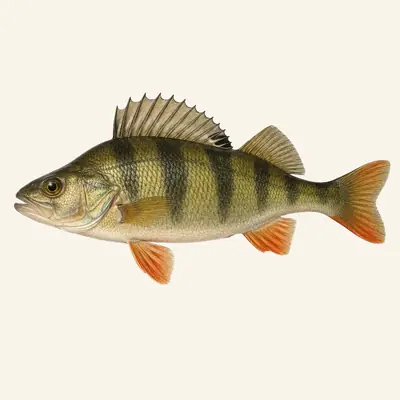
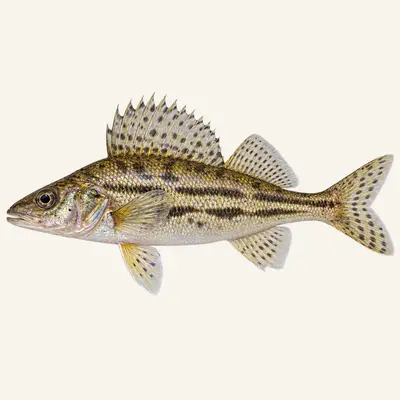
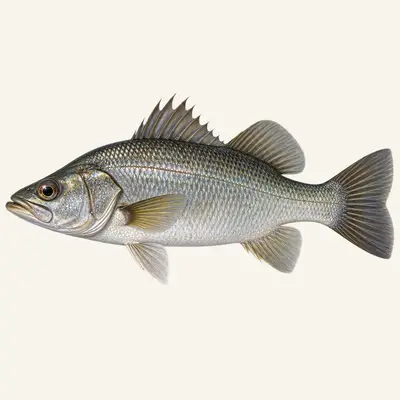
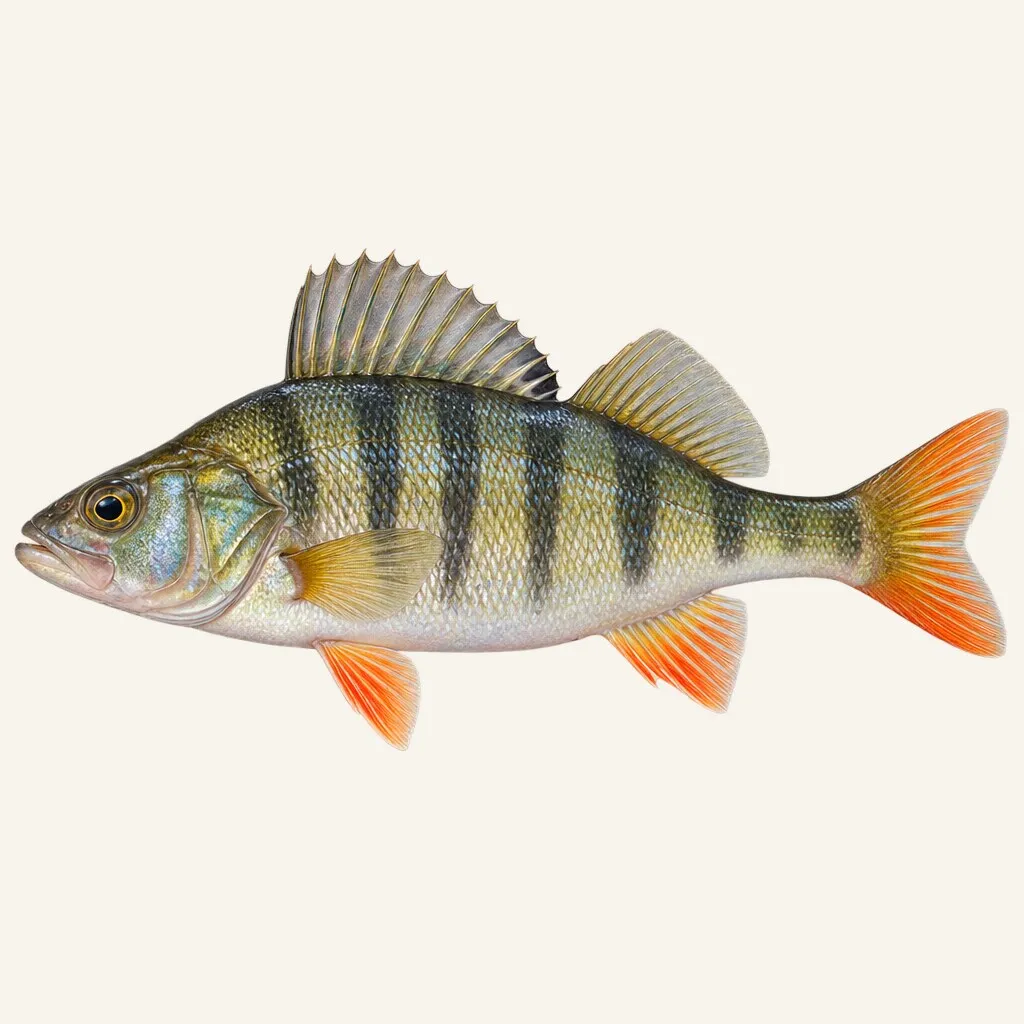
The Balkhash perch (Perca schrenkii) is a freshwater percid endemic to the closed Balkhash-Ili basin in Kazakhstan, identifiable by its laterally compressed oval body, yellowish flanks marked with dark vertical bars, and well-developed spiny dorsal fins.
Calendar
Recorded in 1 country
Kazakhstan
GBIF occurrence records — native and introduced populations combined.
Its range
One basin, and it has no way out. This perch belongs to the Balkhash system in Kazakhstan: the lake, the rivers that arrive at it off the mountains, and the delta where the largest of them spreads out. Nothing drains from there to any sea.
That geometry is more important than the size of the range. A closed basin is a room with the door shut. Whatever lives inside it cannot spread beyond it and cannot be restocked from outside it by any natural route, so what the map shows is not a distribution in the ordinary sense — it is the entire species, in one water body, with no population held anywhere in reserve.
The inflow decides the rest. The main river feeding the lake rises across the frontier in China, which puts the water balance of the only basin this fish occupies in the hands of decisions taken upstream of the country that contains it.
The water it needs
Lake, river and delta — and the delta is the entry that repays attention on a fish a long way from any ocean. Balkhash grows saltier from its western end towards its eastern one, so the arrival of a large freshwater river creates a salinity gradient with no tide and no sea at the end of it. The site lists an estuary for this species, and that is what the word means here.
Beyond that the biological record is close to empty. There is no depth range published for the species, no temperature band, no diet beyond what the genus does generally, and no description of spawning. What exists is a name, a lake, and a fishery.
Areas
- Submerged weed beds
- Vegetated banks
- Shallow water
- Lake deltas
Techniques
- Small soft plastics
- Live bait fishing
- Light jigging
- Float fishing
Baits
- Earthworms
- Small live fish
- Bloodworms
- Small jigs
How to catch it
The record lists a commercial fishery and stops there. Neither of its two congeners is filed that way: both are also entered as game fish, and this one is not. There is no angling literature to draw on.
So anything said about taking it is carried over from the genus rather than observed here — a shoaling percid working vegetated margins and shallow water answers to small soft lures, live bait and light jigs — and it is worth labelling that as inference. This fish has been written up for the fishery statistics, not for the angler.
One thing does follow from the geography rather than from the family. There is a single stock. On a coastline or in a river basin, effort concentrated on one part of the range is diluted by the rest of it; here there is no rest of it.
Conservation
Everything acts through the inflow. The level of a closed basin is the difference between what its rivers deliver and what evaporates off its surface, so water taken off the tributaries for irrigation does not trim the habitat at the edges — it lowers the whole lake and concentrates what stays behind. A fish adapted to the fresh end of a salinity gradient loses ground at both ends of that arrangement.
There is nothing to fall back on. No neighbouring population can recolonise a closed basin, so a fishery worked on this lake is a fishery worked on the species, and a bad decade has no external supply to correct it.
The third pressure is that nobody can currently say what the first two have done. The standing reference for the species is a mid-century Soviet survey of the fresh waters of the USSR, translated later and never replaced. A single-basin fish, described once seventy years ago, in a system under this much hydrological pressure, is a fish whose condition is unknown rather than reassuring.
Regulations
Check the local regulations in force (legal size limits, closed seasons, bag limits).
For guidance only. Legal sizes, quotas and open seasons vary by location and season: always check the local regulations in force before fishing.
Other names
Balkhash perch is the name to use, after the lake that holds it. Chinese perch turns up as an alternative and is best avoided: in the aquaculture literature those two words belong to Siniperca chuatsi, an unrelated Asian freshwater fish in another family altogether, and the collision is total.
The epithet is a personal name — a nineteenth-century naturalist who travelled Central Asia — and carries no information about the animal. The lake itself is written Balkhash, Balqash or Balkash depending on the transliteration in use, which matters when looking for anything published about it.
Sources: fishbase.se · api.gbif.org