Butterfly peacock bass
Cichla ocellaris · Cichlidae
- Freshwater
- Predators
- Medium
- Size
74 cm
- Weight
6.8 kg
- Water temp.
24–27 °C
Where to fish
- Estuary
- Lake
- River
Habitat icons: Flaticon
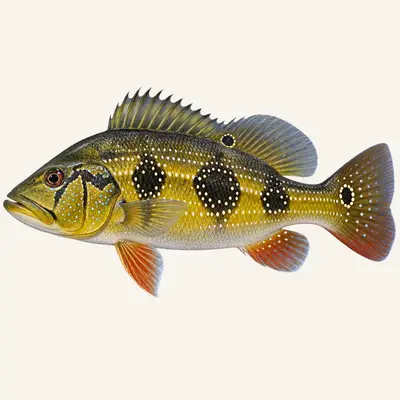
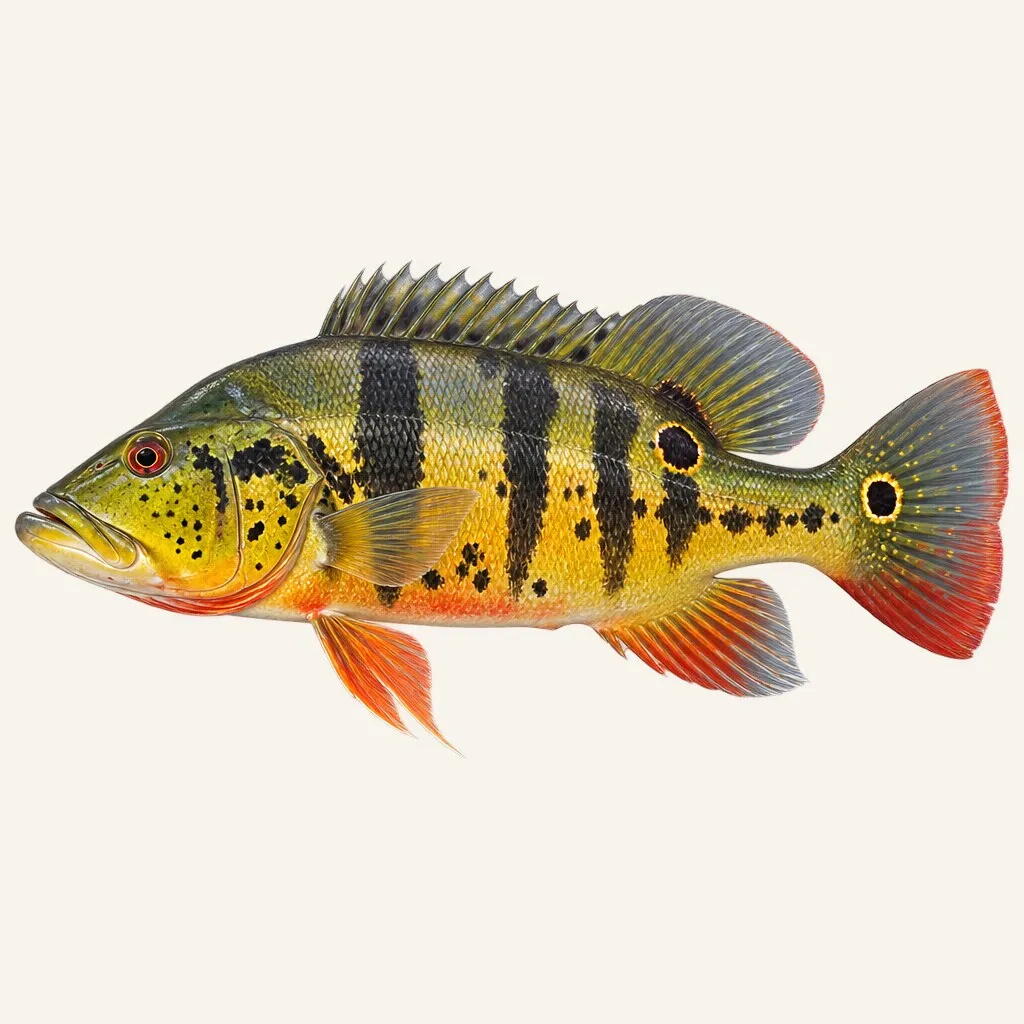
The butterfly peacock bass is one of the most iconic predatory cichlids of South America, introduced in North America and Asia. Its elongated body bears three prominent ocellated spots on the flank and a fourth at the tail base, hallmarks of the species.
Calendar
Recorded in 6 countries
Brazil · Colombia · French Guiana · Singapore · Taiwan · United States
GBIF occurrence records — native and introduced populations combined.
Its range
Three coastal basins hold all of it: the Marowijne, shared by Suriname and French Guiana, west to the Essequibo in Guyana.
That is a Guianan range, and far smaller than the name has suggested for most of the past century. Cichla ocellaris served as the catch-all binomial for peacock bass right across the Amazon, and it took a revision of the whole genus in 2006, which named nine species at a stroke, to hand the name back to these three rivers. Anything published before that date under this name may concern almost any large Cichla.
The latitudes on record reach 26°N. Nothing in South America lies that far north: the figure comes from Florida, where the fish was released and where it now breeds.
Identifying it
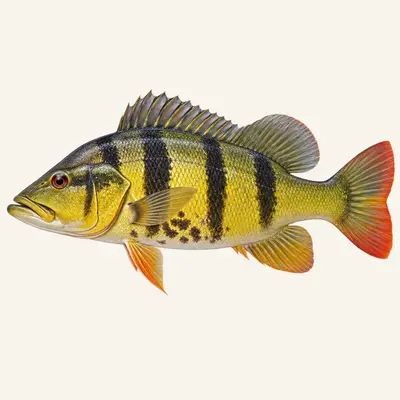
Two extra bars sit between the main flank bars, numbered 1a and 2a in the genus key. Four congeners carry that pair and the rest do not, so it is where identification starts.
From there the work is counting and noting absences. The lateral line runs unbroken from head to tail, where several close relatives show it interrupted. The reference scale row holds 70 to 80 scales, exceptionally 67 or 82 — well short of the 84 to 93 counted in C. pleiozona. Irregular dark patches mark the forward belly. The nape bears no distinct bar, or one too faint to read.
An adult still shows its vertical bars, and they keep roughly the same width from the back down to the belly rather than broadening above and tapering below. One mark is constant at every size: an eye-ringed spot in the upper part of the third bar.
The juvenile is a different fish to look at. Its dark lengthwise band is short, stopping well before the tail, and that shortened band is shared with a handful of congeners rather than with the genus at large.
None of this belongs on a riverbank. Scale rows are not counted on a fish held over the water, and a Cichla named by eye is a Cichla named provisionally.
Breeding
Spawning runs right through the year, peaks as the rains begin, and repeats about every two months.
The site is a flat stone in shallow water, either bare to begin with or scrubbed free of algae by the pair as the spawning proceeds. The female moves forward laying a single row of eggs; the male follows that row and releases sperm over it, row after row. The eggs are adhesive, 1.4 mm across, and hatch in 78 hours at 28 °C.
Then the pair moves the brood. Hatched larvae are carried in the parents' mouths to a pit dug to receive them.
Output is high — 9,000 to 15,000 eggs per kilogram of fish at each spawning. Maturity comes from 32 cm.
The water it needs
Adults use two kinds of water — the rapids, and quiet reaches of middling depth over rocky bottom, from about five metres down.
They also school, which is worth recording for a predator of this size, since many fish that reach 70 cm hunt alone.
The thermal band is narrow, 24 to 27 °C, and the species tolerates brackish water. That tolerance is not the start of a migration: the fish stays put, and no seaward movement is recorded.
Areas
- Reservoir shorelines
- Aquatic weed beds
- Tributary mouths
- Submerged structures
Techniques
- Cast and retrieve with minnow lures
- Topwater fishing with poppers
- Jigging
- Live bait fishing
Baits
- Silver minnow lures
- Surface poppers
- Colored jigs
- Local live fish
- Wobbling spoons
What it eats
Small fish, and nothing besides. The documentation is explicit about the exclusivity, which is unusual — most predator diets come with a margin of insects, shrimp or fry.
The prey actually named are the interesting part: threadfin shad, mosquitofish, tilapia, bluegill. Not one of the four is South American. The diet on record was measured in Florida, in a fish community assembled entirely out of introductions, and it describes what a transplanted predator found waiting for it rather than what the species eats in the Marowijne.
That appetite is also why it is judged a poor candidate for pond culture, despite being farmed.
How to catch it
Rapids and rock, and a fish that travels in company: one take often means several more within casting range, and a group converging on a surface lure is the behaviour the genus is fished for.
An exclusive diet of fish settles the lure. Anything that reads as a small fish, worked on top or just under it, matches what the species hunts, and the invertebrate baits that take other cichlids are beside the point.
The parental phase costs more than it appears to. A pair carrying larvae in the mouth is a pair whose brood ends the moment both fish leave the water, and year-round spawning means there is no month in which that cannot happen.
Conservation
The native range is three rivers. There is no fourth, and no inland stronghold to make up for a damaged one.
The pressure worth writing down runs outward rather than inward. Released in Florida, the species established itself well enough for its diet there to reach the literature, and a predator that eats only fish, dropped into a community that never held one of its kind, redraws that community. The documentation lists it as a potential pest for that reason.
The second problem was bibliographic, and it lasted longer. While every large Amazonian peacock bass was filed under this name, the species looked continental and untroubled. Its real distribution — three coastal basins between the Marowijne and the Essequibo — became visible only once the genus was taken apart.
Regulations
Check the local regulations in force (legal size limits, closed seasons, bag limits).
For guidance only. Legal sizes, quotas and open seasons vary by location and season: always check the local regulations in force before fishing.
Other names
Peacock bass in English. The word bass is a misnomer here: these are cichlids, unrelated to the North American Micropterus and to the temperate sea basses alike. Anglers travelling to South America meet the fish as tucunaré in Brazil and pavón in Venezuela and Colombia.
The epithet refers to eye-shaped markings. Its history is the more useful thing about it: for a century and a half the name described a fish from the Guianas while being applied to fish from half a continent away.
Sources: fishbase.se · api.gbif.org