Gila trout
Oncorhynchus gilae · Salmonidae
- Freshwater
- Salmonids
- Hard
- Size
13–32 cm
- Weight
0.0 kg
Where to fish
- River
Habitat icons: Flaticon
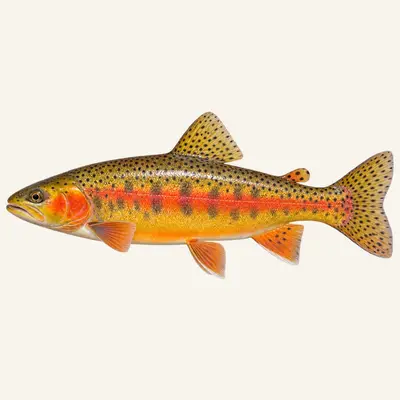
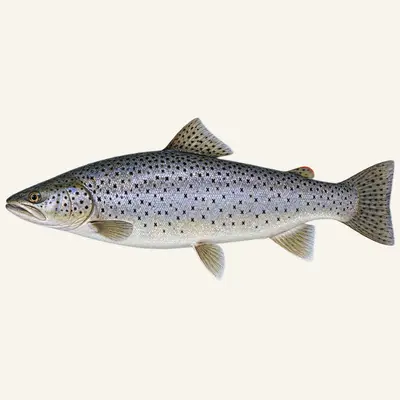
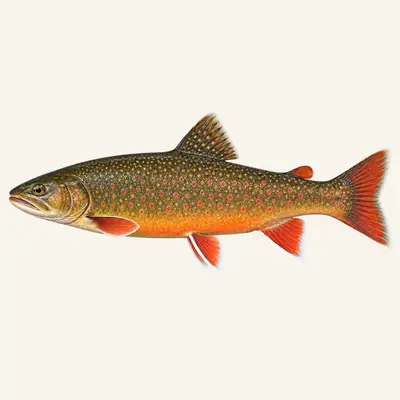
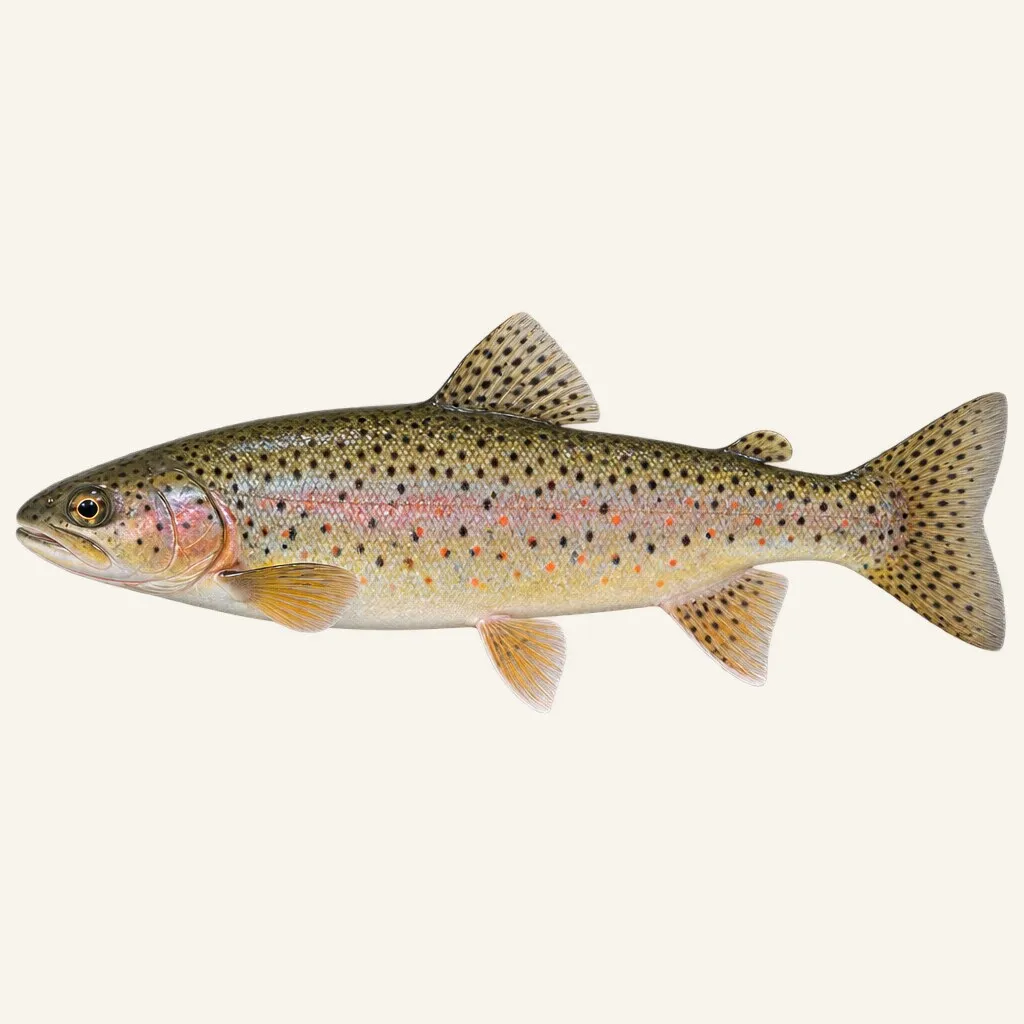
The Gila trout is a wild trout endemic to the headwater streams of the Mogollon highlands in New Mexico and Arizona. It has a golden-olive body marked with large black spots and red spots ringed with pale blue along its flanks.
Calendar
Recorded in 1 country
GBIF occurrence records — native and introduced populations combined.
Its range
One drainage carries this trout: the Gila, straddling New Mexico and Arizona. It has never occupied anything else, and everything the species owns in the world sits in the upper branches of that system.
Elevation closes the door further. The adults occupy clear cool creeks above 2,000 m, and the fish lives and dies in fresh water. There is no run down to a large lake, no marine period, and no mechanism by which an emptied creek could be recolonised from anywhere.
The water it needs
The requirement comes to very little: clear, cold, running water in high creeks in a desert. That contradiction defines the species — a salmonid in the middle of an arid region, held there by relief alone, on remnants of cool water that a few hundred metres of elevation separate from lethal conditions.
A fish like that has no fallback. When the creek warms or dries there is no higher section to retreat into: the spring is already the end of the ground available.
Areas
- Small shaded streams
- Mountain springs
- Shallow riffles
- Vegetated undercut banks
Techniques
- Dry fly
- Light nymph
- Ultra-light spinning
- Sight fishing
Baits
- Artificial fly
- Nymph
- Terrestrial insects
- Small worms
How to catch it
Size governs the exercise. The common length is 13 cm, which makes this the smallest fish in the genus, and equipment has to be scaled to it if an individual is to be released undamaged.
One peculiarity deserves mentioning before a first handling: this small salmonid bites when it is picked up. The behaviour is on record and it surprises in an animal that size. It does no harm to whoever is holding the fish, but it explains the reflex to let go that does the damage.
No fishery of any kind is listed for this trout in the reference sources — not subsistence, not commercial, not sport. That silence is unusual in a genus exploited everywhere else, and it describes the state of the record as much as the state of the water.
Conservation · Endangered (IUCN) — This species is threatened with extinction. Always release it (no-kill), handle it with the utmost care and check local rules — fishing for it may be prohibited.
Conservation
Confinement to one network of high creeks is itself the threat. Each population occupies a few kilometres of bed with no continuity to the others, and the fate of the species is an addition of short segments that nothing links.
At that scale an ordinary event becomes final. An ash flood after a hillside fire, a prolonged low flow, the arrival of an introduced salmonid in a single branch: each of those ends a population, and natural reconquest is impossible, since there is no source of recolonisation either above or below.
Holding the species therefore depends entirely on human intervention — barriers, managed translocations, restoration of reaches — and on work carried out creek by creek.
Regulations
Check the local regulations in force (legal size limits, closed seasons, bag limits).
For guidance only. Legal sizes, quotas and open seasons vary by location and season: always check the local regulations in force before fishing.
Other names
Gila trout, after the river that is its last ground, and the specific epithet repeats the same hydronym, so that fish and river share one identity. That is not a figure of speech, since neither is found outside the other. The Apache trout was for a period treated as a subspecies of this one, and the two are still discussed together in the literature on south-western trout.
Sources: fishbase.se · api.gbif.org