Huchen
Hucho hucho · Salmonidae
- Freshwater
- Salmonids
- Hard
- Size
70–150 cm
- Weight
4.3–52 kg
- Lifespan
20 years
- Water temp.
6–18 °C
Where to fish
- River
Habitat icons: Flaticon
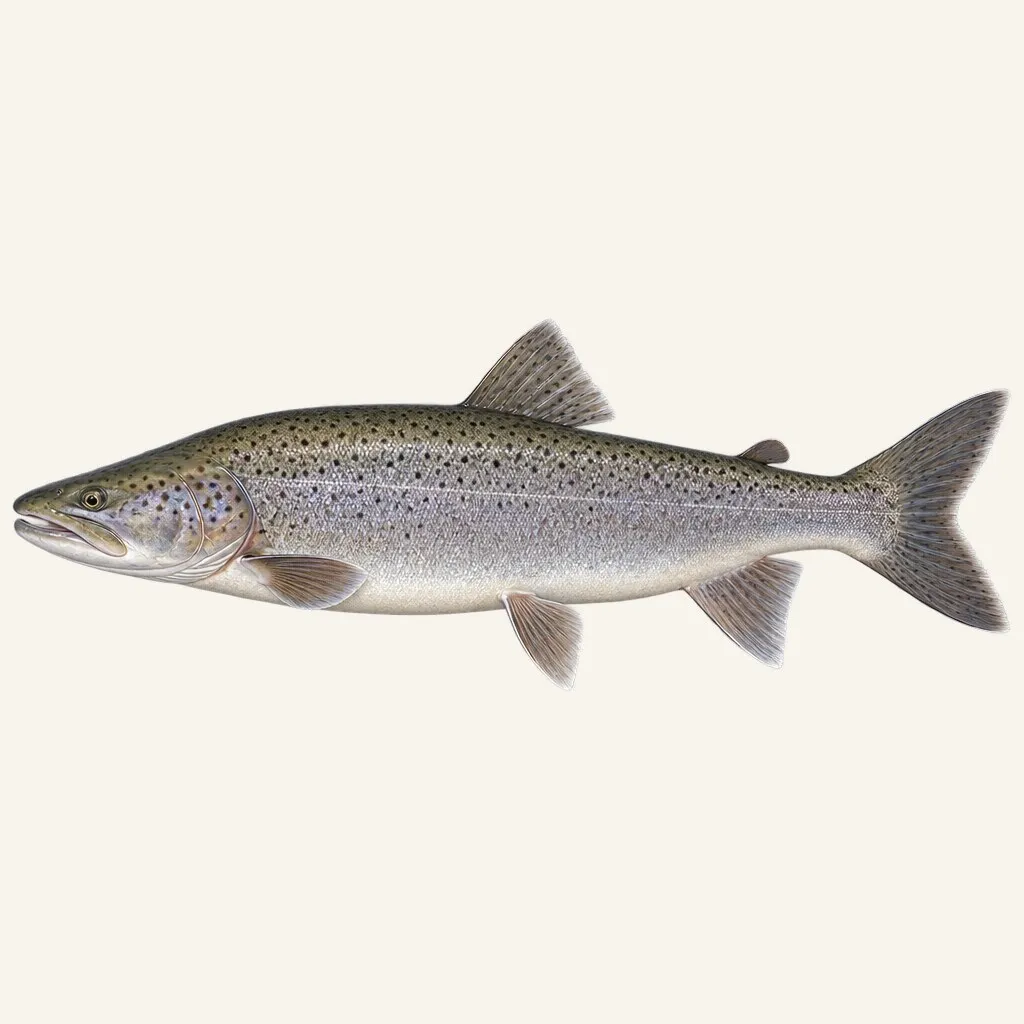
The huchen is Europe's largest salmonid, capable of exceeding one metre in length and weighing over twenty kilograms, with a streamlined golden-brown body marked by small dark spots. An apex predator of the clear fast rivers of the Danube basin, it hunts fish, aquatic mammals and surface-swimming birds.
Calendar
Its range
The species is native to the Danube drainage and nowhere else.
It has been introduced into other European river basins as its Danube numbers fell under ecological change. Those introductions are the only reason it exists outside one catchment — an insurance policy taken out after the loss, not a natural range.
Identifying it
Two absences do most of the work: no red spots, and no white fin margins. Every char in central Europe has both, so their absence rules out the whole genus Salvelinus in one look.
The lateral line carries 180 to 200 scales, a very high count. The head is long and flattened above, at 22 to 24% of standard length. The body is roundish in section, the tail deeply emarginate.
Counts: 3 to 5 dorsal spines with 8 to 14 soft rays, the same at the anal, and 66 to 72 vertebrae.
Size itself is a character, in undisturbed water at least. That qualifier is doing real work: common length is 70 cm, and across most of the range today the fish no longer approaches the sizes the older records carry.
Breeding
Mature fish run upstream into smaller, shallower water — 0.3 to 1.5 m deep — usually in the upper reaches of tributaries.
Males arrive first and defend females against other fish. Spawning generally happens in daylight, which is unusual among salmonids and makes the whole business observable.
The female cuts a shallow hollow in gravel, the eggs go in, and both sexes cover them with substrate. Both then defend the site afterwards.
Two features of that account bear on management. The spawning water is thirty centimetres deep in places, so any barrier at all closes it. And a pair that guards its redd is a pair that can be found and taken at the moment it matters most.
The water it needs
Usually solitary, it holds the deeper parts of swift streams with oxygen-rich water, between 6 and 18°C. Adults are territorial without being strictly solitary.
What a huchen needs is a long stretch of free-flowing river: deep holding water for the adult, shallow tributary gravel for the spawning, and passage between the two. Very little of the Danube system still supplies all three in one continuous piece.
Areas
- Deep rapids in large rivers
- Pools downstream of obstacles
- Strong current zones over gravel beds
Techniques
- XXL lures
- Giant streamers
Baits
- Swimbaits
- Giant jerkbaits
- Salmon flies
What it eats
Juveniles feed mainly on invertebrates. Adults take mostly fish, but also amphibians, reptiles, small mammals and waterfowl.
A salmonid that eats waterfowl is not a detail of diet — it is a statement about size and about the amount of prey a river must produce to grow one. Nothing in Europe fills that role, which is why the huchen's decline has no substitute.
How to catch it
The fish holds deep water in fast, cold, well-oxygenated rivers, and it holds a territory. Finding one is a matter of knowing the river rather than covering it.
A diet running to fish, amphibians and small mammals sets the scale of what it will take, and the size of the fish sets the tackle. Fishing for it is regulated wherever it survives, and what applies is a question for the competent authority before setting out.
The daylight spawning in shallow tributaries is worth avoiding on purpose: a guarding pair in thirty centimetres of water is visible, catchable, and irreplaceable.
Stocking has not worked. Transplantation of artificially incubated and reared young has not been successful, which removes the usual fallback — this is a species that cannot simply be replaced from a hatchery.
Conservation · Endangered (IUCN) — This species is threatened with extinction. Always release it (no-kill), handle it with the utmost care and check local rules — fishing for it may be prohibited.
Conservation
The failure of hatchery transplantation is the fact that changes everything. For most declining salmonids, rearing and stocking buys time; here it has not worked, so the only thing that maintains a population is a functioning river.
That river has to be long. Deep adult holding water, shallow tributary gravel, and free passage between them, all in one uninterrupted stretch — and the Danube system has been cut into pieces shorter than that.
A pair that guards its redd in thirty centimetres of water during daylight adds a direct vulnerability at exactly the wrong moment.
Regulations
Strict minimum size / Catch-and-release often mandatory
For guidance only. Legal sizes, quotas and open seasons vary by location and season: always check the local regulations in force before fishing.
Other names
Huchen in English, also Danube salmon — a name that flatters and misleads, since the fish never goes to sea and belongs to a genus of its own. Huchon in French and Huchen in German, against salmón del Danubio in Spanish, salmone del Danubio in Italian and salmão-do-Danúbio in Brazilian Portuguese; dunajský hlavátka and cognates run across central Europe.
Sources: fishbase.se · api.gbif.org