Golden trout
Oncorhynchus aguabonita · Salmonidae
- Freshwater
- Salmonids
- Hard
- Size
30–71 cm
- Weight
0.3–5.0 kg
- Lifespan
9 years
Where to fish
- Lake
- River
Habitat icons: Flaticon
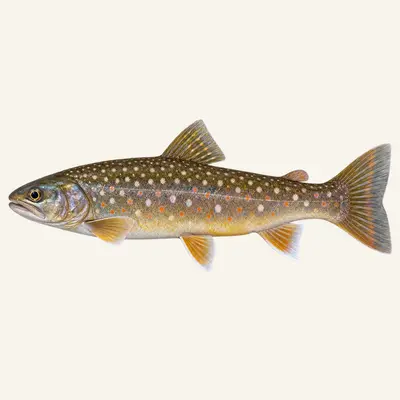
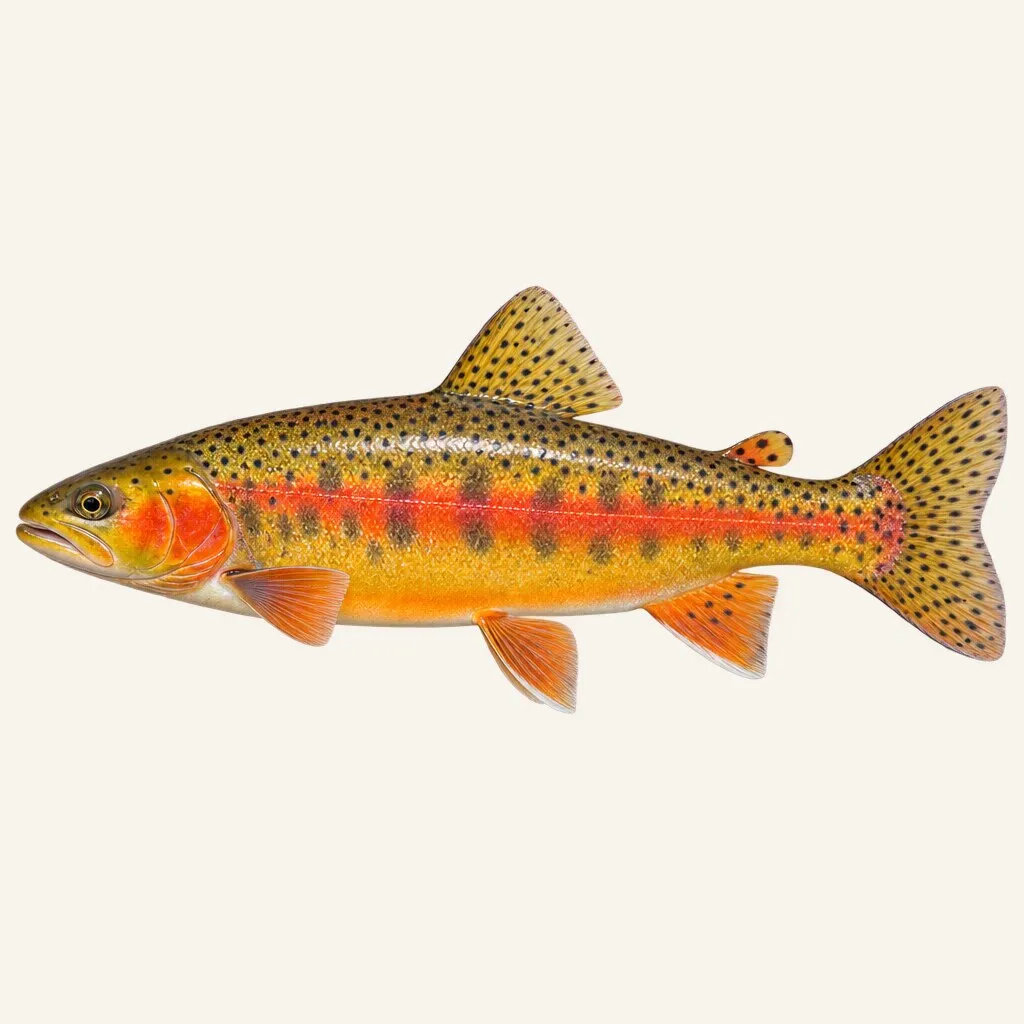
The golden trout of California is one of the most vividly coloured trout in the world: its flanks display a bright red-to-orange lateral band, the belly is an intense golden yellow, and the body is scattered with small black spots. It is endemic to the alpine streams of the California Sierra Nevada.
Calendar
Recorded in 3 countries
GBIF occurrence records — native and introduced populations combined.
Its range
The whole species fits inside the upper Kern basin, across two Californian counties, Tulare and Kern. There is no natural population anywhere else, and this is not a range that shrank — it is a range that was never large.
Inside that single basin the isolation continues from fork to fork. Two subspecies were long distinguished, one for the main Kern and the Little Kern, the other for the South Fork. The three streams belong to the same network, and their fish diverged far enough for separate names to have seemed worth giving.
That internal partition is what makes transfers delicate. Moving fish from one fork into another would merge lineages the geography of the basin has held apart for a long time, and the operation does not run backwards.
The water it needs
An elevation defines the habitat: above 2,100 m, in clear cool creeks, headwaters and lakes. Below that line the Kern becomes a river too warm for the fish, and it is the river itself that sets the lower bound.
The whole cycle runs in fresh water, with no descent and no migration of any kind. No fish of this species ever leaves its basin, which denies these populations the recolonisation route migratory salmonids have: a fork emptied does not refill on its own.
Areas
- Alpine lakes
- High mountain streams
- Shaded riffles
- Glacial springs
Techniques
- Dry fly
- Nymph dead-drift
- Ultra-light spinning
- Sight fishing
Baits
- Artificial fly
- Nymph
- Terrestrial insects
- Small worms
- Aquatic larvae
How to catch it
The gap between the two reported lengths is worth understanding before setting out. The common length is around 30 cm; the published maximum is a different order of animal. The first figure describes a high-country creek fish; the second requires a body of water able to feed a salmonid through the nine years the species can live. Looking for a record fish in a headwater torrent is an error of scale.
The water imposes the rest: little volume, extreme clarity, short lies, and access limited by altitude to a fraction of the year. Tackle follows, light, and handling counts for more than technique — in a population confined to a few branches of one river, every adult carries a weight no lowland trout does.
Local use is recorded as subsistence as much as sport.
Conservation
A species whose world distribution fits into the headwaters of a single basin has no margin at all. One marked drought, one heat episode that lifts the thermal boundary a few hundred metres, and an entire fork becomes uninhabitable. Nothing would repopulate it from below, because below is precisely what the fish cannot tolerate.
The second factor is the loss of the internal separation. What protects the three lineages is a hydrographic partition that a transfer of fish, deliberate or otherwise, cancels in a season.
The third is documentary. The species has never been assessed at global level, so its monitoring rests entirely with Californian managers, and the absence of an international verdict says nothing about the situation on the ground — only that the information has to be looked for elsewhere.
Regulations
Check the local regulations in force (legal size limits, closed seasons, bag limits).
For guidance only. Legal sizes, quotas and open seasons vary by location and season: always check the local regulations in force before fishing.
Other names
California golden trout is the full name, and the qualifier earns its place. Several unrelated fish are called golden trout in North America, among them the palomino strain of hatchery rainbow, which is a colour variant rather than a species. The scientific epithet aguabonita is Spanish for pretty water. The fish is California's state freshwater fish, and American usage often attaches the name of its river as well, which is the most exact of the labels available.
Sources: fishbase.se · api.gbif.org