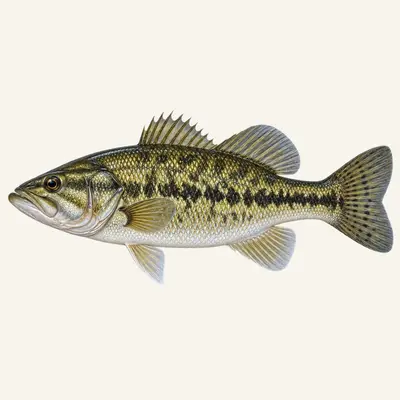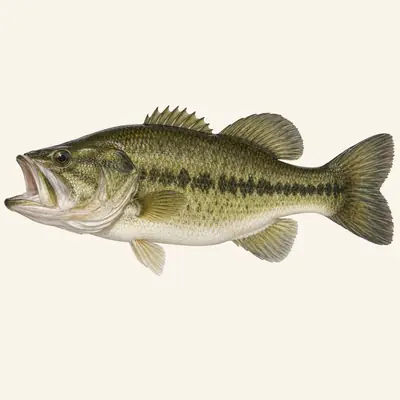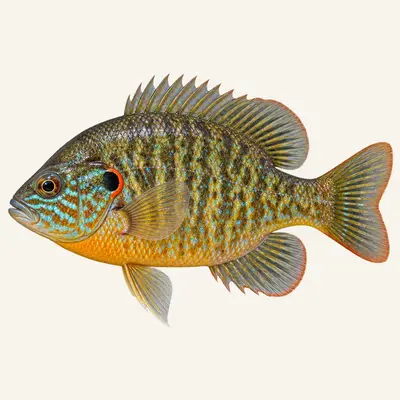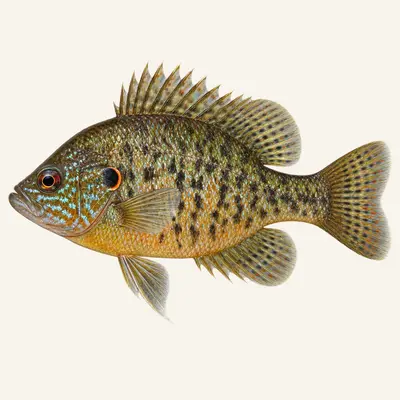
Green sunfish
Lepomis cyanellus · Centrarchidae
- Freshwater
- Predators
- Medium
- Size
20–31 cm
- Weight
0.2–1.0 kg
- Lifespan
9 years
- Water temp.
18–32 °C
Where to fish
- Lake
- River
Habitat icons: Flaticon
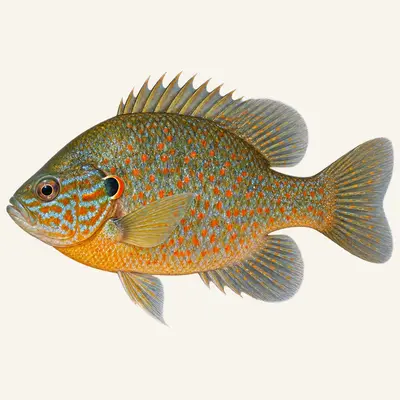
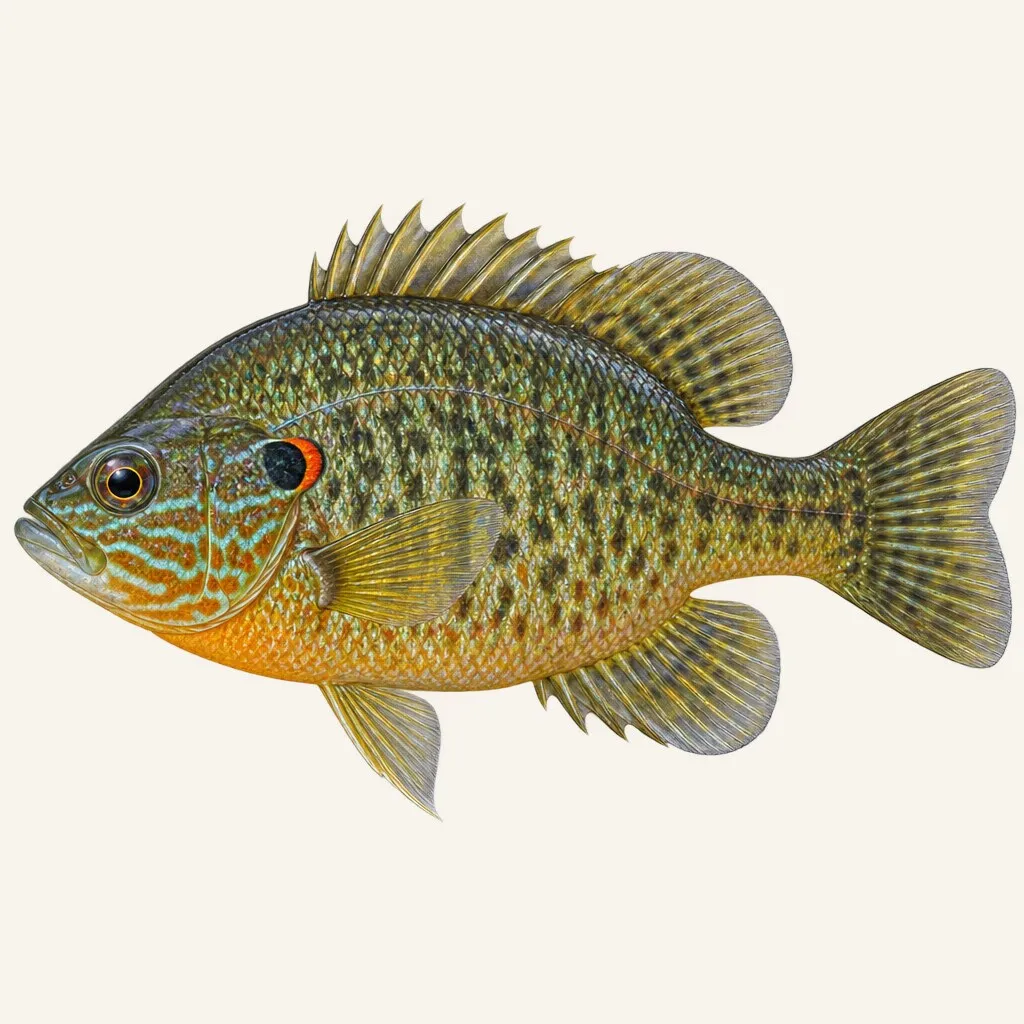
The green sunfish is a brightly colored North American centrarchid, easily recognized by its olive-green flanks dotted with turquoise spots and the dark spot adorning the rear of its gill cover. A hardy and adaptable species, it readily colonizes shallow, densely vegetated waters from streams to calm ponds.
Calendar
Recorded in 4 countries
Canada · China · Mexico · United States
GBIF occurrence records — native and introduced populations combined.
Its range
No other sunfish is recorded across this much ground. The range takes in the Great Lakes, the Hudson Bay drainage and the Mississippi, from New York and Ontario west to Minnesota and South Dakota and all the way down to the Gulf of Mexico; then, separately, the Escambia in Florida and the Mobile Bay drainage across Georgia and Alabama, west to the Rio Grande in Texas and into northern Mexico.
From 50 degrees north to 26 is a span that includes ice-covered ponds and Texas creeks that go to blood heat, and a fish holding both ends of it is not fussy about much.
The warmouth occupies almost the same map, which is the source of a good deal of confusion between the two. What separates them is not geography at all — it is the water each one is actually recorded in, and where in it each fish sits.
The water it needs
Quiet pools and backwaters of sluggish streams, together with lakes and ponds, usually somewhere near vegetation. Small, still, weedy water is the pattern, and a green sunfish is as likely to be in a farm pond or a roadside ditch as in anything larger.
The temperature band says more than the habitat list does. Eighteen degrees to 32 is the warm end of the genus, several degrees up on where the warmouth is recorded, and it means this fish is at its most active in the part of the summer when other species have gone off the feed.
It also works the water column rather than the bed. Classed as benthopelagic, it hunts up off the bottom and along the outside of stems instead of grubbing over the mud, and that alone puts it in a different place in the same pond as a bottom-feeding relative. It spawns on a nest, as they all do, and the published account of its breeding stops at that word.
Areas
- Stony-bottomed streams
- Vegetated banks
- Sheltered coves
- Shallow areas
Techniques
- Ultra-light spinning
- Float fishing with worm
- Small soft lures
- Dry fly
Baits
- Earthworms
- Insect larvae
- Crickets
- Small baitfish
What it eats
The young take immature insects and microcrustaceans. For the adults the record is silent, and the head has to answer instead.
The mouth of this species is conspicuously bigger than the genus standard — a real gape rather than the pursed opening that most sunfish work an insect through. Prey size scales with mouth size in fish, so an adult green sunfish is taking items its neighbours cannot get down, and small fish are among them. That is a reading of morphology and not a list of stomach contents, which is worth stating plainly.
The consequence in a small water is worth stating too. A sunfish able to swallow fry is not merely another competitor for the insect supply; it is a predator on the year class of whatever else lives there, and its position in a pond is not the one its size suggests.
How to catch it
The gape is the difference that shows up at the end of a line. Where a pumpkinseed or a bluegill forces hook sizes down to the limit of what can be tied, this fish will take a bait or a lure several times larger, and it hits with an aggression out of all proportion to a 20 cm body.
That widens the approach. A small soft plastic, a light spinner, a surface bug or a whole worm all work, and none of them need trimming to fit. It is also the reason a green sunfish so often turns up in a bass or crappie session while its small-mouthed relatives do not.
Look for it in the water nothing else bothers with: an isolated pool, a cattle pond, a warm ditch, the dead end of a backwater. Nine years is the greatest reported age, and an ordinary adult of 20 cm is what a good spot produces.
Regulations
Check the local regulations in force (legal size limits, closed seasons, bag limits).
For guidance only. Legal sizes, quotas and open seasons vary by location and season: always check the local regulations in force before fishing.
Other names
Green sunfish is the standard name and the least useful character in it. Several members of the genus show green through the flank, some of them more brightly than this one; the reliable way to tell it is the size of the mouth, not the colour of the fish.
Cyanellus, the species epithet, means blue, which does not help either — it refers to the blue-edged fins and the blue spotting a fresh fish carries, both of which fade within minutes of being landed. The names that stick locally are no more precise but at least point somewhere: green perch and black perch are both in use for it across the middle of its range, and neither one is a perch of any kind.
Sources: fishbase.se · api.gbif.org