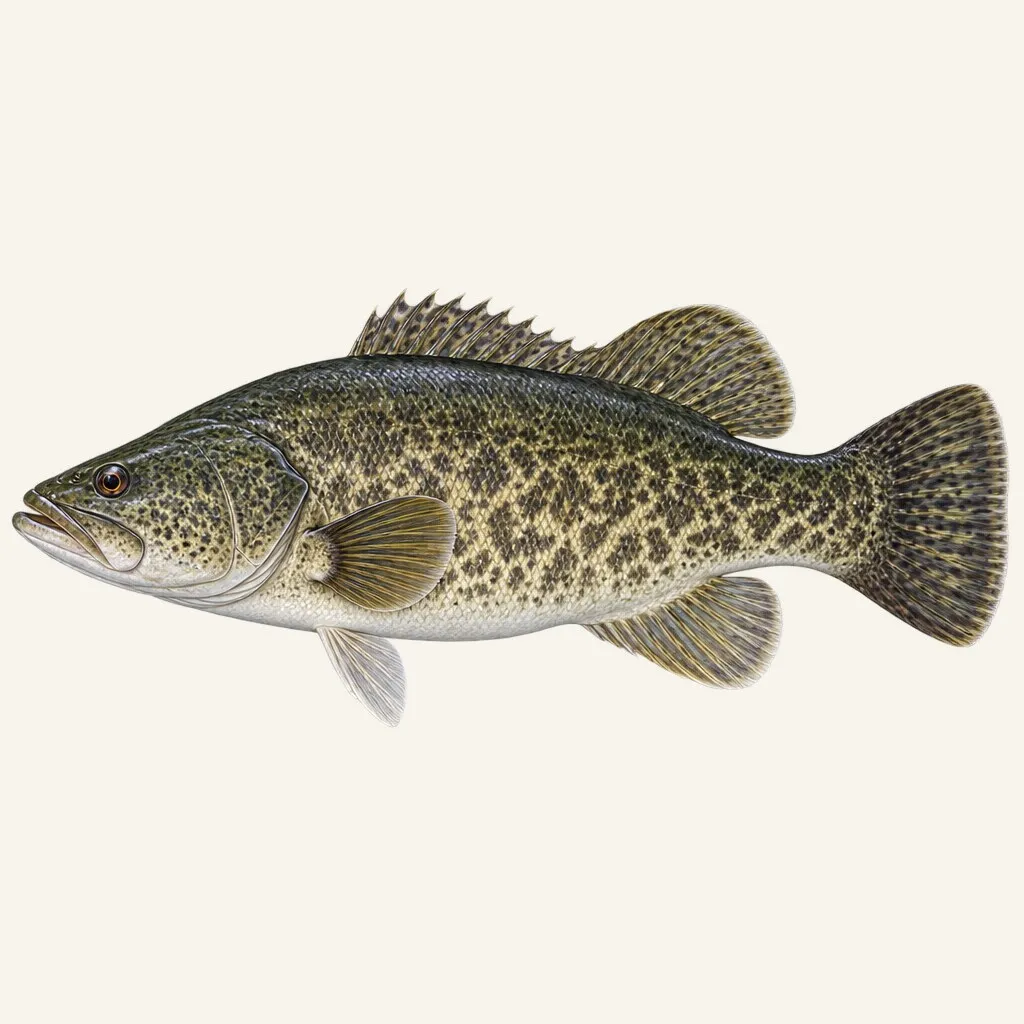
Murray cod
Maccullochella peelii · Percichthyidae
- Freshwater
- Predators
- Hard
- Size
60–180 cm
- Weight
2.4–113 kg
- Lifespan
48 years
Where to fish
- Lake
- Pond
- River
Habitat icons: Flaticon
Australia's largest exclusively freshwater fish, a massive, long-lived apex predator emblematic of the Murray-Darling Basin.
Calendar
Recorded in 1 country
GBIF occurrence records — native and introduced populations combined.
Its range
Most of the Murray-Darling, across South Australia, Victoria, New South Wales and Queensland, with the upper reaches of the southern tributaries excepted.
Two entries then have to be read together. Abundance has been drastically reduced across the natural range, and the fish is now considered rare in many Victorian tributaries. And it has been introduced into many lakes and dams throughout Victoria and New South Wales.
So the distribution is being held up at both ends by different means. The rivers that produced the species carry fewer of them; the impoundments that carry them were stocked. A dot on the map no longer distinguishes a population from a fishery.
Breeding
Pairs form, and one male spawns with each female. That is a strict pairing, without the satellite males that attend most fish spawnings, so each spawning event involves exactly two adults and no more.
The site can be in 30 cm of water. Egg masses are laid on the bottom, they adhere to the substrate, and the male guards them and probably fans them through incubation. Spawning runs from spring into early summer.
Thirty centimetres, for a fish of this size, is the whole vulnerability of the species in one figure. That depth is set by the river and not by the fish: a level that drops at the wrong moment leaves the eggs dry, and a male guarding a clutch in ankle-deep water is as exposed as the clutch is.
Maturity comes at 55 cm, in a range of 48 to 62.
The water it needs
The territory is an object, not an area. The record ties it to a specific hole, a specific snag — one piece of large woody debris — or a defined part of a river or lake. Murray cod are territorial, and what they hold is a thing rather than a stretch.
That makes the unit of this fishery a structure. The species will occupy almost any water: clear rocky streams, slow turbid rivers, billabongs. What it wants inside them is narrow — sheltered water with cover from rock, timber or an overhanging bank, generally in less than five metres.
So one of the largest freshwater fish in the world spends its life in shallow water, pressed against an obstruction, in a spot it defends.
Areas
- Murray River
- Darling River
- Murrumbidgee and tributaries
- Impoundments (Mulwala, Copeton)
- Deep holes with submerged timber
Techniques
- Hard-body lure casting
- Large soft plastics
- Spinnerbaits
- Live or dead bait fishing
- Topwater fishing
Baits
- Large diving hard-body lures
- Bulky soft plastics
- Spinnerbaits
- Live baitfish
- Worms and yabbies
What it eats
Adults are carnivorous and the list runs long: invertebrates, fish, amphibians, and occasionally reptiles, birds and aquatic mammals.
The last three entries say more about the mouth than any measurement would. A fish holding station under a snag in less than five metres of water takes what passes above it as readily as what swims by, including animals that were never in the water to begin with.
The young eat zooplankton, which is an unremarkable starting point and worth mentioning only for where it finishes.
How to catch it
Cast at the structure. Less than five metres of water, against rock, timber or an undercut bank, at a fish that is holding a particular object rather than patrolling a beat — accuracy is the method here, and covering water is close to useless.
The diet licenses large lures, on the surface as much as under it. An animal that takes birds and small mammals is not going to be put off by the size of a plug.
Then the figure that ought to govern the decision at the net: the maximum reported age is 48 years. A large Murray cod predates most of the infrastructure that reduced its habitat, and it cannot be replaced inside a human career. Fishing for the species is regulated in every state that holds it, and what applies is a question for the authority that issues the licence.
Conservation
Three pressures, and the first is specific to this animal.
Spawning happens in 30 cm of water, on the bed, guarded by the male, and whether it succeeds is decided by the flow regime. The Murray-Darling is among the most regulated and most heavily abstracted river systems anywhere, which means the depth over the eggs is set by water management upstream.
Second, the arithmetic of a long life. Forty-eight years with maturity at 55 cm produces a stock that answers anything, good or bad, over decades rather than seasons. The recorded threats are over-harvesting and habitat loss, in that order.
Third, the cover. This fish needs timber and rock in shallow water, and desnagging for navigation and for drainage removed exactly that structure along thousands of kilometres of channel. Habitat loss here is not an abstraction about water quality; it is the physical removal of the objects the animal lives against.
Hatchery production and stocking now support the fishery in lakes and dams. That keeps fish available, which is not the same as restoring the shallow, timbered, variably flooded margin the species breeds in.
Regulations
Regulated species with an annual spawning closure, slot limit and strict bag limits; check state regulations.
For guidance only. Legal sizes, quotas and open seasons vary by location and season: always check the local regulations in force before fishing.
Other names
Murray cod is wrong twice and it is not going to change. The fish is not a cod and not a gadid; it belongs to Percichthyidae, an Australian family that also holds the golden perch. The name is settler shorthand — a large edible fish, therefore a cod.
What is unusual is how far the error travelled. All six of the catalogue's languages translate it rather than replace it: bacalao de Murray in Spanish, Murray-Dorsch in German, merluzzo di Murray in Italian, bacalhau-de-Murray in Portuguese, morue de Murray in French. Five languages have faithfully imported an English mistake about a fish family, along with the name of the river.
Maccullochella honours the ichthyologist Allan Riverstone McCulloch. Peelii is the Peel River.
Sources: fishbase.se · api.gbif.org