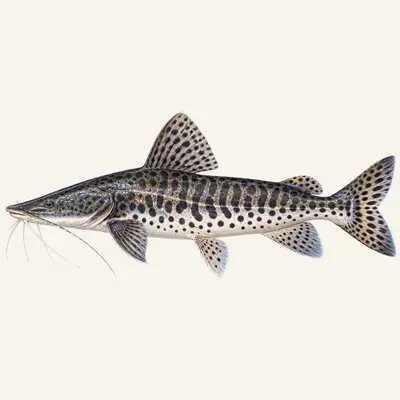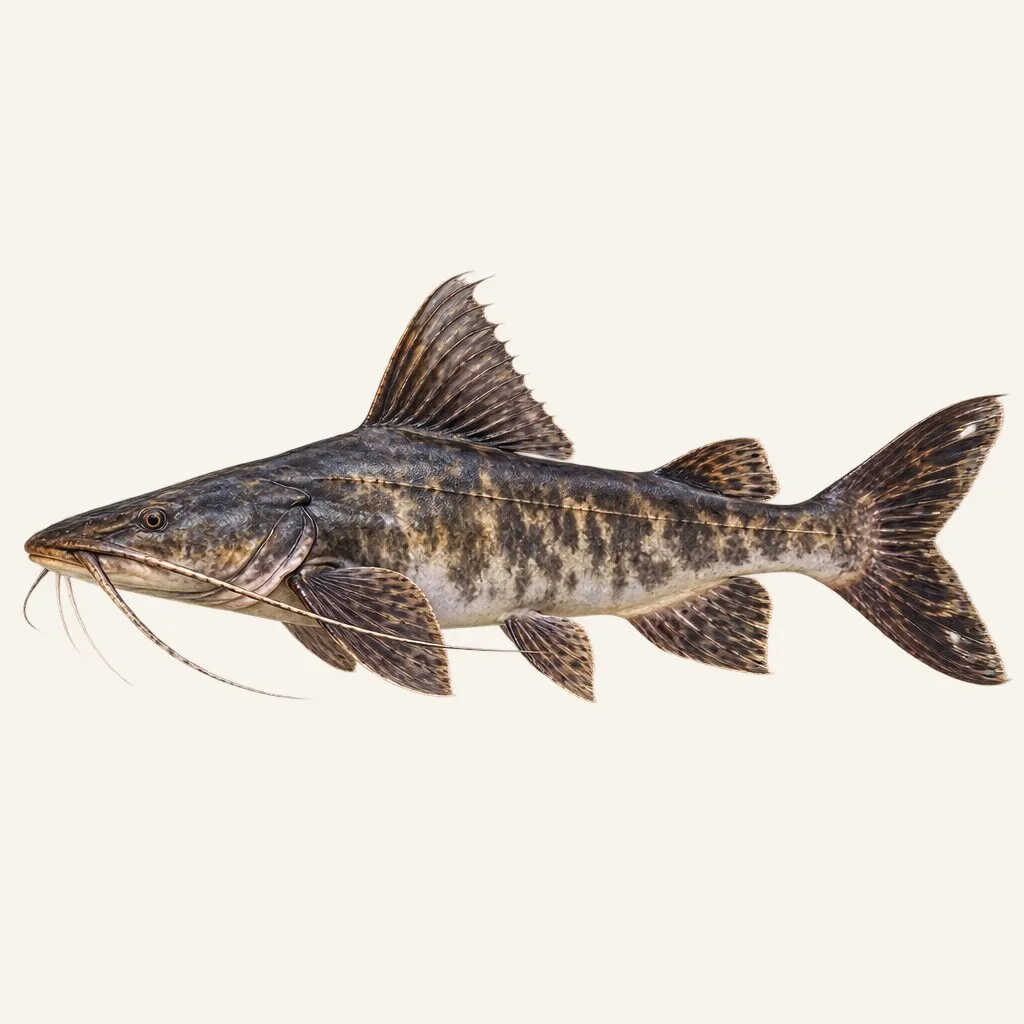
Goonch catfish
Bagarius yarrelli · Sisoridae
- Freshwater
- Catfish
- Hard
- Size
230 cm
- Water temp.
18–25 °C
Where to fish
- River
Habitat icons: Flaticon
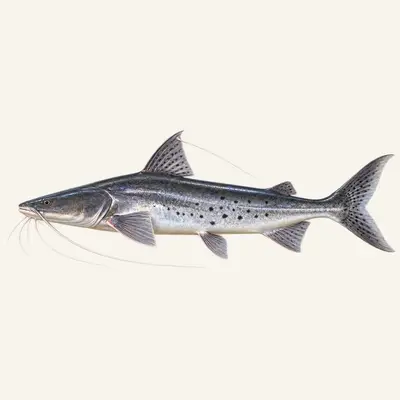
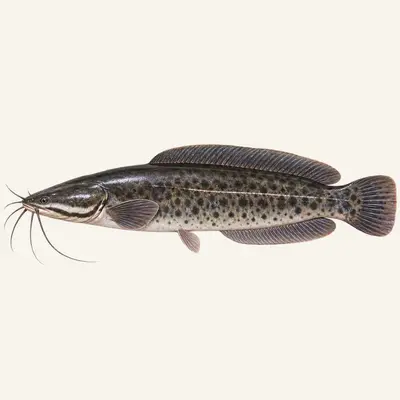
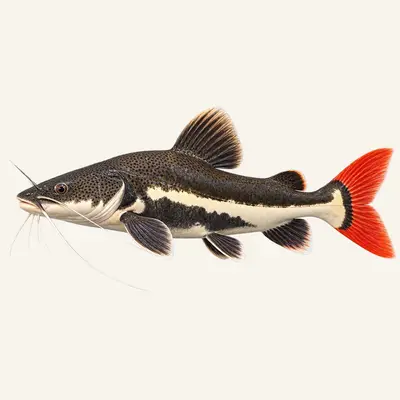
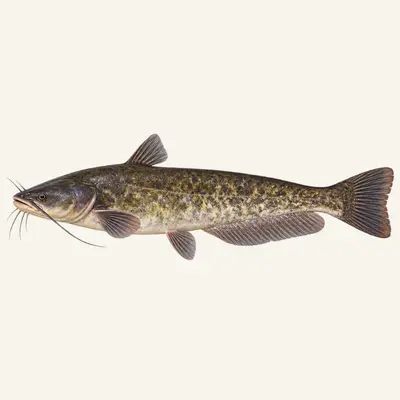
The giant goonch is an impressive catfish from the Sisoridae family, with a massive, ventrally flattened body and a wide mouth lined with sharp teeth. It inhabits large, fast-flowing rocky rivers of South Asia, particularly in the Himalayan foothills.
Calendar
Recorded in 2 countries
Indonesia · Malaysia
GBIF occurrence records — native and introduced populations combined.
Identifying it
No diagnosis accompanies this species in the file consulted. No ray counts, no colour, no proportion, nothing that would key it against the other members of its genus. What is available is an outline, and it comes from the catalogue entry on this page: a heavy body flattened underneath, a wide mouth carrying sharp teeth.
The family placement carries more information than the outline does. Bagarius sits in the Sisoridae, the catfishes of the fast rivers of southern Asia, and everything else on this page is consistent with that address rather than with any published description of this particular fish.
The water it needs
The water chemistry is the one part of the file given in numbers, and it is unexpectedly precise for a species with no diagnosis at all: pH 6.5 to 7.8, hardness 12 to 30, temperature 18 to 25 degrees.
Taken together those three figures describe a hard, near-neutral, cool river. Hardness in that band is water that has run over rock and taken minerals out of it, and a ceiling of 25 degrees is low for the latitudes involved. Neither number belongs to a warm lowland floodplain. Both belong to a river fed off high ground, which is why this animal and the Himalayan foothills are named in the same breath everywhere.
Two further entries widen the picture. The species tolerates brackish water, and it moves within the freshwater network without going to sea. Between them those allow it the whole length of a river system, from broken rock in the upper sections down to the reaches that taste of salt.
Areas
- Eddies below rapids
- Rocky strong-current zones
- Deep pools in mountain rivers
- Narrow channels between rocks
Techniques
- Bottom fishing in torrential river
- Live bait on heavy weighted rig
- Dead bait in eddies
Baits
- Large dead fish
- Local live fish
- Meat chunks
- Giant shrimp
How to catch it
The file classes the fish as benthopelagic rather than demersal, which is a small distinction with a practical edge: it works the bed and the water above it, and it is not permanently pinned to the bottom.
The places listed for it are all edges of current rather than current itself — the eddy below a rapid, the slack behind a boulder, the narrow chute between rocks, the deep pool at the foot of broken water. Every one of those is somewhere the flow loses speed without stopping, which is also where whatever the river is carrying comes to rest.
That settles the presentation. Bait goes in heavy and is allowed to settle at the bottom of the slack, put in above the seam if anything, so that it finishes where the current would have deposited it anyway. Holding a bait out in the fast water is fishing the wrong side of the line.
The species supports a small commercial fishery and is also taken deliberately by anglers, so two kinds of pressure fall on the same populations.
Conservation · Vulnerable (IUCN) — This species is threatened with extinction. Always release it (no-kill), handle it with the utmost care and check local rules — fishing for it may be prohibited.
Conservation
The recorded decline is attributed to the level of exploitation, and the file contains almost nothing else that could be used to manage it. No spawning season, no fecundity, no diet, no age. A species known only through what is landed can only be governed by what is landed.
Two entries in the environment line make that worse than it sounds. The fish moves inside the river network, and it tolerates brackish water at the bottom of it. A population defined that way is one unit spread across an entire drainage, so anything that divides the drainage divides a stock nobody has counted.
The missing longevity figure is the last problem. Without it there is no way to estimate how long a stripped reach takes to refill, and therefore no basis for saying whether a recovering stretch is actually recovering or merely still holding the fish that were left behind.
Regulations
Check the local regulations in force (legal size limits, closed seasons, bag limits).
For guidance only. Legal sizes, quotas and open seasons vary by location and season: always check the local regulations in force before fishing.
Other names
Goonch is a name from the Indian subcontinent that the European languages took whole instead of translating, and English doubles it — goonch catfish — because the word alone carries no meaning for an English reader.
That empty word has been filled by something else. In English-language television and print this fish has acquired a reputation as a man-eater, and the reference file answers the question directly, in its own vocabulary: under threat to humans it is entered as harmless. That is the only published statement on the point, and it contradicts the whole of the popular account.
Sources: fishbase.se · api.gbif.org