North African catfish
Clarias gariepinus · Clariidae
- Freshwater
- Catfish
- Medium
- Size
90–170 cm
- Weight
4.9–60 kg
- Lifespan
15 years
- Water temp.
8–35 °C
- Depth
0–80 m
Where to fish
- Canal
- Lake
- River
Habitat icons: Flaticon
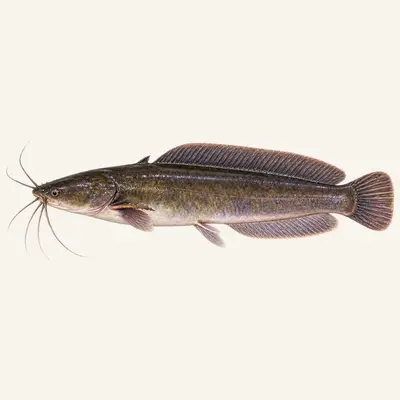
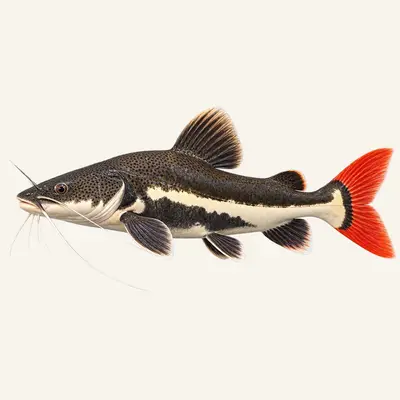
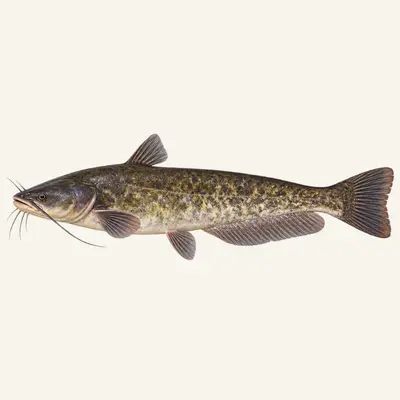
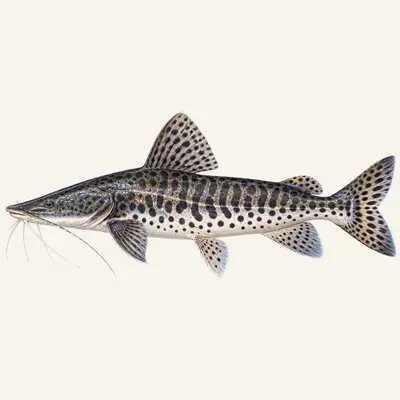
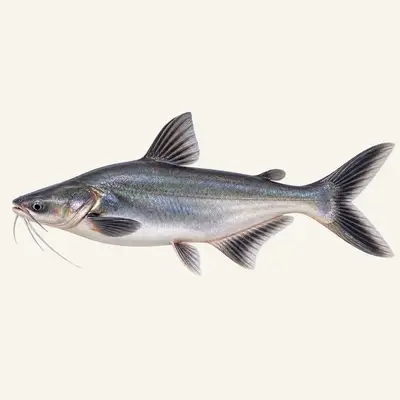
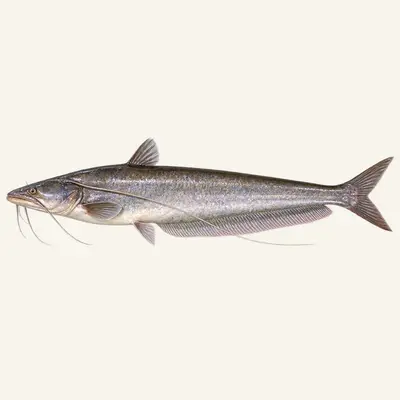
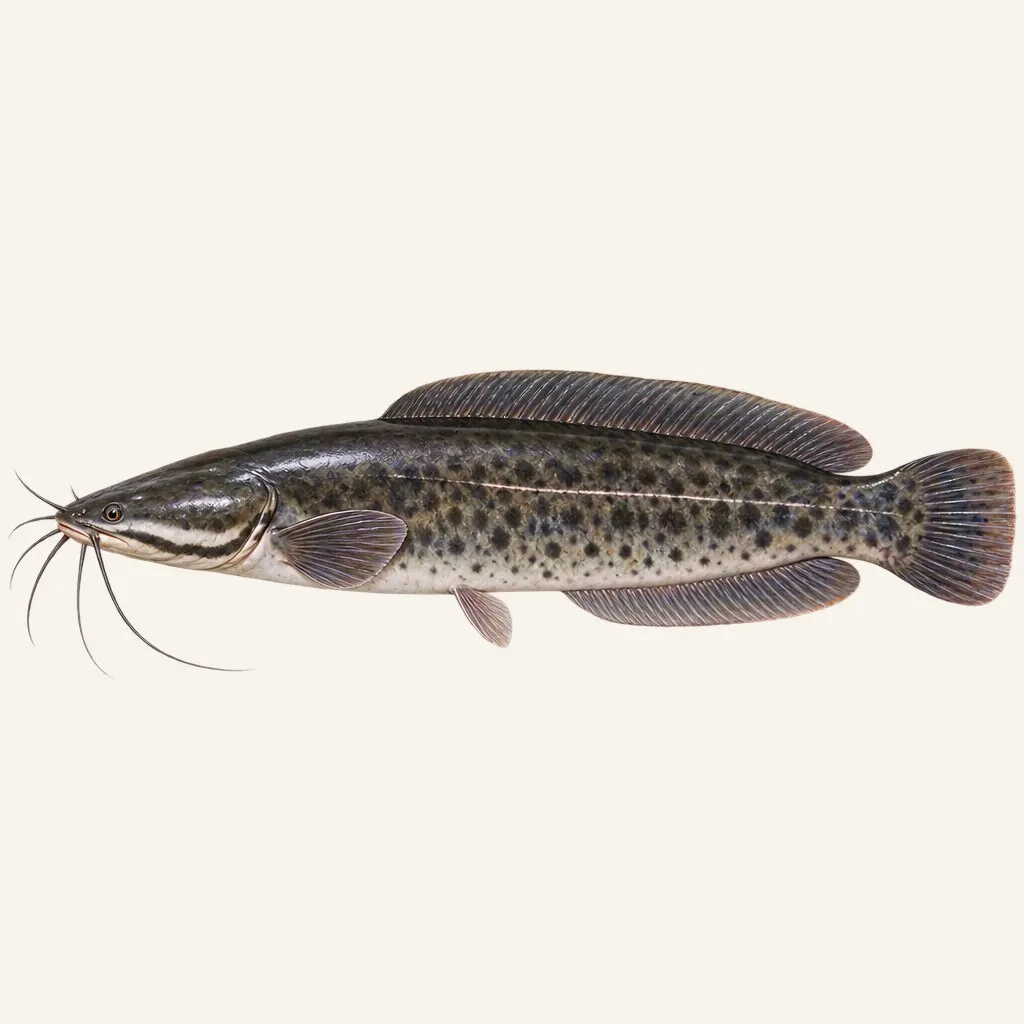
The African catfish is a large freshwater clariid with an elongated cylindrical body, identifiable by its broad flat head, four pairs of barbels and its ability to breathe air through an arborescent organ.
Calendar
Recorded in 21 countries
Botswana · Central African Republic · China · Hong Kong SAR China · India · Indonesia · Israel · Kenya · Malawi · Malaysia · Mozambique · Namibia · Netherlands · Singapore · South Africa · Tanzania · Thailand · Uganda · Vietnam · Zambia · Zimbabwe
GBIF occurrence records — native and introduced populations combined.
Its range
The native range covers almost the whole African continent, with clear gaps: the Maghreb, Upper Guinea and most of Lower Guinea, Cape Province, probably Nogal. What is more striking is that it extends beyond Africa on its own. Jordan, Israel, Lebanon, Syria and southern Turkey belong to the natural distribution, which is rare for an African freshwater fish.
Everything else on the map is human work. Aquaculture carried the species far beyond its cradle, elsewhere in Africa, into Europe and into Asia, for three reasons that fit in one sentence: it grows fast, it survives anything, it sells. Several countries have reported adverse ecological impact since.
What that dissemination produced can be deduced from the animal itself. A large predator that breathes air, holds in water at eight degrees as readily as at thirty-five, and leaves its pond at night to find another one, is not held by any farm bank. One escape does what other species need repeated stocking to achieve, and the fish is listed as a potential pest for that reason. Containment failure is not an accident here; it is the same set of traits the farm was built to exploit, working outward.
Identifying it
The character that separates this catfish from all its African congeners cannot be seen from outside: the gill cover has to be lifted and the rakers counted. They are long, slender and closely set, and above all numerous — from 24 to 110, a count that climbs as the fish grows. No other Clarias comes near those values.
The rest reads by eye. The head accounts for 30 to 37 per cent of standard length, draws a rectangle rounding off towards the front when seen from above, and carries small eyes set high on the sides. Each pair of barbels has its own proportion: the maxillary pair almost always exceeds the length of the head and reaches a point between the origin of the dorsal and the insertion of the pelvics; the outer mandibular pair is longer than the inner; the nasal barbels run from a fifth to half the head length in a fish over 12 cm, and from half to four fifths in a smaller one. A proportionally long barbel therefore betrays a young fish.
Two black bands run beneath the head, one on each side. The body is six to eight times longer than deep, oval in section. The dorsal carries no spine but 61 to 80 soft rays and reaches almost to the tail; the anal has 45 to 65 and starts closer to the caudal base than to the snout. A thin white line marks the lateral line from the back of the skull to the middle of the caudal base.
There remains the pectoral spine, better located before a hand is laid on the fish: robust, serrated on its outer face only, and the more serrated the older the animal.
Breeding
Breeding hangs on the flood. When the rains come, adults leave the river channel or the lake margin and move laterally onto the inundated plains, spawn there, and return to permanent water without waiting. The young stay behind on the drowned ground and rejoin the river or the lake only once they have reached 1.5 to 2.5 cm.
That timetable rests on one number: incubation lasts about 33 hours at 25 degrees. An embryo that hatches in a day and a half can make do with a temporary sheet of water, where a species with a long incubation would see its eggs dry out before hatching. The eggs are greenish and stick to the flooded substrate.
In the Sudd of Sudan, laying is not concentrated into a few days but spread across the entire flood season, which distributes the risk over several water levels. Sexual maturity arrives at 40 to 45 cm in females, 35 to 40 in males.
The water it needs
Water chemistry counts for almost nothing in the choice of a lie. The species lives between 8 and 35 degrees, at pH 6.5 to 8, in hardness from 5 to 28, from the surface to 80 m: few freshwater fish show that amplitude on every axis at once.
Its preference goes to calm, shallow water over soft mud — vegetated margins of rivers and lakes, isolated pools, swamps, irrigation channels and even effluent canals. It is also met in fast rivers and in rapids, which shows that calm is a choice and not a requirement.
The accessory breathing organ governs the rest. The fish gulps air at the surface, stays in the mud when a pond draws down, and moves at night on its pectorals and their spines to reach another water or to gain a spawning area along a path a few centimetres deep. It has been farmed in rice fields.
Two colour types coexist, and their distribution follows the turbidity of the water and the nature of the bottom. One further peculiarity completes the portrait: during aggressive encounters between individuals, the animal emits monophasic electric discharges, head-positive, lasting from 5 to 260 milliseconds.
Areas
- Vegetation-choked banks
- Swamps and flooded areas
- Deep river holes
- Irrigation canals
Techniques
- Bottom fishing with meat bait
- Live bait fishing
- Worked dead bait
- Bottom soft plastic lure
Baits
- Dead fish
- Poultry liver or offal
- Large earthworm
- Live fish
What it eats
An omnivorous bottom grubber that comes up to feed at the surface on occasion, but whose real diet is a predator's: crustaceans, insects, fish. The night menu widens to whatever passes — plankton, invertebrates, young birds, plants, rotting flesh. That indifference to the nature of the prey explains the growth rate and, in waters where it has been introduced, the pressure it puts on several levels of the community at once.
How to catch it
Two traits govern the fishing. The first is that it holds where nothing else does. A stagnant pool, a loaded canal, a puddle left behind by a falling river: places nobody prospects because they look dead hold a fish that a shortage of oxygen does not concern. Any water without visible life deserves a line laid in it before being written off.
The second is the feeding mode. Hunting happens at night, on the bottom, and decaying flesh is ordinary fare for the species. That points towards a scented bait laid on the bed far more than towards lure work, and towards the dark hours rather than broad daylight.
The critical point remains the handling. The pectoral spine is robust and its serration sharpens with age, so a large fish opens the hand that grips it at the level of the paired fins. The fish is taken hold of elsewhere, never behind the pectorals. Its capacity to breathe air prolongs the difficulty: laid on the bank, it goes on struggling long after capture, with all its strength intact.
Conservation
The question this catfish raises is not its survival but its expansion. Its culture is a pillar of African inland production, where the flesh is sought after and sells fresh or frozen, and it is that aquacultural success which took it out of Africa. The ponds built for it everywhere are exactly what spread it.
The two faces cannot be separated. A fish farmed for its hardiness is a fish that hardiness takes out of the farm, and a country that gains a production gains with it a predator nothing calls back. Where the balance has been drawn, the effect on resident communities is judged adverse; where it has not, the absence of a finding is not the absence of an effect.
Regulations
Check the local regulations in force (legal size limits, closed seasons, bag limits).
For guidance only. Legal sizes, quotas and open seasons vary by location and season: always check the local regulations in force before fishing.
Other names
The species name comes from the Gariep, the name given to the Orange River, source of the material described. English aquaculture says sharptooth catfish; French has settled on poisson-chat africain, German on Afrikanischer Raubwels, literally the African predatory catfish. The three names state three different things about the same animal: its origin, its dentition, its diet.
English speakers have one confusion to watch. African catfish and walking catfish are both used loosely in the trade, the second belonging properly to the Asian Clarias batrachus, and the two species now occur together in several countries where neither is native.
Sources: fishbase.se · api.gbif.org