Striped catfish
Pangasianodon hypophthalmus · Pangasiidae
- Freshwater
- Catfish
- Medium
- Size
130 cm
- Weight
44 kg
- Water temp.
22–26 °C
Where to fish
- Canal
- Lake
- River
Habitat icons: Flaticon
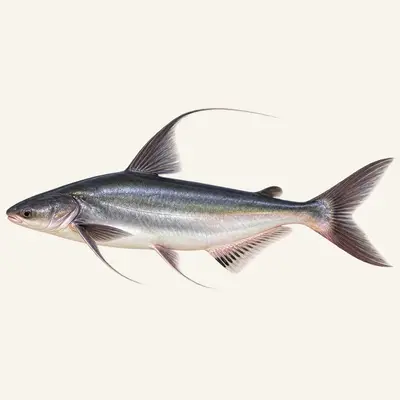
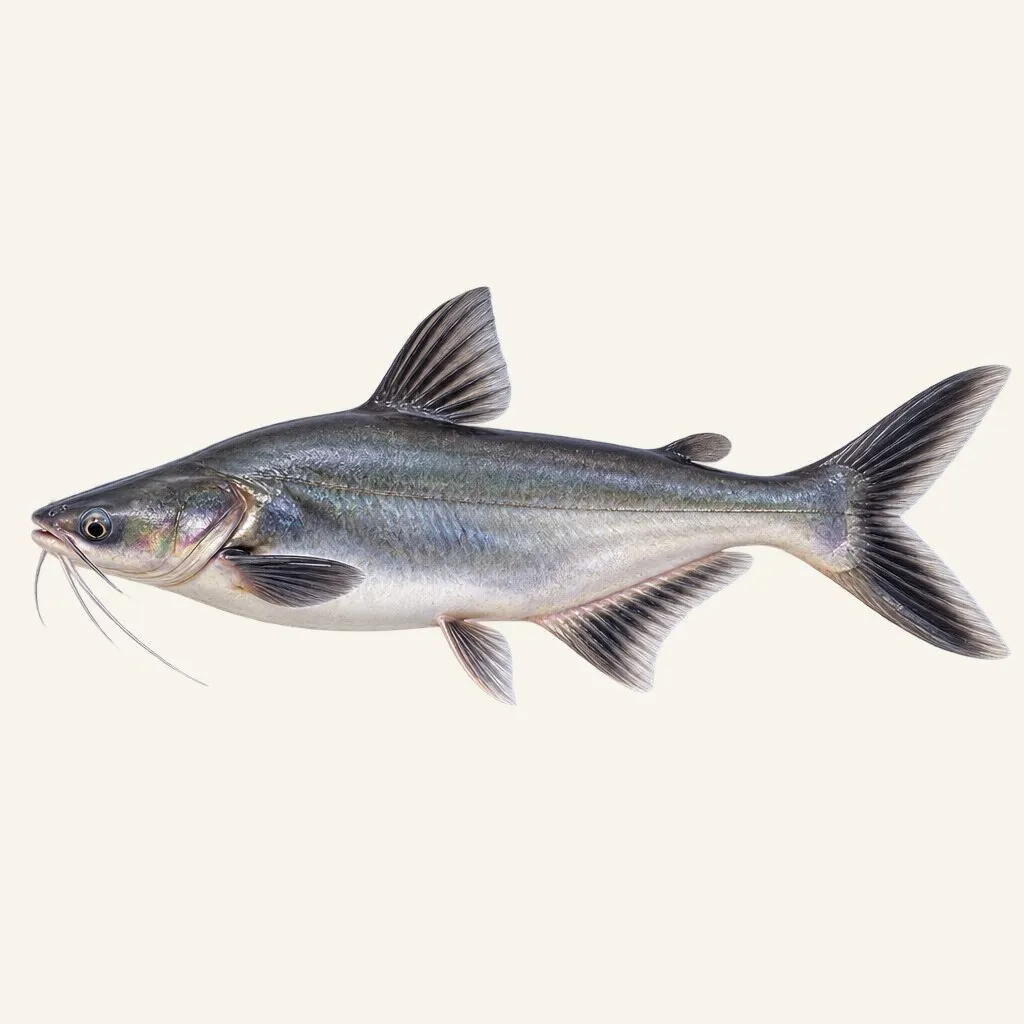
The pangasius is a large, laterally compressed silver catfish recognizable by its two pairs of barbels and slender profile.
Calendar
Recorded in 5 countries
Colombia · Indonesia · Malaysia · Singapore · Thailand
GBIF occurrence records — native and introduced populations combined.
Its range
Three basins natively: the Mekong, the Chao Phraya and the Maeklong. Nothing else.
Everything beyond that outline is aquaculture. The species has been introduced to further river basins in order to be farmed, and those introductions are why it now appears far outside southern Asia. A population met outside the three named systems is an escape or descended from one, and it says nothing about the natural range.
The chemistry recorded in the file explains part of why it travels so well. A pH window of 6.5 to 7.5 is narrow, but a hardness range of 2 to 29 covers very nearly anything a pond can be. Temperature runs 22 to 26 degrees.
Identifying it
The livery is age-dependent and it inverts completely. A young fish carries two long black stripes, one following the lateral line and a second beneath it. A large adult carries none: it is plain grey from end to end.
Between those two states the fins hold the marks. They are dark grey to black, with a dark stripe down the middle of the anal and one in each lobe of the tail. Six branched rays in the dorsal.
The gill rakers are what to reach for once the colour has gone. Small ones alternate at regular intervals with larger ones — a rhythm rather than an even comb, and the sort of detail that separates pangasiid catfishes which otherwise look interchangeable at a metre.
The two states are also sorted geographically. The lower Mekong holds the young, and that is where they are collected for the cages; the middle river holds large individuals that have lost the juvenile pattern. A striped fish and a plain one taken from the same river are the same animal at different distances from the sea.
Breeding
The file makes an admission at the outset that governs everything after it. Reproduction in this species is assumed to follow that of a congener; it has not been described here. Whatever else gets written about it, that assumption sits underneath.
What has been observed is movement, and the record is unusually detailed. In the Mekong the fish runs upstream from May to July to spawn, then drops back to the mainstem between September and December. South of the Khone Falls the upstream run happens instead from October to February, peaking in November and December, triggered by receding water, and it reads as dispersal following the lateral retreat off the floodplain at the end of the flood. A downstream movement runs from May to August, from Stung Treng to Kandal in Cambodia and on into the delta.
Two runs going opposite ways in the same river during overlapping months is not a contradiction between sources. It is a population doing more than one thing at a time. Eggs are present between Stung Treng and Kandal from March to August, so the downstream movement is a spawning migration and a feeding migration together, and it finishes by putting the fish onto the Cambodian and Vietnamese floodplains as the flood arrives.
The gap in all of it is the pair of endpoints. The rearing areas the fish leaves are recorded as unknown. The areas it spawns in are recorded as unknown. The timetable is known in months; the geography is not known at all.
The water it needs
Adults hold large rivers, working the bed and the water above it. The species can take air at the surface without being compelled to, which is why it has been grown in rice fields — water a metre deep, warm enough to lose its oxygen by every afternoon.
Areas
- Large moderately flowing rivers
- Alluvial plain lakes
- Confluences and deep holes
- Banks of large canals
Techniques
- River bottom fishing
- Dead bait mid-water presentation
- Live bait on sliding rig
Baits
- Small dead fish
- Shrimp
- River worms
- Oily fish chunks
What it eats
Omnivorous: fish, crustaceans and plant debris.
The third item is why this species and not another became one of the great aquaculture fishes of Thailand. A strict predator has to be fed protein that was itself grown somewhere, and its production cost tracks the price of that protein. A fish that converts vegetable matter can be fed on a formulation built around it, in a pond, at densities a carnivore would not accept. One line in a diet rubric is what put the fillet on European counters.
How to catch it
The runs supply the calendar, with the caution that their endpoints are unmapped and the published dates come from particular reaches rather than from the river as a whole.
On the water this is a big-channel fishery: main stems, confluences, deep margins. The omnivory opens the bait list wider than a predator's would — cut fish and shrimp work, and so do oily and vegetable baits that would be wasted on a strict piscivore.
The cages are the other thing to know. Where juveniles are collected and grown in floating pens, escapes are routine, and a fish caught below a cage operation has an origin that cannot be read off the outside of it.
Conservation · Endangered (IUCN) — This species is threatened with extinction. Always release it (no-kill), handle it with the utmost care and check local rules — fishing for it may be prohibited.
Conservation
State the paradox without decoration. This is one of the most important aquaculture species in Thailand, its fillet is sold across Europe under a trade name, and nobody has located where it breeds in the wild.
That gap has direct costs. A spawning ground that has never been found cannot be protected. A migration whose endpoints are unknown cannot be assessed against a barrier placed between them. Decisions about the flow of the Mekong are therefore taken without the one piece of information that would say what they cost this animal.
Farming is the answer usually offered to pressure on a wild stock, and here it works by halves. It does absorb demand. It also concentrates enormous numbers of one species into ponds beside the river that produced it, with escape as a normal event and with broodstock drawn from a population nobody is tracking.
The decline recorded for the wild fish is attributed to harvest and to habitat change acting together. Both fall on a migratory animal whose route is documented in dates and not in places.
Regulations
Check the local regulations in force (legal size limits, closed seasons, bag limits).
For guidance only. Legal sizes, quotas and open seasons vary by location and season: always check the local regulations in force before fishing.
Other names
Striped catfish is the standard English name, and it describes a stage rather than an animal. The stripes belong to juveniles and subadults and are gone from the large fish of the middle river. The name works in a hatchery and fails on a mature specimen.
The aquarium trade supplies the second English name, iridescent shark, which sells a catfish as a shark to buyers whose tanks it will outgrow within a couple of years.
The third name is the one on the packaging. Panga, or pangasius, is a counter word across Europe now — and it is a genus name pressed into service as a trade term for a fish that is not in that genus. This species is Pangasianodon. Pangasius is a different genus, and it holds the giant of the family, an animal that has gone the opposite way in every respect.
Sources: fishbase.se · api.gbif.org