Redtail catfish
Phractocephalus hemioliopterus · Pimelodidae
- Freshwater
- Catfish
- Medium
- Size
60–135 cm
- Weight
2.6–44 kg
- Water temp.
20–26 °C
Where to fish
- River
Habitat icons: Flaticon
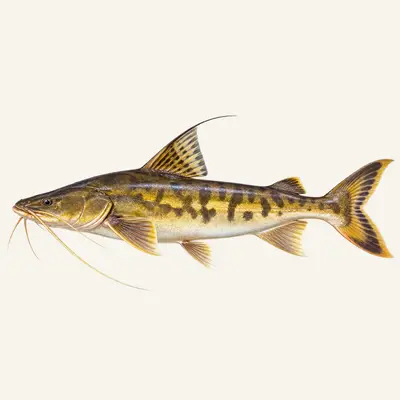
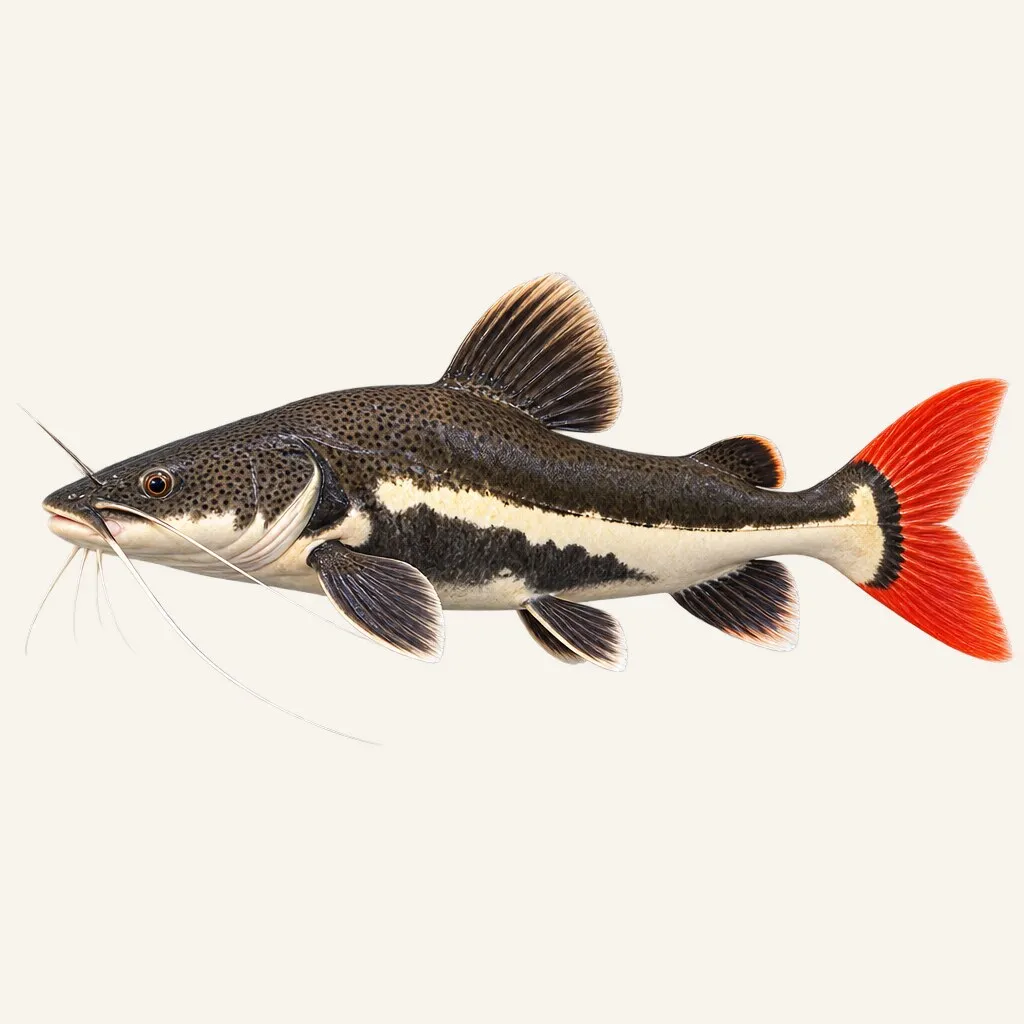
The redtail catfish is a large South American predator from the Pimelodidae family, easily recognized by its dark brown body contrasting with a vivid orange-red caudal fin and tail top. It inhabits the main channels and confluences of the Amazon basin.
Calendar
Recorded in 12 countries
Bangladesh · Bolivia · Brazil · Colombia · Ecuador · Germany · Guyana · Mexico · Peru · Thailand · United States · Venezuela
GBIF occurrence records — native and introduced populations combined.
Identifying it
A dark brown body ending in a caudal fin of vivid orange-red, with the same colour carried over the top of the tail. Nothing else in the basin is painted that way, and the contrast holds at a distance and in poor light.
The head supplies the other mark, and the genus name states it: Phractocephalus means armoured head, after the bony shield that roofs the skull. It is a hard, fixed casing rather than the smooth flexible skull of most large catfishes, and it is what the animal is named for.
The water it needs
The published envelope is acid and soft from end to end: pH 5.5 to 6.8, hardness no higher than 10. There is no alkaline half to it at all, which is a narrow chemistry for a fish that lives in large rivers, and it points at black and clear waters rather than at silt-laden white ones.
Temperature runs from 20 to 26 degrees. The species is demersal, working the bed, and potamodromous, so the whole of its movement stays inside the river network. The catalogue places it in the main channels and at confluences, which is the coarse-scale version of the same thing: volume, depth and a bottom.
Areas
- Deep holes in large rivers
- Logjams and submerged trunks
- Tributary confluences
- Undercut banks
Techniques
- Amazon bottom fishing
- Dead bait under submerged logs
- Live bait on heavy rig
- Large soft lure
Baits
- Odorous dead fish
- Live Amazonian fish
- Piranha chunks
- River shrimp
What it eats
Fish, crabs and fruit. The third item is what separates this predator from every other large catfish in the catalogue.
Fruit only reaches a river where forest stands over it, and it reaches the water by falling. A fish that takes fruit is feeding on what the canopy drops, in the same water column and by the same reflex that brings it a struggling prey fish — which is a description of the flooded-forest economy of the Amazon rather than of a taste for plants.
The crabs anchor the other half of the diet on the bed. Between the three items the animal covers the bottom, the mid-water and the surface film, and it is opportunistic across all of them.
How to catch it
Two figures sit in the file and they do not agree in the way one would expect. Common length is 60 cm. Length at first maturity is reported from 85 cm upwards. The ordinary fish encountered is therefore below the size at which the species starts to breed, and that is the fact to weigh before deciding what goes back.
The rest follows the diet. A bait fished on the bottom in a channel matches the crabs; a dead fish matches the main item; and the fruit entry is a reminder that this predator inspects what falls, so the water immediately under overhanging forest is not the marginal option it would be for a bottom feeder with a narrower diet.
Confluences deserve their own mention. Two rivers meeting produce a permanent seam, deep and turbulent, where drift concentrates without needing a flood to put it there.
Conservation
The pressure on this species is not a fishery. It is the aquarium trade, which is listed as commercial for the redtail catfish and which sells it at a few centimetres.
The consequence is written into the file in five words: introduced but not established in Florida. Releases are happening — nobody introduces a large predatory catfish to Florida on purpose — and so far they have failed to found a population. That is the current state of a running experiment, not a guarantee, and it is the reason the species is worth naming when the subject is ornamental fish that outgrow their tanks.
Inside the native range the corresponding point is the size structure. A common length below the reported onset of maturity means the fish most often caught has not yet contributed anything to the next generation.
Regulations
Check the local regulations in force (legal size limits, closed seasons, bag limits).
For guidance only. Legal sizes, quotas and open seasons vary by location and season: always check the local regulations in force before fishing.
Other names
Five of the six catalogue languages name the tail and nothing else: redtail catfish, bagre de cola roja, Rotschwanzwels, and their equivalents. The trade name in English is the same one, which is unusual — for most South American catfishes the aquarium name and the fisheries name diverge.
Portuguese takes another route. Pirarara is Tupi, the word for fish followed by the word for macaw, and it names the whole colour scheme rather than one fin. A macaw is red, blue and yellow at once; so, in its own arrangement, is this animal.
The scientific name splits the same way, one half for the head and one for the fins, and it is the head that carries the meaning: a skull covered over, in a family where that is worth remarking on.
Sources: fishbase.se · api.gbif.org