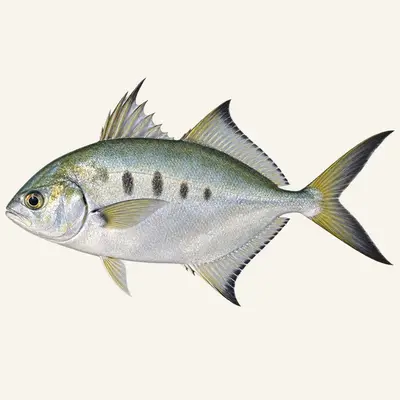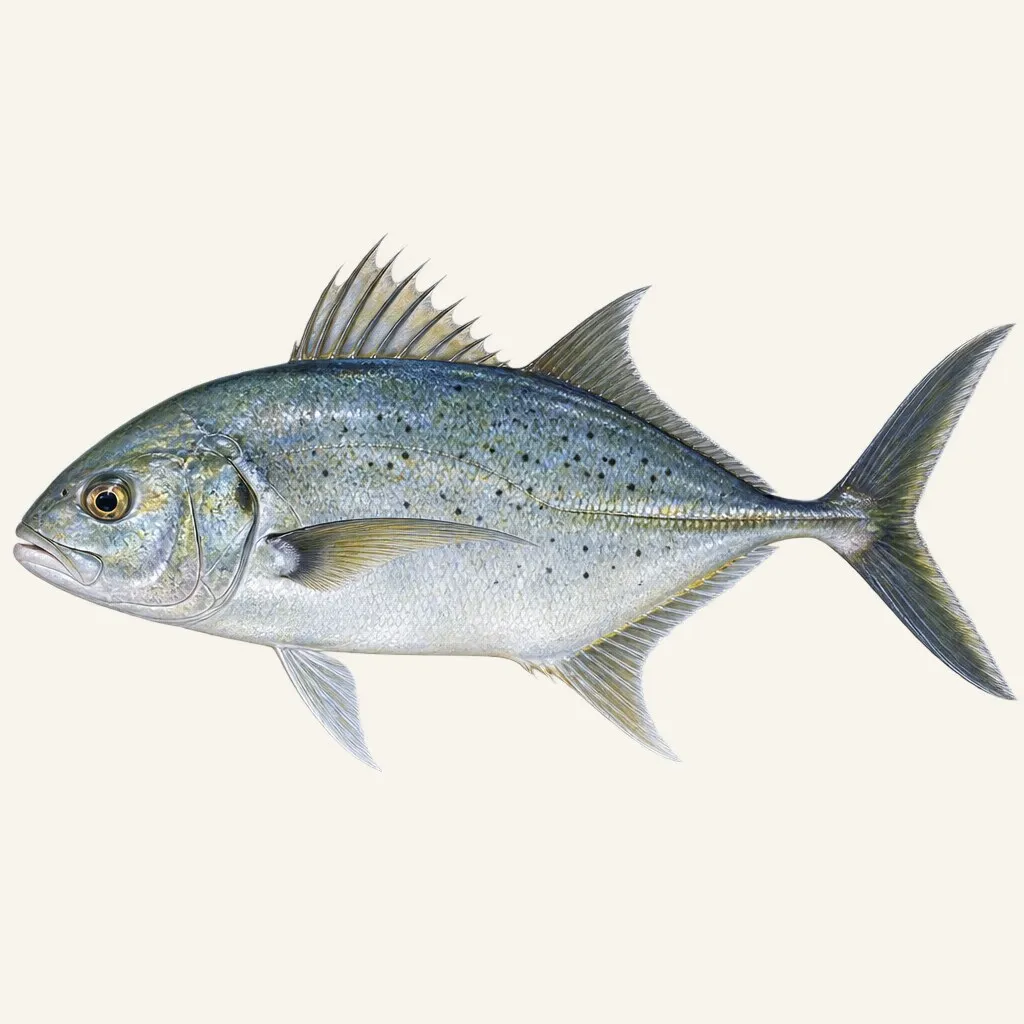
Longrakered trevally
Ulua mentalis · Carangidae
- Saltwater
- Coastal
- Medium
- Size
60–100 cm
- Weight
4.1 kg
Where to fish
- Reef
- Rocky shore
Habitat icons: Flaticon
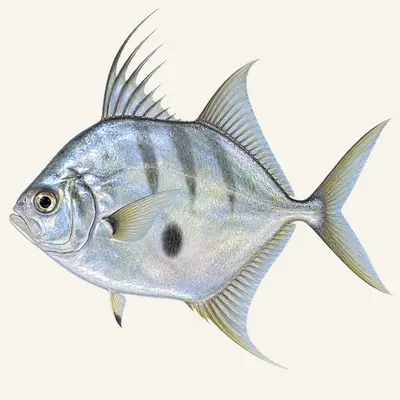
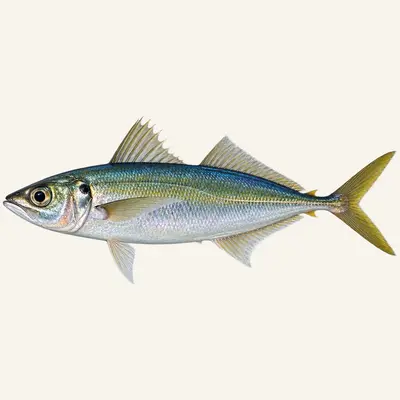
The longrakered trevally is a large carangid of tropical coastal waters across Asia, Africa and Oceania, distinguished by its notably long gill rakers and its powerful, laterally compressed body. It actively preys on fish and cephalopods around reef structures and channels.
Calendar
Recorded in 2 countries
Australia · Mozambique
GBIF occurrence records — native and introduced populations combined.
Identifying it
Short and deep. That is the whole of the shape information in the reference account, and it comes with four numbers: nine dorsal spines, 21 or 22 soft rays, three anal spines, 17 or 18 rays.
What the file does not contain is worth setting down, so that nobody takes this page for a careless reading of it. There is no weight, no depth range, no temperature range, no breeding season and no description of the colour. For a commercially fished jack of this size, that is an unusually short entry, and most of what an angler would want from it has to come from elsewhere on this page.
The water it needs
Adults live in shallow coastal water near reefs.
The range covers the western Indo-Pacific, from East Africa and Madagascar eastward to Taiwan and Australia. That is a quarter of an ocean rather than the full crossing several jacks of the same waters achieve — the island trevally and the giant trevally both carry on to Hawaii, and this one stops well short of the central Pacific.
Areas
- Reef passes
- Coral drop-offs
- Strong current zones
- Reef flats and shallows
Techniques
- Heavy jigging
- Surface popper
- Live bait fishing
- Large hard lures
Baits
- Large live fish
- Heavy jigs
- Poppers
- XXL soft lures
What it eats
Juveniles feed on bottom-living crustaceans. Adults feed on crustaceans and fish.
Read the two sentences together and the difference is an arrival rather than a departure. Fish join the list; the crustacean stays on it. Most marine predators of this size have long since dropped invertebrates by the time the mouth is large enough for a mackerel, and this one has not.
The entry above supplies a structure the reference account omits: gill rakers of notable length. Long rakers belong to fishes that retain small items passing through the gill chamber, which is consistent with a large animal that never gave up small prey.
How to catch it
Two consequences follow, one about ground and one about bait.
The ground is tight. Shallow coastal water, at the immediate edge of the reef: a fish of this build hooked in a few metres of water beside hard structure allows very little, and the distance between the take and the first coral head decides the fight before the drag does.
The bait follows the diet. Because crustaceans remain on the adult menu, an invertebrate bait or a crustacean-profile lure worked near the bottom keeps its value on a large specimen, where the same choice would be dismissed out of hand in front of a predator of comparable size. Common length is 60 cm.
Regulations
Check the local regulations in force (legal size limits, closed seasons, bag limits).
For guidance only. Legal sizes, quotas and open seasons vary by location and season: always check the local regulations in force before fishing.
Other names
The genus name is the trap, and it is specifically an English-language one. Ulua is Hawaiian, and in Hawaii it is the everyday word for the large jacks of the reef — the giant trevally above all. Applied here as a genus, it labels a fish whose recorded range ends at Taiwan and Australia and never reaches the central Pacific at all. An angler who knows the word from Hawaii and meets it in a scientific name off Mozambique is not looking at the same animal.
The common names are unanimous and they name something nobody sees on a live fish. Longrakered trevally in English, jurel de branquiespinas largas in Spanish, Langkiemenreusen-Stachelmakrele in German, carangide branchiospine lunghe in Italian, xaréu-de-rastros-longos in Brazilian Portuguese: five languages pointing at the bony combs on the gill arches, inside the mouth, behind a cover that has to be lifted. The account consulted here says nothing about them.
The epithet aims at a third character again. Mentalis comes from Latin mentum, the chin, so the describer thought the underside of the head worth a name. Two naming traditions, two structures, and a published diagnosis that takes up neither.
Sources: fishbase.se · api.gbif.org