Permit
Trachinotus falcatus · Carangidae
- Saltwater
- Coastal
- Medium
- Size
94–122 cm
- Weight
13–36 kg
- Lifespan
23 years
- Depth
0–36 m
Where to fish
- Reef
- Beach
Habitat icons: Flaticon
Forms large schools, especially in the surf zone along sandy beaches. Adults feed on mollusks, crabs, shrimps, and small fish; juveniles feed on benthic invertebrates.
Calendar
Recorded in 18 countries
Belize · Brazil · Cameroon · Cayman Islands · Côte d’Ivoire · Gabon · Ghana · Guadeloupe · Honduras · Jamaica · Liberia · Martinique · Mexico · Nigeria · Puerto Rico · Sierra Leone · U.S. Virgin Islands · United States
GBIF occurrence records — native and introduced populations combined.
Its range
The range draws a coastal ribbon from Massachusetts to south-eastern Brazil, doubled by an archipelago — the Bahamas and a good part of the West Indies. That shape belongs to the shallow banks of the western Atlantic, and it matches the animal's requirements item for item: sand under a few metres of water, reef within reach, and deep water accessible for spawning.
The clear carbonate platforms that the Florida pompano will not use are where this fish is at home. Two members of one genus divide the same seaboard between them, one taking the loaded water and the other the transparent.
African records have nothing to do with this animal. They rest on misidentifications, mostly of Trachinotus teraia of the Gulf of Guinea, and any eastern Atlantic datum filed under the permit should be discarded before use.
Identifying it
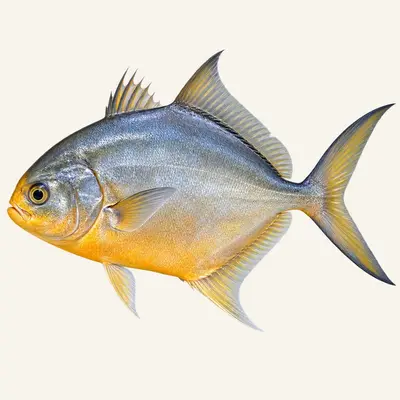
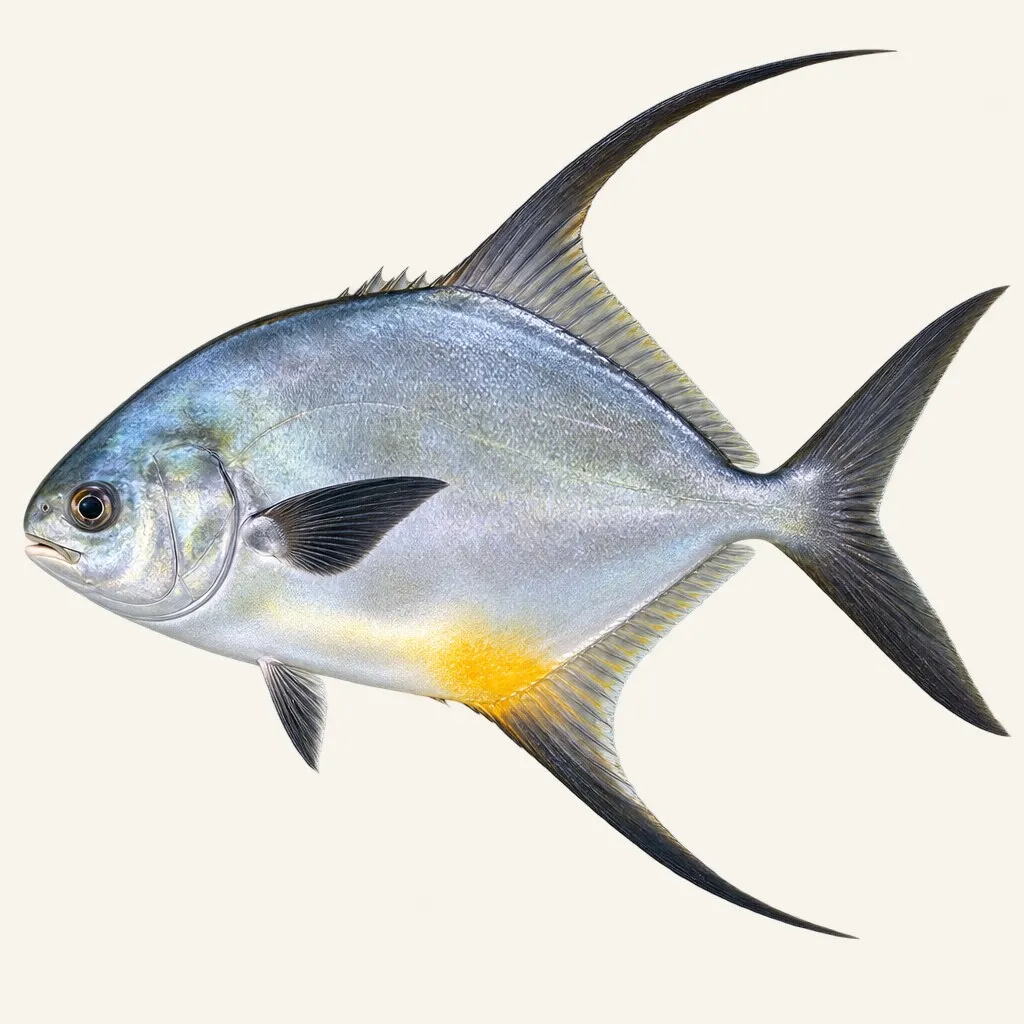
The leading lobes of the soft dorsal and of the anal fin are long and dark, standing up and down off the rear of the body like a pair of scythes. That is the permit's character, and it is the exact reverse of its congeners, which carry those lobes short.
The belly confirms it. A broad orange-yellow field spreads ahead of the anal fin on a fish that is otherwise silver. The pectorals are blackish.
The body is short and very deep, so compressed that a fish seen head-on nearly disappears. There are no scutes on the caudal peduncle.
Six or seven spines in the first dorsal and 18 to 21 soft rays in the second; two or three anal spines and 16 to 18 rays.
Common length is where the species leaves the rest of the genus behind. Captures average 94 cm to the fork. On most sport fish the ordinary capture sits far below the record; here the fish you meet is already a large fish.
Recorded longevity is 23 years.
Breeding
The cycle plays out in two places with nothing linking them. Adults live on the shallow banks, but spawning happens offshore, in open water. The fish has to leave the bright sand it spends its life on and breed somewhere else.
The return is by way of the beach. In summer the juveniles form large schools in the breaking zone along sandy shores — the only time in the life of the species that it is met in numbers.
Maturity falls around 55 cm on average, with the earliest individuals ripe at 48. Set against a common capture length of 94, that figure is low: virtually every fish taken has already bred.
The water it needs
Depth stops at 36 m and nearly everything happens in the top 30. This is a shallow-water fish, associated with reefs and with sandy bottoms.
The detail that counts is elsewhere. Adults are frequently in the channels and holes inside the sandy flats. On a flat and uniform expanse, in other words, they pick the few places where the water is deeper than the rest. Where everything looks alike, those depressions are what makes the spot.
Adults are solitary or move in small schools. The smaller fish tolerate brackish water; the large ones no longer do.
Areas
- Sandy shallow flats
- Reef passes
- Tropical lagoons
- Surf-washed beach edges
Techniques
- Fly fishing on flats
- Light spinning with crab lure
- Natural crab or shrimp drift
- Light jigging
Baits
- Live swimming crab
- Natural shrimp
- Soft crab lure
- Sand worms
What it eats
Molluscs, crabs, shrimps and small fishes for the adult; benthic invertebrates for the juvenile. The diet is therefore built upward, mobile prey being added on top of a foundation of bottom invertebrates that is never given up.
Crabs are the item that matters most, and they explain the shape of the fishery. A predator whose central prey walks on the bottom and does not flee in a straight line has no use for speed, and a great deal of use for a deep body that can be held stationary over one spot in moving water.
How to catch it
Everything rests on an apparent contradiction: the heaviest fish of its genus by a wide margin, living in a metre of water. It is therefore fished on light tackle, which the literature underlines — not out of elegance but because a sand flat in transparent water permits nothing else. The fish sees everything.
Reading the ground comes down to the depressions. Channels, holes, breaks of level inside the bank: on a flat surface that is where the adults hold, and a plateau worked at random gives nothing.
The prey dictates the bait. A crab is the central item on the menu, and a crab imitation put in front of a located fish works better than a fast retrieve, which corresponds to nothing in the way the animal feeds.
Adults are alone or in small numbers, so the fishery consists of finding one fish and fishing for it rather than covering water and waiting for a school. The one exception is summer, in the surf of the beaches, where the juveniles gather in numbers.
Conservation
The life cycle crosses two worlds that are not governed by the same rules. The adults live on coastal banks; spawning takes place offshore. Protecting the sand flats therefore does not protect reproduction, and the reverse holds too: both halves of the cycle have to be covered together or neither is covered at all.
Twenty-three years is the second figure to weigh. A fish of that size is a decades-old animal, and a population of large individuals does not rebuild over a few seasons. Handling a fish taken on a flat, in warm shallow water, has to take that into account: time out of the water and exhaustion after a long fight both count double under those conditions.
One thing works in its favour, and it is rare in a large sport fish: maturity sits well below the length commonly caught. The spawning stock is not what the fishery removes first.
Regulations
Check the local regulations in force (legal size limits, closed seasons, bag limits).
For guidance only. Legal sizes, quotas and open seasons vary by location and season: always check the local regulations in force before fishing.
Other names
Permit is the English name and both French and Italian have adopted it unchanged, which almost never happens for a fish of this standing. The origin of the word is not established.
The confusion that costs most is local rather than international. On the same coast, pompano names the small silver species, permit names this one, and palometa names a third, and the three words are used interchangeably by people who have not had all three in hand. Brazilian Portuguese pampo-galhudo, the antlered pompano, at least names the two long lobes that give the animal its outline.
German Gabelmakrele is to be set aside: the word also serves for the eastern Atlantic relative, an animal an order of magnitude lighter.
Sources: fishbase.se · api.gbif.org