Mangrove red snapper
Lutjanus argentimaculatus · Lutjanidae
- Saltwater
- Coastal
- Medium
- Size
80–150 cm
- Weight
6.5–12 kg
- Lifespan
31 years
- Water temp.
16–30 °C
- Depth
1–120 m
Where to fish
- Estuary
- Reef
Habitat icons: Flaticon
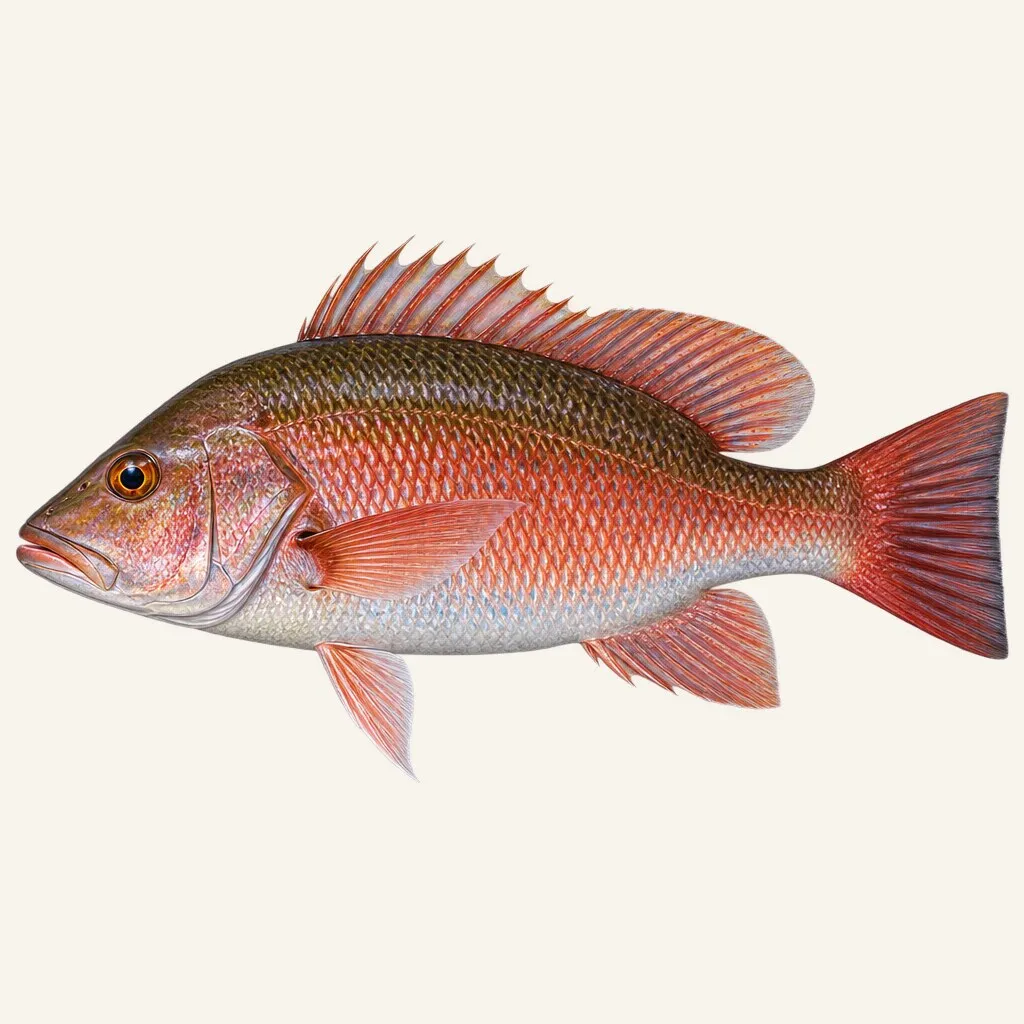
The mangrove red snapper is a sturdy lutjanid with silvery flanks and pinkish hues, easily identified by its strong jaw and spiny dorsal fin. It inhabits estuaries, coastal reefs, and mangrove systems across tropical Asia, Africa, and Oceania.
Calendar
Its range
East Africa to Samoa and the Line Islands, southern Japan to Australia: an ordinary Indo-West Pacific range.
The exception is what earns attention. The species has passed through the Suez Canal and been recorded in the eastern Mediterranean off Lebanon, without ever properly establishing there. Salinity tolerance and a thermal window from 16 to 30 °C were enough for the journey. What is missing at the far end is the nursery — a fish whose whole early life is spent in mangrove estuary and tidal creek finds acceptable reef in the Levant and very little of the brackish habitat that manufactures its recruits.
Identifying it
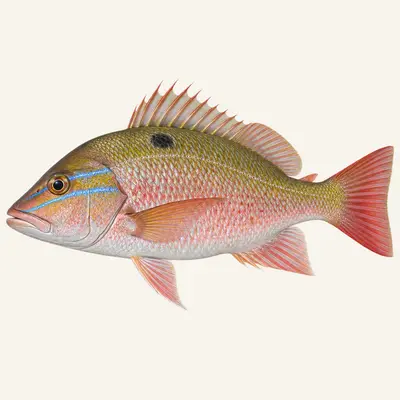
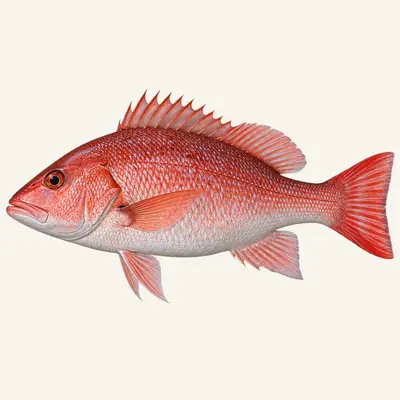
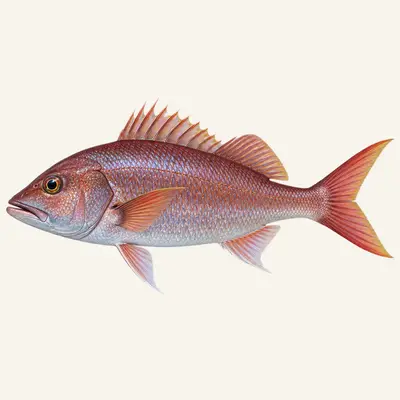
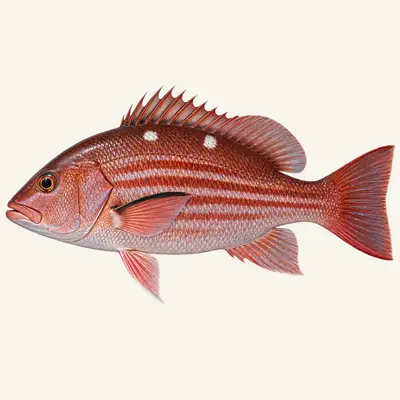
Colour on this fish is a record of where it was caught. One taken in a mangrove channel has a greenish-brown back grading to red along the flanks and a silvery belly; one hauled off deep reef is red throughout. Same species, two depths, and usually two ages.
Juveniles carry a mark that does not shift: about eight white streaks and two blue ones across the cheeks. It fades with growth, so the clearest character in the species can only be read on small fish.
That leaves the countable features. The preopercular notch is poorly developed, which rules out the relatives with a sharp notch and knob. The vomerine tooth patch is crescent-shaped. Gill rakers on the first arch number 16 to 20 including rudiments. The dorsal has ten spines and 13 or 14 soft rays, the anal three and eight. Body depth goes 2.3 to 2.7 times into standard length, which is neither slab-sided nor elongate.
One character is worth knowing only in order to distrust it. The scale rows on the back may run parallel to the lateral line, may tilt upward behind, and are occasionally oblique from end to end. Knowing that they vary is more useful than using them.
The water it needs
The life cycle is a one-way ramp and it uses the full salinity range. Juveniles and young adults live in mangrove estuaries, the lower reaches of freshwater streams and tidal creeks. Adults gather around coastal coral. Older fish move offshore to deeper reef, sometimes below 100 m.
A single individual therefore crosses, in one lifetime, a depth band from 1 to 120 m and a salinity gradient from fresh to full ocean. No one fishery covers that span, and no one habitat protection covers it either.
Areas
- Mangrove channels
- Estuary mouths
- Shallow coastal reefs
- Lagoons and atolls
Techniques
- Estuarine live bait fishing
- Soft lure fishing
- Handline fishing
- Surface fishing at night
Baits
- Live shrimp
- Small live fish
- Crabs
- Cut squid
- Marine worms
What it eats
Activity is mainly nocturnal, and the diet has two entries: fishes and crustaceans. The echinoderms, assorted molluscs and drifting material that several relatives pick up are absent from it.
That narrowness describes a mobile hunter rather than a bottom-picker, consistent with a fish that patrols a channel mouth on a running tide. It also simplifies bait choice down to something that swims or a prawn.
How to catch it
One species, three fisheries, and the age of the fish decides which one is in play.
In estuary and mangrove the quarry is juveniles and mid-sized adults, at night, on live bait, along channel edges and at the mouths a falling tide empties. On coastal reef the quarry is adults in small groups. Past 100 m it is the large fish, which calls for deep bottom gear. Looking for all three in the same place is a way of missing two of them.
The species is taken on handlines, bottom longlines and trawls, which is a fair measure of how much vertical ground its habitat covers.
A word on the published sizes, because they do not agree with each other. The maximum length and the maximum weight on record cannot describe the same animal in a fish of this build, and the monitored series from the east coast of Australia agrees with neither. Where the records diverge that far, none of them is worth judging a capture against. What the Australian work does settle is the age: 39 years for the oldest fish.
Conservation
Longevity comes first — 31 years in the reference figure, 39 in the Australian series, against maturity at around 57 cm. A fish of that length has a decade or more behind it, and it has spent that decade changing habitat.
The second pressure is commercial and unusually specific. The species sells throughout the Indo-Pacific, freezes without going rancid, which opens the export trade to it, and commands a price with no ceiling by size. Nothing in the market discourages taking the biggest fish, which is to say the oldest, which is to say the ones that came from deep water.
Third, it is described as an important market species that is never present in large quantities. High value on a thinly spread resource is a combination with no slack in it.
Then the mangrove. The entire recruit class lives in a habitat that is not reef, falls under different protections, and appears in no landing statistics. Pressure on estuaries acts on this snapper without being visible anywhere in the figures kept for it. Farming the species is established and shifts part of the demand elsewhere, but it removes none of that.
Regulations
Check the local regulations in force (legal size limits, closed seasons, bag limits).
For guidance only. Legal sizes, quotas and open seasons vary by location and season: always check the local regulations in force before fishing.
Other names
The English names for this fish put it in the wrong family. In Australia it is the mangrove jack, and it is not a jack: jacks are carangids, built and fished on entirely different lines. The FAO name, mangrove red snapper, is accurate and lives mostly in print.
Between hemispheres the confusion gets worse. The mangrove snapper of the Caribbean is Lutjanus griseus; the mangrove jack of Queensland is this fish. Both are estuary snappers named after the same trees, and neither name tells anyone which ocean is meant.
The epithet describes silver spots, a feature of the estuary fish rather than of the red adult that comes off the deep reef — the scientific name, like the vernacular ones, was fixed on the young.
Sources: fishbase.se · api.gbif.org