Mackerel scad
Decapterus macarellus · Carangidae
- Saltwater
- Coastal
- Medium
- Size
30–46 cm
- Weight
0.3 kg
- Depth
0–400 m
Where to fish
- Reef
- Offshore
Habitat icons: Flaticon
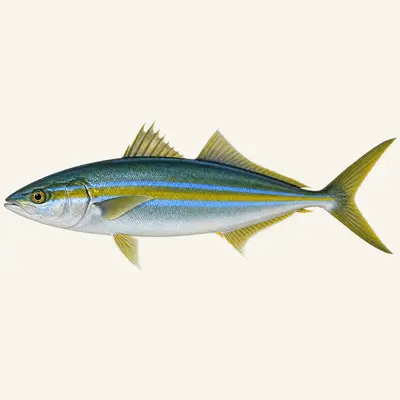
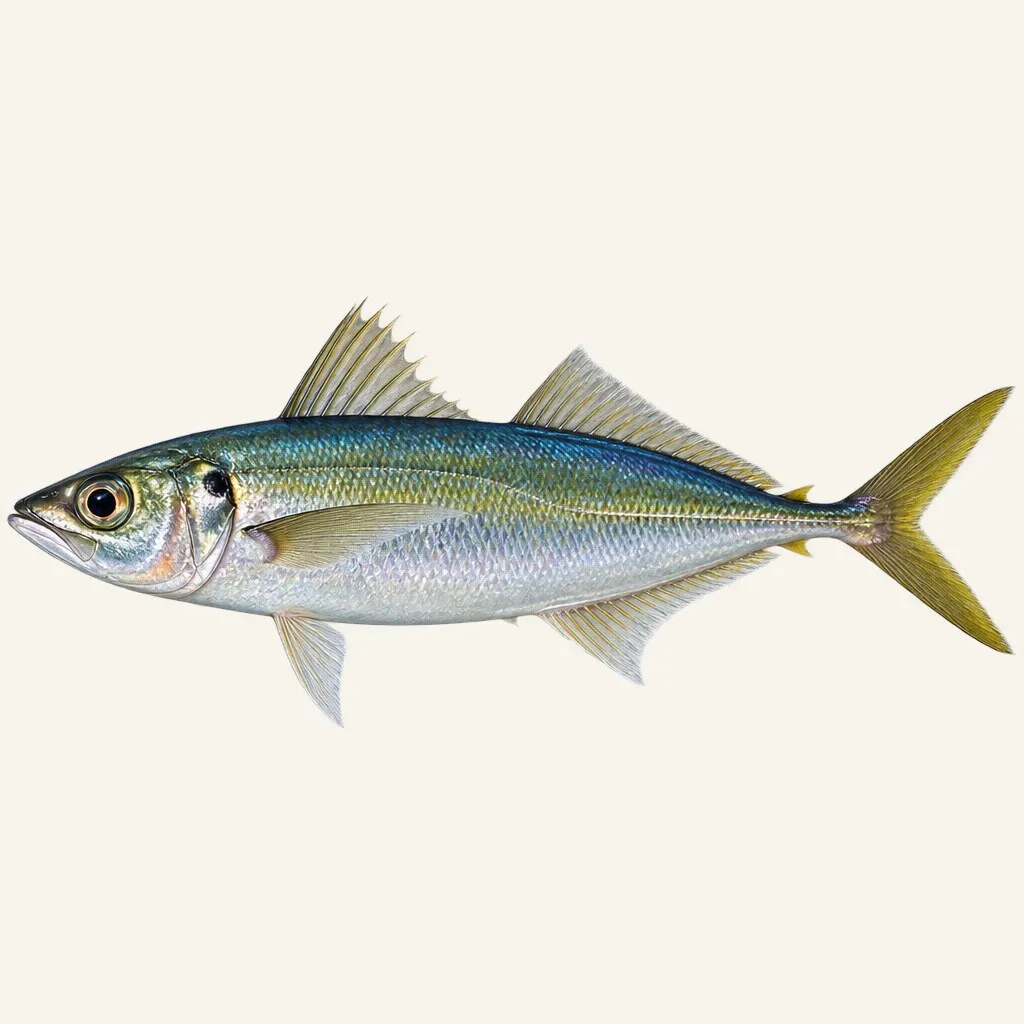
The mackerel scad is a streamlined Carangidae with silvery colouration, a metallic blue-green back and a small black spot at the edge of the operculum, typical of the genus Decapterus. A widespread coastal pelagic species of tropical and subtropical oceans, it forms large open-water schools.
Calendar
Recorded in 23 countries
American Samoa · Australia · Brazil · British Indian Ocean Territory · Colombia · France · French Polynesia · Guadeloupe · Japan · Madagascar · Marshall Islands · Mayotte · Mexico · Mozambique · Netherlands · Northern Mariana Islands · Portugal · Puerto Rico · Réunion · Seychelles · Spain · United Kingdom · United States
GBIF occurrence records — native and introduced populations combined.
Its range
There is a hole in the middle of the western Atlantic range, and it is the entry to start from. The species runs from Nova Scotia and Bermuda down to about Rio de Janeiro, and yet it appears to be absent from the Gulf of Mexico — an absence set inside a presence, with occupied coast on either side of it.
Read the rest of the list and the hole explains itself. The eastern Atlantic records are St Helena, Ascension, Cape Verde, the Azores, Madeira and the Gulf of Guinea. The Indian Ocean records are the Red Sea, the Gulf of Aden, the Seychelles, the Mascarenes, South Africa and Sri Lanka. The eastern Pacific records run from the Gulf of California and Revillagigedo down to Ecuador. Island after island, with deep water alongside each of them.
A species called circumglobal is not therefore a species found everywhere. This one is found wherever clear oceanic water comes close to land, and a broad, shallow, river-fed gulf offers nothing that it uses.
Identifying it
Take the cross-section first. It is oval, not flattened — a round-bodied fish, built along the lines of the mackerel it is named after rather than of a jack, and that alone separates it from the compressed scads it shoals near.
The pectoral fin is the measurable character. It is short, 58 to 72% of head length, and laid back against the body its tip falls well short of a vertical dropped from the front of the second dorsal fin. That can be checked on any specimen with a finger for a ruler.
Then the mouth, which carries two characters at once. The oral valve — the membrane at the join of the upper jaw — is conspicuously white in adults and shows the moment the mouth is opened. Both jaws are without teeth.
The rest wants a closer look. The last ray of the dorsal and the last ray of the anal each form a widely detached finlet. The margin of the shoulder girdle bears two small papillae, the lower one the larger. The rear end of the upper jaw is straight above, moderately rounded, and slanted noticeably downward and forward. The interorbital scales usually run forward as far as the front margin of the pupil.
Nine dorsal spines, 31 to 37 soft rays, three anal spines, 27 to 31 rays, 24 vertebrae. Bluish green above, silvery below, with a small black blotch near the upper edge of the gill cover margin; the tail is yellow-green and the anal and pelvic fins are pale.
The water it needs
Clear oceanic water, frequently around islands. The fish is generally caught between 40 and 200 m, has been recorded from the surface down to 400, and turns up near the surface from time to time without that being the rule.
The position is precise, and it is the most useful thing on this page. Schools travel fast along reef edges next to deep water — the line where the shelf gives out. That edge is where current meets structure and where drifting food gets concentrated, and a school works along it rather than settling on it.
Areas
- Coastal pelagic waters
- Island and reef edges
- Open bays
- Marine convergence zones
Techniques
- Drift sabiki
- Small jigs
- Light surface lures
- Light rod casting
Baits
- Small colored feathers
- Fresh shrimp
- Marine worms
- Micro-jigs
What it eats
Mainly zooplankton.
The toothless jaws and that diet are one statement. Nothing on the menu has to be held, so nothing in the mouth is built to hold: the fish swims through a concentration of small animals and takes them in. It accounts for the schooling, the speed and the drop-off position all at once, because a food source spread thinly through water is worked by covering ground rather than by waiting on a station.
How to catch it
This fish is fished for what eats it. Fast schools along a reef edge are the live bait supply of the large predators in the same water, and finding the scad and finding what is hunting the scad are frequently one job.
Taken for itself, it comes on very small hooks: a sabiki drifted through a school, small jigs, light lures near the surface, a light rod worked by hand. The depth to try first is 40 to 200 m near a drop-off. Common length is 30 cm, so none of this is heavy work.
The commercial fishery uses purse seines and trawls, and the catch is sold fresh or salted and dried.
Regulations
Check the local regulations in force (legal size limits, closed seasons, bag limits).
For guidance only. Legal sizes, quotas and open seasons vary by location and season: always check the local regulations in force before fishing.
Other names
Mackerel scad in English, opelu in Hawaiian — where the fish has a long-standing place in both diet and custom — and comaron in French.
Both English words are borrowed, and neither is exact. "Mackerel" points at the round body and the speed, not at any relationship: the Scombridae are elsewhere. "Scad" is applied across several carangid genera, so it narrows the field to a small silver schooling fish and stops there. Between them the two words describe the animal's build and its habits fairly well while getting its identity wrong twice over.
Sources: fishbase.se · api.gbif.org