Pilotfish
Naucrates ductor · Carangidae
- Saltwater
- Coastal
- Medium
- Size
40–70 cm
- Weight
0.7 kg
- Depth
0–300 m
Where to fish
- Rocky shore
- Offshore
Habitat icons: Flaticon
Pilot fish - pelagic sea fish, worldwide
Calendar
Recorded in 42 countries
Angola · Australia · Benin · Brazil · Cameroon · Canada · Colombia · Congo - Brazzaville · Congo - Kinshasa · Costa Rica · Côte d’Ivoire · Ecuador · Egypt · Equatorial Guinea · France · French Polynesia · Gabon · Ghana · Guinea · Guinea-Bissau · Ireland · Italy · Japan · Liberia · Mayotte · Mexico · Mozambique · New Caledonia · New Zealand · Nigeria · Panama · Portugal · Réunion · Senegal · Sierra Leone · South Africa · Spain · Taiwan · Togo · United Kingdom · United States · Wallis & Futuna
GBIF occurrence records — native and introduced populations combined.
Its range
Circumtropical, and the outline is worth reading against the biology. Western Atlantic from Nova Scotia to Argentina; eastern Atlantic from the British Isles, where it is a rare vagrant, and from Norway and the Bay of Biscay down to Namibia, Mediterranean and Canaries included; eastern Pacific from Vancouver Island to the Galápagos and Chile; common throughout the Indian Ocean.
Nova Scotia, Norway, Vancouver Island. None of those is tropical, and none is a place a warm-water carangid makes a living. They are places a host went. An animal whose entire living is attached to sharks, rays and turtles inherits the range of those animals instead of drawing its own around a band of temperature, and the northern ends of this map are strays that arrived underneath something large.
Identifying it
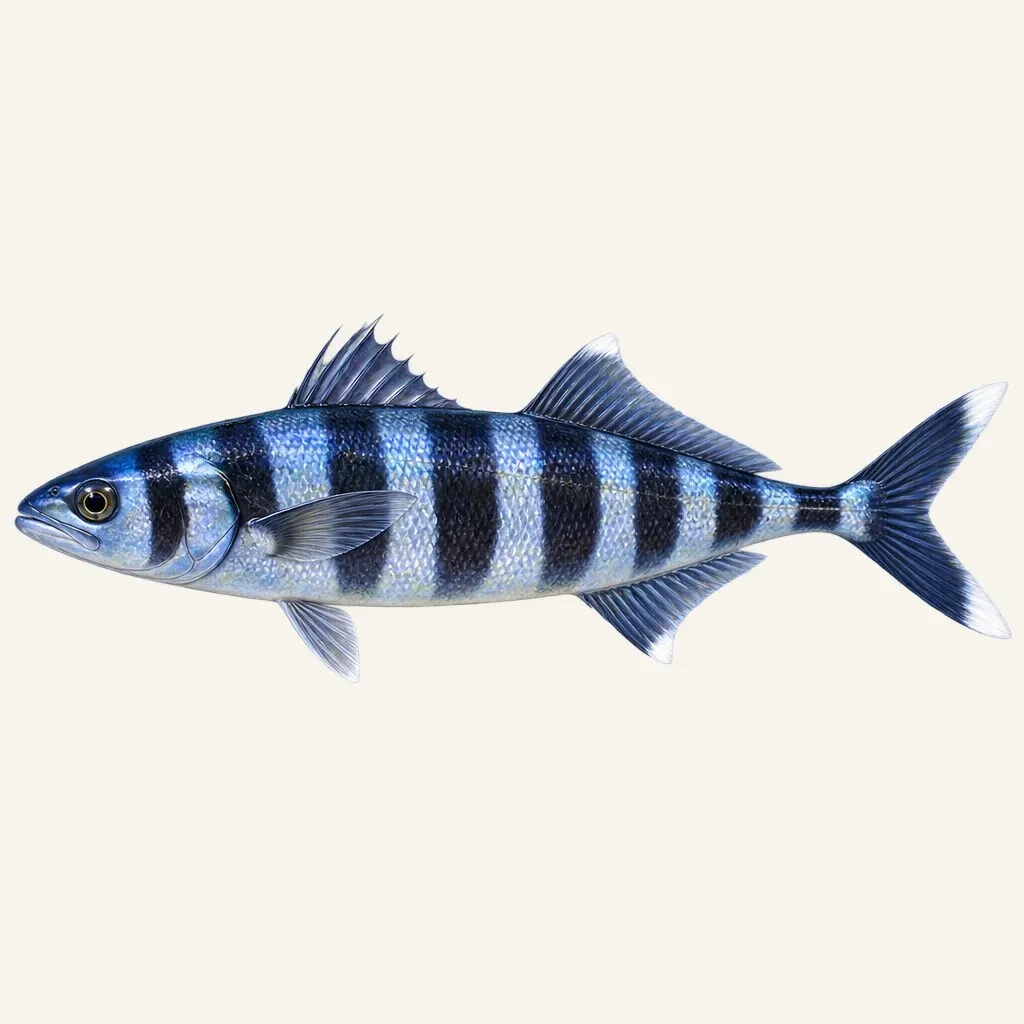
Ahead of the dorsal fin stand four or five short spines, free of any membrane, spaced out along the back like the teeth of a comb. Behind them comes one further spine and then the fin proper, 25 to 29 soft rays of it — the formula written IV-V+I 25-29. Those isolated spines are what determines the fish. Everything else about it is easier to see and less decisive.
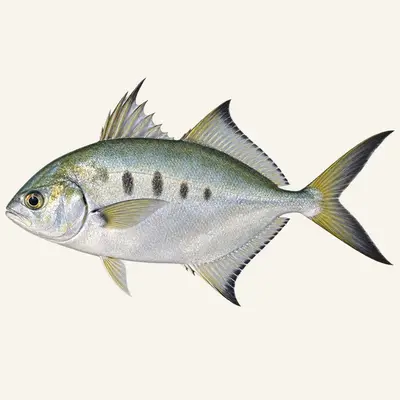
What is easier to see is the barring: six or seven broad dark bars crossing a body that is otherwise pale to dark bluish, with white tips on the lobes of the tail, of the second dorsal and of the anal. The pattern is what gets the fish remembered and named. Banded fish are common enough, though, and the count of free spines is what closes the question.
The body is elongate, slender, and not strongly compressed. The rear end of the upper jaw reaches the front rim of the eye. Three anal spines and 15 to 17 rays.
The water it needs
The species keeps what its own account calls a semi-obligate commensal relationship with sharks, rays, other bony fishes and turtles. Both halves of that phrase carry weight. Commensal: one party gains and the other is not harmed. Semi-obligate: the association is neither an occasional convenience, as it is for a fish that happens across a drifting plank, nor an absolute dependence. A pilotfish can live without a host. Most of them do not.
The young start on something smaller. Jellyfish and drifting weed are the usual early company — a host that is ridden rather than followed.
Depth is recorded from the surface to 300 m, which is the working range of the animals it travels with rather than a preference of its own.
Areas
- Offshore pelagic waters
- Around floating objects and wrecks
- Shark-frequented areas
- Warm temperate surface waters
Techniques
- Light surface lure fishing
- Light trolling line
- Drift live bait fishing
- Cast fishing near floating objects
Baits
- Small soft lures
- Small live fish
- Fresh fish pieces
- Light metal lures
What it eats
Scraps left over from the host's meal, the host's parasites, and the host's droppings. Small fishes and invertebrates on its own account.
That list is the relationship, set out as a menu. The pilotfish is not accompanying a shark out of affinity, and not for shelter alone: it eats what the shark spills, carries and voids, and takes the parasites off the animal in the process. The exchange is real and it is lopsided in the way commensalism usually is. The shark would manage.
How to catch it
Nobody sets out for this fish. It arrives attached to something else: circling a hooked shark at the side of the boat, in the shadow of a ray, holding station beside a turtle.
That makes it worth more as a sign than as a catch. A pilotfish at the surface is a statement about what is beneath it, and offshore crews read it that way — the small banded fish first, the large animal a moment later. Light lures, a light trolled line, a drifted live bait, a cast near a floating object: all of them take it, and all of them are the tackle of a fish met by accident. Common length is 40 cm.
The commercial fishery is minor, the catch sold fresh or salted and dried, and the gear is the detail that says most about the animal — it is taken at the surface with hand nets. A hand net only works on a fish that will not leave the thing it is following, even with a boat over it.
Public aquariums keep the species, which is possible for the same reason.
Conservation
Nothing is recorded as pressing on the fish itself, and the exposure it has is borrowed. An animal semi-obligately attached to large sharks, rays and turtles carries whatever happens to those populations, and none of it would appear in a count of pilotfish until well after the fact.
Regulations
Check the local regulations in force (legal size limits, closed seasons, bag limits).
For guidance only. Legal sizes, quotas and open seasons vary by location and season: always check the local regulations in force before fishing.
Other names
Pilotfish in English, and the name is a fossilised mistake. Sailors held that it went ahead of sharks and of ships to show them the way. Naucrates is the ship-master and ductor the leader, so the scientific name preserves the same belief twice over. Observation replaced it with something less flattering and more interesting: the fish does not lead, it follows, and it follows in order to eat.
Italian keeps fanfano, French poisson-pilote, and English sea lore is full of pilotfish escorting vessels into harbour. The story outlived its own refutation by a long way, which is not unusual for a name.
Sources: fishbase.se · api.gbif.org