Pompano
Trachinotus ovatus · Carangidae
- Saltwater
- Coastal
- Medium
- Size
35–70 cm
- Weight
0.3–2.8 kg
- Depth
50–200 m
Where to fish
- Beach
Habitat icons: Flaticon
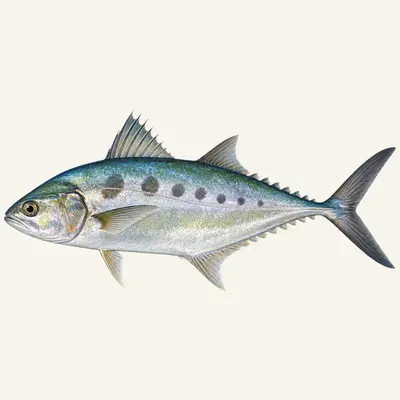
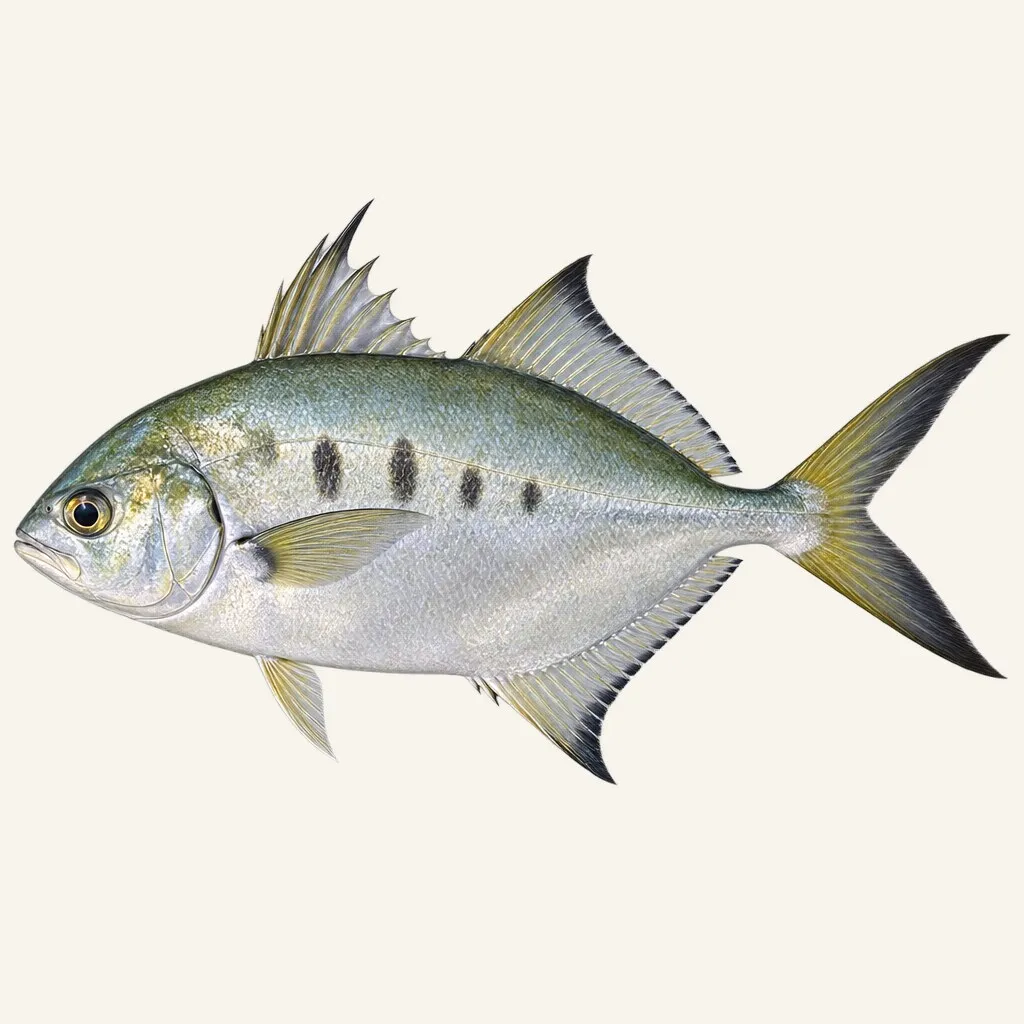
The ovate pompano is a coastal carangid with a tall, compressed body, recognizable by its dark rounded spots on silvery flanks. It occurs in warm coastal waters of the eastern Atlantic, from the Mediterranean to African and American coastlines.
Calendar
Recorded in 29 countries
Algeria · Angola · Benin · Brazil · Cameroon · Cape Verde · China · Congo - Kinshasa · Côte d’Ivoire · Cyprus · Egypt · France · Gabon · Ghana · Greece · Israel · Italy · Lebanon · Liberia · Mauritania · Nigeria · Portugal · Senegal · Sierra Leone · Spain · Türkiye · United Kingdom · United States · Western Sahara
GBIF occurrence records — native and introduced populations combined.
Its range
The northern end of the map misleads. Records exist as far as British and Scandinavian water, but they are strays, and that mention pushes the cartographic limit more than a thousand kilometres past the real one. The working limit is the Bay of Biscay.
Southward the range runs unbroken to Angola, taking in the whole Mediterranean and the offshore Atlantic islands, the Macaronesian archipelagos among them. A coastal fish tied to sandy ground that nevertheless reaches isolated islands is explained by the drift of its eggs and by nothing else.
Identifying it
Three to five black spots mark the front half of the lateral line. They are drawn out vertically, sharp against a silver flank, and they are enough on their own: no other fish of the eastern Atlantic seaboard carries that row of marks along that line.
The mouth is the second character, and it contradicts what the family suggests. The upper jaw narrows to almost nothing at its rear end and reaches only as far back as the front third of the eye. Open, the gape is small, close to pinched, and the tongue carries a narrow band of teeth. The lower limb of the first gill arch counts 22 to 32 rakers.
Then the lateral line itself, barely arched above the pectorals and dead straight after that, and carrying no scutes. A bare peduncle is a negative character in this family and settles nothing on its own.
One point separates this fish from its close relatives in the genus. The lobes of its soft dorsal and anal fins are short — the dorsal lobe goes 3.9 to 5.6 times into the fork length — where other members carry them drawn out into long dark points. Those lobes, and the caudal lobes with them, are black at the tip.
The body is less deep than the genus leads you to expect: depth goes 2.6 to 3.5 times into the fork length, which makes this the most elongate of the group. Scales are small, cycloid and half sunk into the skin. The back is greenish grey, the flanks silver.
The second dorsal carries one spine and 23 to 27 soft rays, the anal two detached spines then one spine and 22 to 25 rays; the two bases are the same length.
Breeding
The eggs are pelagic. Released in open water, they drift with nothing to hold them and nobody attending them.
The rest is missing, and the gap is worth stating rather than filling. Neither length at first maturity, nor spawning season, nor number of batches appears in the documentation for this species — even though it is farmed commercially, which means a hatchery necessarily knows things about it that the literature on the wild stock has never recorded.
The water it needs
What the species wants is moving water over clean ground. Adults hold in shallow water, in areas of surge, in clear water, over sand or mud. They enter lagoons and estuaries on occasion and put up with reduced salinity.
They live in schools, which is what sets this fish apart from the solitary members of its own genus.
The depth band recorded for the species, 50 to 200 m, does not overlap any of that description. It is the wave zone that matches what is known of its life and what an angler actually meets.
Areas
- Sandy beaches with surf
- Small sheltered coves
- Coastal wave zones
- Sandy shallows
Techniques
- Surf fishing
- Light soft lure casting
- Bottom fishing with natural bait
- Shore fishing with running rig
Baits
- Fresh shrimp
- Sea worms
- Small soft lures
- Fresh mussels
What it eats
Small crustaceans, molluscs and fishes. The composition is ordinary; it is the calibre that counts, and the calibre is fixed by a jaw that stops short of the middle of the eye.
A gape that size rules out large prey as reliably as a sieve does. The band of teeth on the tongue and the many gill rakers finish the portrait of an animal working on fry and on invertebrates a few millimetres across.
How to catch it
One documented fact overturns the picture. Small individuals are taken regularly at night, from steep rocky shores. That is not the sand beach anyone imagines and not daylight either: it is a vertical edge fished over deep water after dark.
The adults are looked for in the wash, over sand, in clear water. The zone where the wave breaks and turns the bottom over is the station, and the clarity is a condition rather than an accident — this fish does not use loaded water.
The rig follows the mouth. A small fine-wire hook and a bait of a couple of centimetres — a shred of crustacean, shellfish or flesh — go in where an ordinary sea bait is refused for want of being able to enter at all. Discretion in the trace counts for more than usual, since the water is transparent.
The fish lives in schools: a take is worth more than a fish, and the stretch deserves persistence after the first one.
Conservation
The sensitive point is on the habitat side. A fish that depends on clear water over clean ground in the breaking zone occupies exactly the coastal strip that development and increased suspended load change fastest. There is no documented overfishing here; there is a narrow habitat, contained entirely within the first few metres of the shore.
Farming of the species has meanwhile grown, and it changes the nature of the question rather than answering it. Tank production shifts the pressure off the wild stock and onto the forage needed to feed the fish, and it rests on broodstock whose origin the published literature does not record.
The standing global assessment of the species dates from May 2013, before that industry took off.
Regulations
Check the local regulations in force (legal size limits, closed seasons, bag limits).
For guidance only. Legal sizes, quotas and open seasons vary by location and season: always check the local regulations in force before fishing.
Other names
English calls this fish pompano, which is also the name in daily use for a different member of the genus on the far side of the Atlantic — the fish sold as pompano in the United States. Derbio is the name that avoids the collision, and it is the one to use where both animals are under discussion.
Translated sources are unreliable across this whole genus. Spanish palometa is applied in ordinary use to several deep-bodied fish with no close relationship to each other, and German Gabelmakrele serves indifferently for this species and for the permit of the West Indies, two animals nobody would confuse at the water's edge.
Sources: fishbase.se · api.gbif.org