Lookdown
Selene vomer · Carangidae
- Saltwater
- Coastal
- Medium
- Size
35–48 cm
- Weight
0.5–2.1 kg
- Depth
1–53 m
Where to fish
- Estuary
- Beach
- Rocky shore
Habitat icons: Flaticon
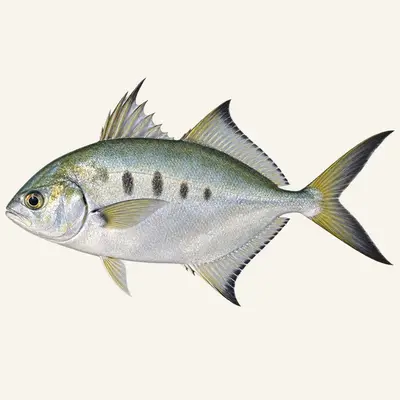
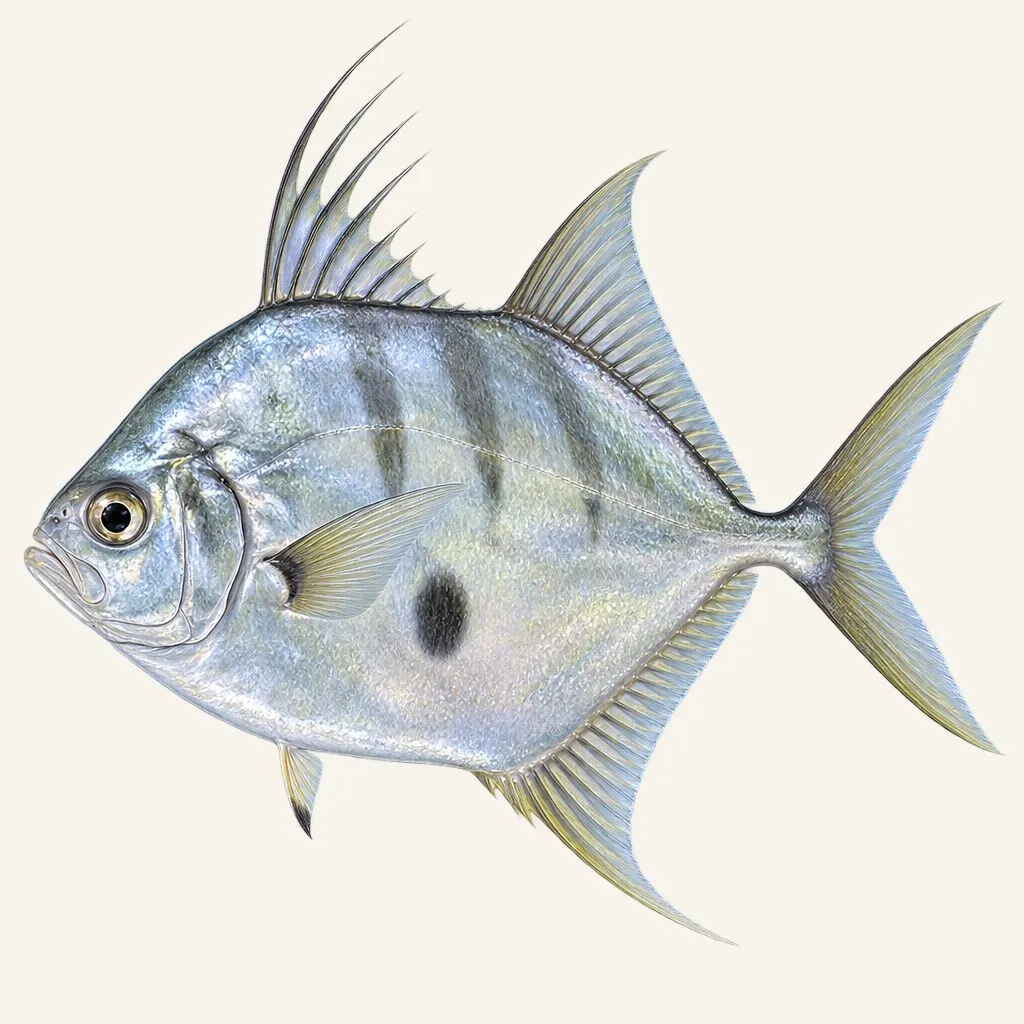
The lookdown is a striking carangid of tropical Atlantic waters in North and South America, recognisable by its extremely disc-like compressed body, nearly vertical frontal profile and the long trailing filaments extending from the dorsal and anal fins in young individuals. Its highly reflective silver surface gives it a characteristic metallic appearance.
Calendar
Recorded in 5 countries
Brazil · French Guiana · Mexico · Puerto Rico · United States
GBIF occurrence records — native and introduced populations combined.
Its range
The range is western Atlantic and nothing else: from Maine, possibly from Nova Scotia, south along the United States to Florida, then down the coasts of Central and South America to Uruguay, taking in Bermuda and the Gulf of Mexico.
One entry on that list is negative and it is the informative one. The species is rare in the Greater Antilles. Those are islands with narrow shelves, deep water close inshore and few large estuaries — which is to say they are short of precisely the ground this fish uses. A continuous continental coastline from Maine to Uruguay supplies shallow sand and hard bottom, river mouths and surf beaches without a break in them; the Antilles supply very little of it, and the scarcity there is a shortage of habitat rather than any barrier to arrival.
Identifying it
Nothing else in the family is built like this. The body is a thin plate, extremely compressed and very deep, and the front of it rises almost vertically from the jaw to the top of the head, so the profile is a blade rather than a curve. The eye sits high on that steep face and well forward, with the whole of the head falling away beneath it. That is what the English name is describing: the animal appears to be looking down over its own snout.
The pelvic fin is small. Nine dorsal spines, 23 soft rays, three anal spines, 18 rays. The whole fish is silver.
Both halves of the scientific name record the same body from different angles. Selene is the moon, a thin bright disc seen flat on. Vomer is the ploughshare, the same disc seen edge-on as a blade. A fish that is a disc from the side and almost nothing from the front is described better by those two words together than by most formal diagnoses.
The water it needs
This is a demersal fish, and that is the first thing separating it from its relatives. It lives on the bottom in shallow coastal water, usually over hard or sandy ground, from 1 m down to about 53. Not the reef edge, not the blue water, not the surface — the bottom, and close in.
Juveniles turn up in estuarine water and off sandy beaches, and the species tolerates brackish conditions.
The grouping varies in a way worth knowing before any search for them. Schools form, but the fish also occur in small parties and in pairs, so the density on a given piece of ground cannot be predicted from the fact that the species is present on it.
Areas
- Coastal sandy beaches
- Estuaries
- Shallow Atlantic zones
- Jetties and piers
Techniques
- Small silver lure fishing
- Light surface popper
- Live bait fishing
- Float fishing
Baits
- Shrimp
- Small fish
- Silver lures
- Marine worms
What it eats
Small crabs, shrimps, fishes and worms.
Three of those four live in or on the sediment, and one of them — the worms — has to be extracted from it rather than run down. That is a bottom-feeder's list, and it agrees with everything else on this page: the demersal habit, the shallow sand and hard ground, and the low forward set of the small mouth beneath that steep face. The head is angled at the bottom because the bottom is where the food is.
How to catch it
Shallow, inshore, over hard or sandy ground, and near the estuaries and beaches that hold the smaller fish. There is nothing offshore about this fishery.
The tackle is small and bright. Small silver lures answer the small fishes on the menu; a light popper worked on the surface, a live bait, and a baited float are the other three approaches in use. Common length is 35 cm, and a fish of that length on this body plan is not a great weight — but a flat body held broadside to the current pulls considerably harder than its mass suggests, and the tackle has to allow for that rather than for the number on the scale.
The flesh is rated excellent and sold fresh, though the commercial fishery is minor. The species also carries reports of ciguatera poisoning, which is worth weighing for a fish caught inshore and eaten close to where it was landed.
Regulations
Check the local regulations in force (legal size limits, closed seasons, bag limits).
For guidance only. Legal sizes, quotas and open seasons vary by location and season: always check the local regulations in force before fishing.
Other names
Lookdown in English, and it is one of the rare cases of a common name being genuinely diagnostic. The steep face and the high-set eye produce exactly that impression, and there is no need for any further description of the fish.
"Moonfish" is the name to handle carefully. Within the same genus it belongs to the Atlantic moonfish, Selene setapinnis, which shares the coast and the compressed silver body; in the wider trade it has been attached to fishes from several unrelated families as well. A fish sold as moonfish on this seaboard may be either Selene, and the two are separated on the head profile in the field guides rather than on colour, which they share.
Horsehead is a third name in local use, and it is describing the same steep front from another direction.
Sources: fishbase.se · api.gbif.org