Ocellated snakehead
Channa pleurophthalma · Channidae
- Freshwater
- Predators
- Medium
- Regulated
- Size
40 cm
Where to fish
- Canal
Habitat icons: Flaticon
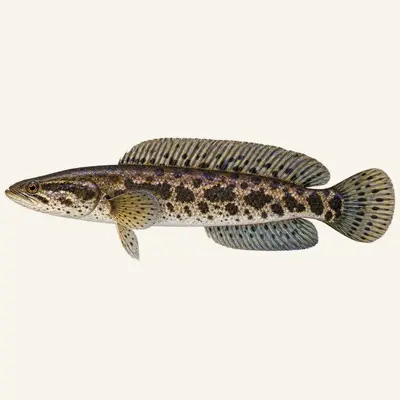
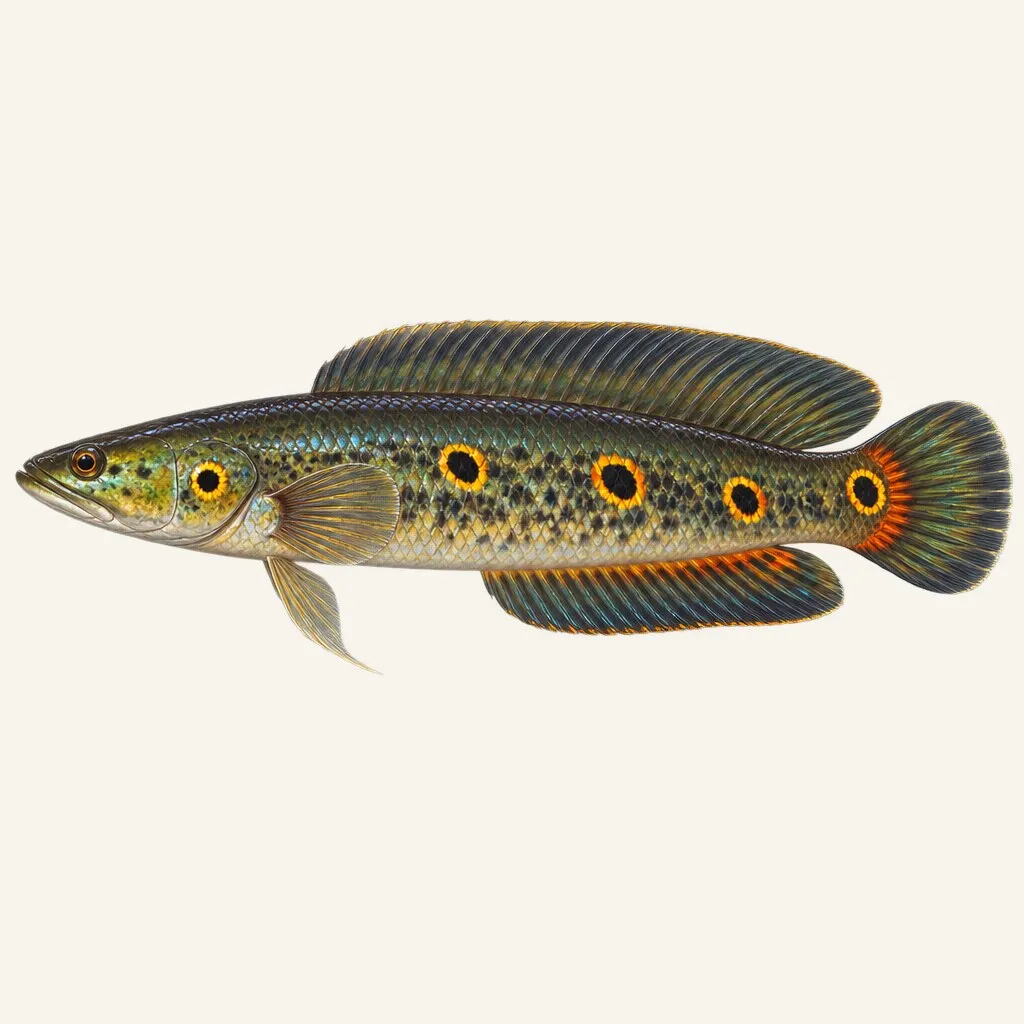
The ocellated snakehead takes its name from the brightly coloured round spots along its flanks resembling eyes, set against an orange-brown to brick-red background. Native to the shallow, slow-moving freshwaters of Borneo and Sumatra, this medium-sized predator favours densely vegetated areas and slightly acidic waters.
Calendar
Recorded in 1 country
Indonesia
GBIF occurrence records — native and introduced populations combined.
Identifying it
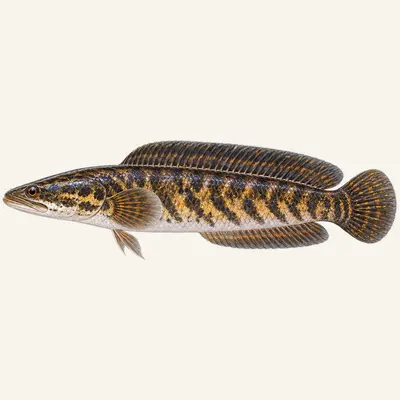
The adult wears false eyes. Three or four round spots, yellow to orange and black at the centre, sit in a line along the flank, and two more complete the arrangement: one on the gill cover, one at the base of the tail. The ground colour is an iridescent metallic green, and the bases of the anal and caudal fins are lit with orange patches.
The layout deserves a pause. One ocellus forward, one aft — the fish carries a mark at each end of its body, a design found in a good many species exposed to predators that aim for the head.
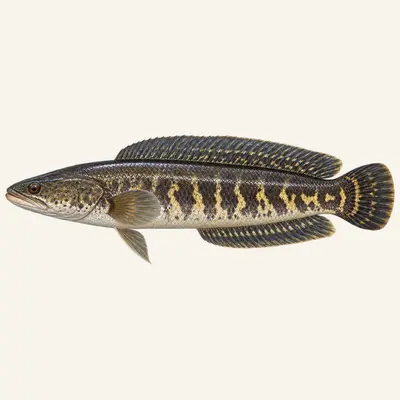
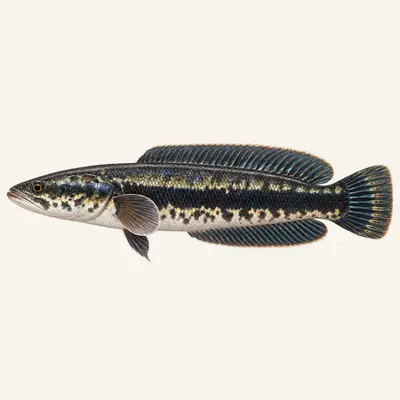
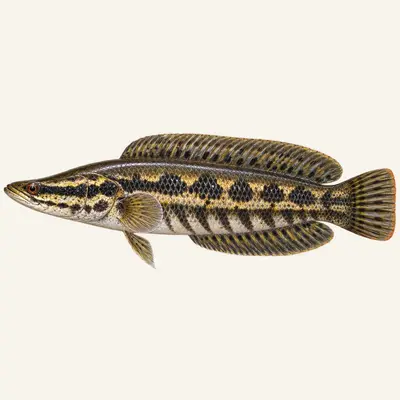
A young one looks nothing like that. It is crossed by four to six interrupted longitudinal black lines forming a reticulated net, with vague dark fields on the flank. Those fields are what will contract into ocelli with age: the pattern is not replaced, it concentrates.
The water it needs
It lives in black water and in clear water. That specification looks unremarkable and in fact separates the species from every one of its relatives: where the group is associated with mud, murky ponds and irrigation ditches, this one occupies water that is transparent, or stained with tannin but still legible.
Black water is not dirty water. It is acid, poor in nutrients, coloured tea-brown by the humic acids released from the peat-swamp forest it drains, and its transparency stays good in spite of the tint. The fish can see in it and can be seen in it, which is true of no other snakehead.
It looks otherwise for standing water and densely vegetated ground, which is the common trait of the genus.
Areas
- Swamp edges
- Rice paddies and irrigation canals
- Floating vegetation zones
- Shaded river banks
Techniques
- Surface lure fishing
- Spinnerbait cast and retrieve
- Live bait fishing
- Dead bait fishing
Baits
- Small live fish
- Frogs
- Soft plastic lures
- Surface lures
- Bloodworms
How to catch it
Transparency governs the approach. An ambush predator posted in water where the bottom is visible picks up a silhouette on the bank and a shadow cast across the surface long before it sees a lure, and most of the work consists of staying low, staying back, and not treading the margin.
It governs the choice of method too. Legible water permits fishing on sight, so the fish is located before the cast and the presentation is put in front of it rather than worked blind over cover. Surface lures keep their value, but the trigger is placement more than noise.
Water stained with tannin finally changes the light available. Under a canopy, in tea-coloured water, contrast carries better than colour, and a dark silhouette cut out against the sky reads from further off than a bright lure does.
Regulated — Often governed by quotas, size limits, seasons, or reporting rules.
Conservation · Near Threatened (IUCN) — This species is in decline. Release your catch quickly and handle it with care — wet hands, as little time out of the water as possible.
Conservation
What presses here is not fishing but the disappearance of the water itself. Black water has a single origin: the peat-swamp forests that feed it. Drained, a peatland stops producing the acid water this species depends on, and the alteration is irreversible on a human timescale, since peat forms over thousands of years.
The most recent assessment does not rest on a decline in numbers already measured but on the expected reduction of that habitat. The fish is still common where the water suits it. What is retreating is the area of water that suits it.
A direct and unusual harvest pressure sits on top of that. The ocellated livery makes it a sought-after aquarium fish, and the export trade is in wild-caught animals. Where the ornamental trade usually introduces a species somewhere else through release, this one takes it in the other direction: its original populations are what supply the market.
Regulations
Check the local regulations in force (legal size limits, closed seasons, bag limits).
For guidance only. Legal sizes, quotas and open seasons vary by location and season: always check the local regulations in force before fishing.
Other names
Ocellated snakehead in English, and the name records the false eyes — the only character that identifies the species at a glance.
The scientific name says the same thing in Greek. Pleuron is the flank and ophthalmos the eye, so pleurophthalma is the eye borne on the side. Whoever coined it kept the flank ocelli and passed over the ones on the gill cover and at the base of the tail, which are just as constant.
In the ornamental trade this is one of the few snakeheads bought for its markings rather than for its eventual size, and trade names attach to it loosely. A shipment record needs the binomial: the English name is shared with nothing, but the trade names are shared with several fish.
Sources: fishbase.se · api.gbif.org