Striped snakehead
Channa striata · Channidae
- Freshwater
- Predators
- Medium
- Regulated
- Size
61–100 cm
- Weight
1.9–3.0 kg
- Water temp.
23–27 °C
- Depth
1–10 m
Where to fish
- Canal
- Pond
- River
Habitat icons: Flaticon
Found in lowland rivers - More common in relatively deep (1-2 m), still water
Calendar
Recorded in 12 countries
Cambodia · China · Hong Kong SAR China · India · Indonesia · Macao SAR China · Malaysia · Singapore · Sri Lanka · Taiwan · Thailand · Vietnam
GBIF occurrence records — native and introduced populations combined.
Its range
The native range runs from Pakistan across to Thailand and into southern China.
Outside it, several countries record ecological damage following introduction, and the reason is contained in the biology rather than in the size of the fish. A predator that breathes air, survives the loss of its pond and spawns in a puddle finds very few water bodies unsuitable. In Hawaii, where it was introduced, the largest specimen taken is reported to have exceeded 150 cm — half again the maximum from the native range.
Introductions of this species have not generally been accidental. It is a food fish of the first rank across South and South-East Asia, and it has been moved deliberately for that reason.
Identifying it
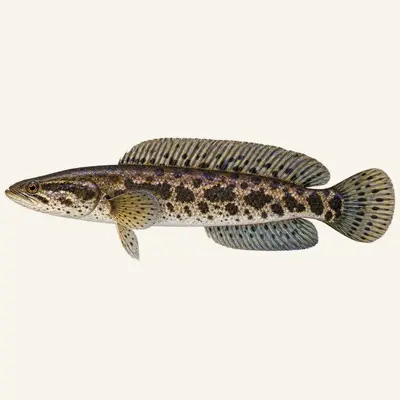
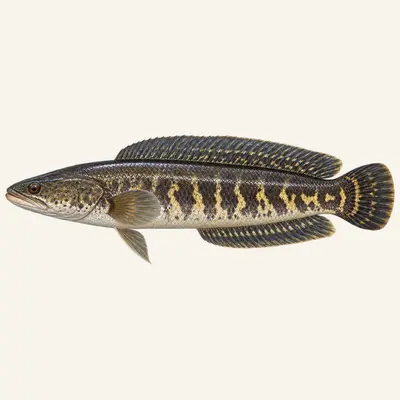
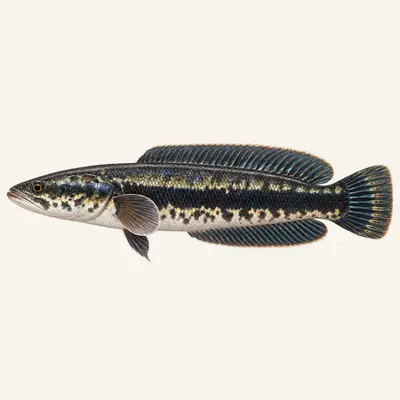
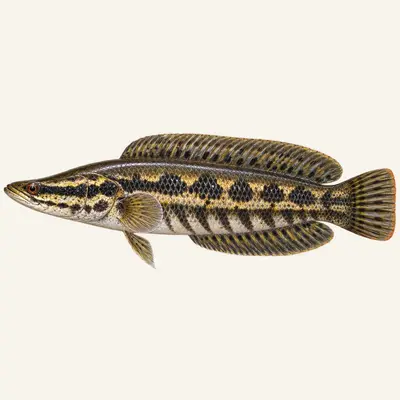
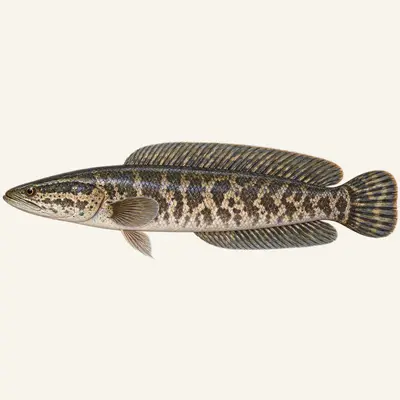
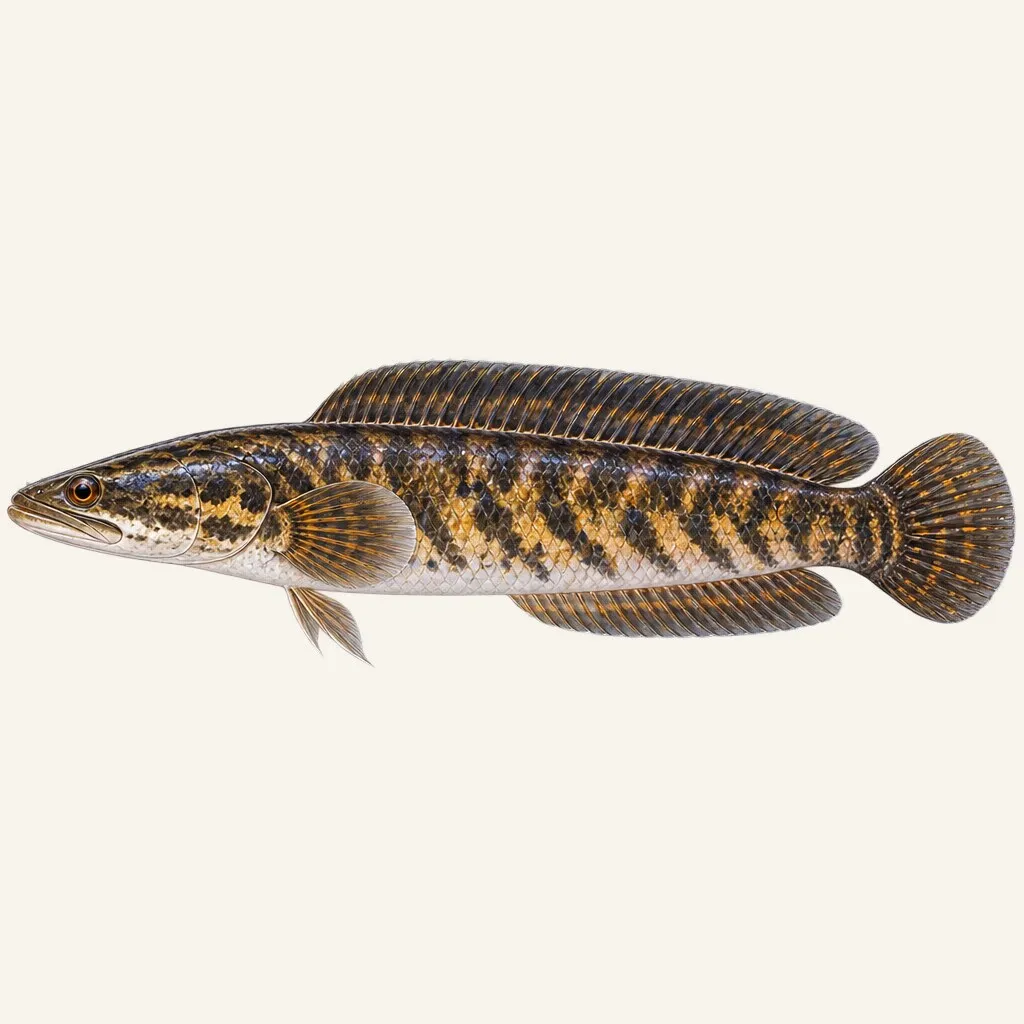
The head is where the family name comes from and where identification starts. It is broad, flattened on top, and plated with scales large enough to read individually — a reptilian look that no other freshwater fish of the region carries. The mouth gapes deeply and is toothed throughout.
The fin counts are the precise part. The dorsal runs on 38 to 43 soft rays, the anal on 23 to 27, and neither carries a single spine. Two long unbroken fins along most of the body length produce the undulating swimming action typical of the group.
The body is sub-cylindrical and elongate, ending in a rounded tail fin. Back and flanks are dark and mottled with black and ochre, the belly white. Scale size is worth noting again: it is unusually large for a fish of this shape, and it is half of why the animal reads as a snake at a glance.
Breeding
Spawning happens in the water nothing else can use. Ditches, farm ponds and flooded paddy fields — warm, shallow, oxygen-poor and often temporary — are the sites, and they are available precisely because competitors and predators cannot occupy them.
What follows is visible from the bank. The fry form a dense cloud at the surface, and the male stations himself immediately below it, out of sight. That combination, a shoal of tiny fish hanging in the top few centimetres with nothing apparently attending it, is the most reliable sign of the species anywhere in its range.
Maturity is reached at about 18 cm. For a fish that grows to a metre that is very early, and it means a population can rebuild from small individuals within a season of a flood.
The water it needs
Stagnant, muddy lowland water. Adults use ponds, streams and rivers, but the concentration is in swamps, sluggish canals, flooded fields and the still parts of lowland rivers, normally in one to two metres of water. The pH range recorded is 7.0 to 8.0.
Two capacities explain that distribution. The first is obligate air breathing: the fish must come up and take atmospheric air, which frees it entirely from dissolved oxygen and makes a foul pond as usable as a clean one.
The second is more drastic. Through the dry season the animal buries itself in the bottom mud of lakes, canals and swamps and lives on stored fat, and it can hold that state for as long as its skin and its breathing apparatus stay moist. A water body that disappears does not kill this fish. It suspends it.
There is also a seasonal sideways movement. On the Mekong and elsewhere, fish leave the permanent channels for the inundated floodplain as the flood rises and return to permanent water when the dry season begins. Rice-field culture of the species is old, and it follows directly from those two capacities.
Areas
- Rice paddies and irrigation canals
- Vegetated ponds and pools
- Ditches and backwaters
- Densely vegetated river banks
Techniques
- Surface lure fishing (frog, popper)
- Cast and retrieve with soft lures
- Surface live bait fishing
- Dead bait fishing
Baits
- Small live fish
- Artificial frogs
- Live shrimps
- Soft lures
- Surface insects
What it eats
An ambush carnivore working near the bottom, taking fish, frogs, snakes, insects, earthworms, tadpoles and crustaceans.
The wide gape and the fully toothed jaws are the equipment of an animal that seizes in one movement rather than one that runs prey down. Nothing in the diet list requires speed; all of it requires a fish to be within reach of a single lunge.
How to catch it
Look where a fish should not be. Stagnant ponds, roadside ditches, muddy canals and flooded fields hold this species precisely because no other predator of comparable size tolerates the water, and that inversion of the usual reasoning is the first habit to acquire.
Then watch the surface. An obligate air breather has to come up on a schedule, and in water with no visibility the soft rolls and bubble trails it leaves are the only positional information available. Fry clouds give away guarding adults, and those adults attack anything that approaches.
Ambush hunting sets the presentation: frogs and other surface or near-surface lures worked over the top of weed, with the strike coming in very little water and with considerable violence.
The dry season closes the fishery. Fish buried in mud are unreachable by any method, and the species becomes available again only when the water returns.
One point concerns the table rather than the catch. Through winter and the dry season the flesh around the body cavity is heavily infested by the larval trematode Isoparorchis hypselobargi; the intestine and the pyloric caeca carry parasites of their own. Thorough cooking is what the local preparations have always assumed.
Regulated — Often governed by quotas, size limits, seasons, or reporting rules.
Conservation
Within its native range the species is abundant and supports one of the largest subsistence and commercial freshwater fisheries in Asia. It is processed into the fish pastes of the Mekong countries, sold with the dark skin separated for soup, and farmed in rice fields, and the pressure of all that has not visibly dented it — the traits that let it survive drought also let it survive fishing.
The question is elsewhere, and it is about removal rather than protection. Once established outside its range, this fish is close to impossible to get rid of: draining a water body, the standard method, is the one thing this species is specifically built to survive. It waits in the mud and repopulates when the water comes back.
Regulations
Check the local regulations in force (legal size limits, closed seasons, bag limits).
For guidance only. Legal sizes, quotas and open seasons vary by location and season: always check the local regulations in force before fishing.
Other names
Striped snakehead and snakehead murrel are both current in English, the second carried over from Indian usage where murrel names the group as a whole. Local names include gabus in Indonesian and haruan in Malay, and the fish reaches the market in Cambodia and Vietnam mainly as fermented paste, under names that describe the product rather than the animal.
Snakehead as an English word is a family label rather than a species one: it covers several dozen fish across two continents, and it is applied loosely enough in the aquarium and food trades that a name on a label is rarely sufficient to identify what is in the tank.
Sources: fishbase.se · api.gbif.org