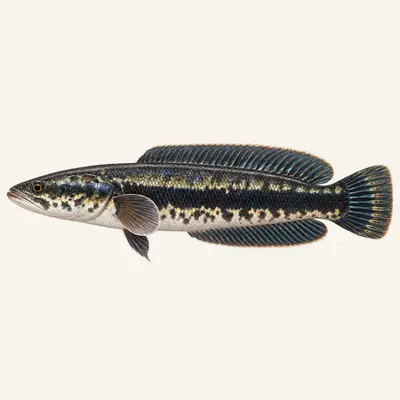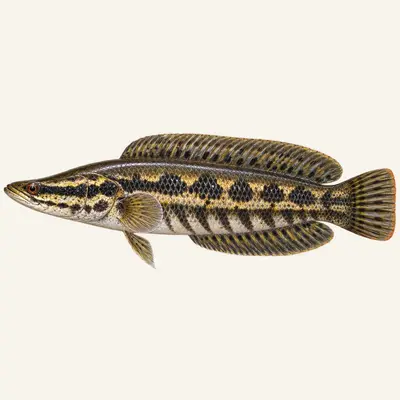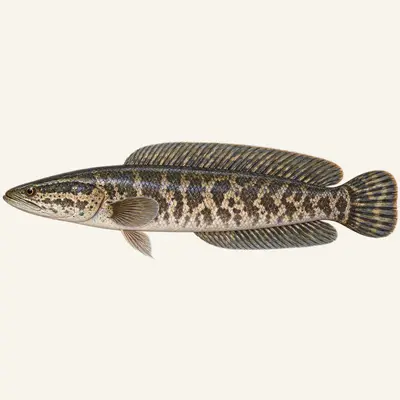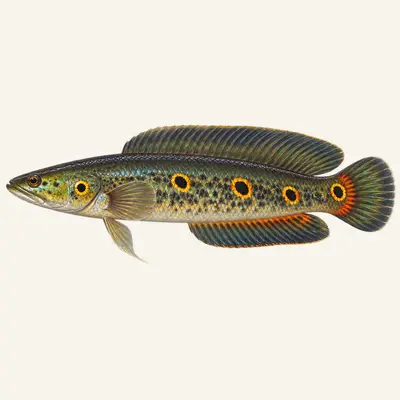
Bullseye snakehead
Channa marulius · Channidae
- Freshwater
- Predators
- Medium
- Regulated
- Size
46–183 cm
- Weight
0.5–30 kg
- Water temp.
24–28 °C
Where to fish
- Lake
- River
Habitat icons: Flaticon
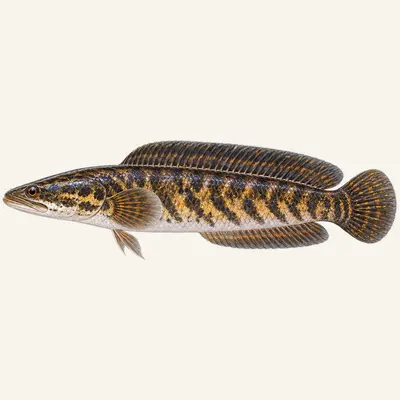
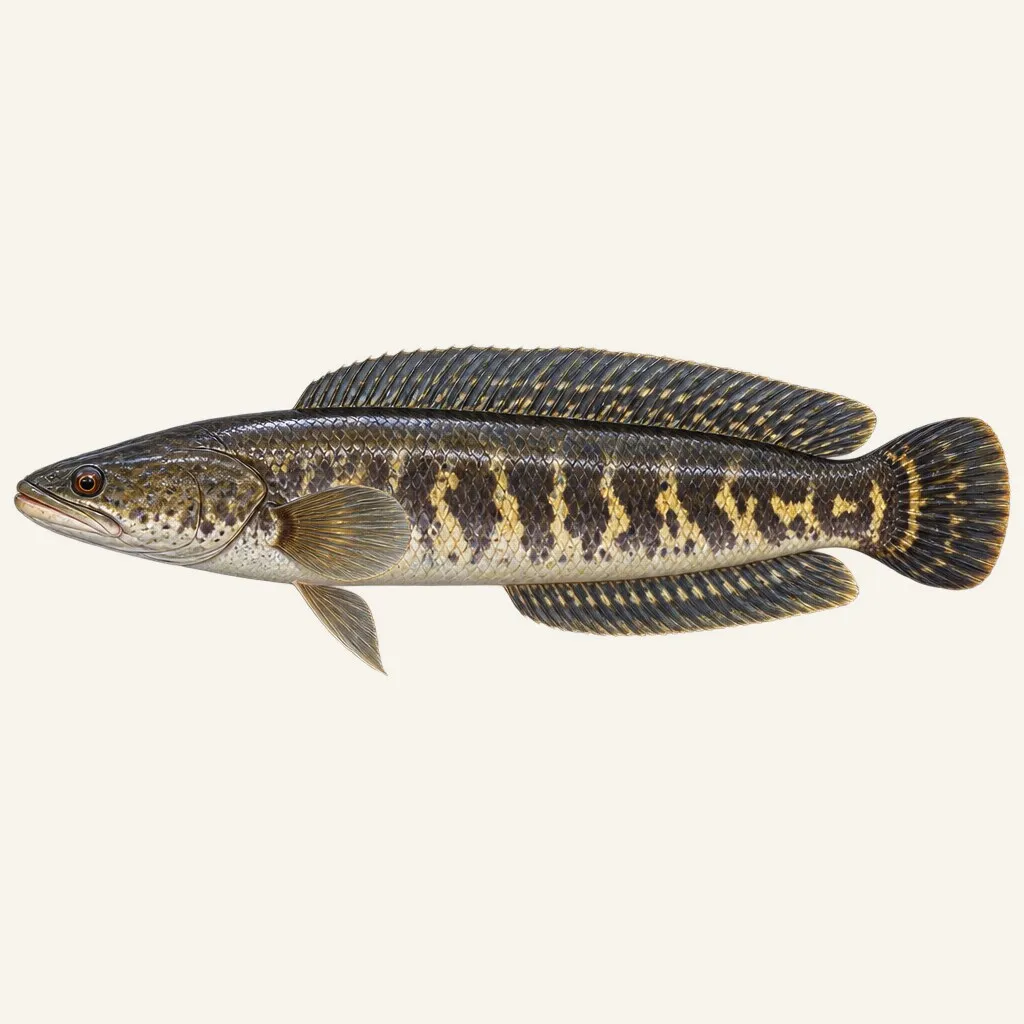
The giant snakehead is one of the largest Channidae, capable of exceeding one metre in length, recognisable by its flattened head, brownish scales with copper highlights, and very elongated dorsal fin. An ambush predator of tropical freshwaters in South and Southeast Asia, it has also established itself in parts of North America following introduction.
Calendar
Recorded in 3 countries
India · Nepal · United States
GBIF occurrence records — native and introduced populations combined.
Its range
The range extends from India through to China and south into Thailand and Cambodia, taking in Pakistan at the western end. That is one of the broadest distributions in the genus, and it spans climates with very little in common.
Breadth of that kind usually means an absence of requirements rather than a presence of adaptations. A fish that takes atmospheric air, eats anything that moves and defends its young does not depend on any particular condition being met, and warm slow water of some description exists nearly everywhere in southern Asia. The temperature band recorded is 24 to 28 degrees.
Identifying it
Size alone narrows it down a long way. This is the heaviest fish in its genus — ahead of the giant snakehead of the Mekong at 20 kg and well ahead of the metre-long northern snakehead. A very large Asian snakehead is more likely to be this one than anything else.
Common length is 46 cm, and the distance between that figure and the maximum is worth registering. Most fish encountered are moderate; the exceptional individuals are exceptional by a factor of four in length and far more in mass.
Breeding
The nest floats. The adults assemble a raft of weed and leaves at the surface and lay orange-yellow eggs into it, which is construction rather than deposition and is uncommon among freshwater fishes.
Hatching follows in 36 to 48 hours, and the fry stay in the raft for about ten days. After they leave it the parents continue to guard them for roughly a month.
A month of parental care is a very long investment, and two things follow from it. Few eggs are needed to maintain the population, because survival through the vulnerable weeks is high. And adults in the guarding period are dangerous to approach: a fish four weeks into defending a brood attacks whatever comes near, without reference to hunger.
The water it needs
Sluggish and standing water: canals, lakes and swamps, with a marked preference for stretches carrying submerged aquatic vegetation.
In rivers the pattern is different and much more useful. The species is generally confined to the deep pools there, occasionally turning up in lakes, and it moves into inundated forest when the rains flood it. So a river holding this fish holds it in a small number of identifiable places rather than throughout.
Males are territorial, which distributes the large individuals across fixed stations instead of grouping them. Air breathing is obligatory here as throughout the genus, and it is what opens up swamp water that no other predator of this size can work in.
Areas
- Dense weed beds along large lake shores
- Large rivers with muddy bottoms
- Reservoirs with submerged vegetation
- Backwaters and swampy areas
Techniques
- Large soft lure fishing (swimbait)
- Live bait fishing with large fish
- Cast and retrieve with crankbaits
- Surface fishing (large popper)
Baits
- Large live fish
- Live frogs and lizards
- Large swimbaits
- Giant shrimps
- Dead fish
What it eats
The broadest diet in the genus, and it is worth listing in full: fish, frogs, snakes, insects, earthworms and tadpoles, with recorded instances of waterbirds, further snakes and rodents.
Birds and rodents change the reading. A fish taking prey of that kind is not confined to its own water column — it is hunting the surface and whatever is sitting on or crossing it, and that single fact does more to direct the choice of lure than any other item on the list.
How to catch it
The station comes first. A territorial male in a deep river pool or along a weed edge stays there, so three known holding places are worth more than a day spent covering a canal.
The diet points upward. A predator that takes frogs, snakes and small mammals responds to imitations that crawl, swim or struggle across the surface and over vegetation, which is the opposite of a deep and discreet presentation.
The month-long guarding period produces adults that strike without feeding motivation, and it is also the period in which taking one leaves an entire brood undefended. That is a real cost and it is worth weighing before casting at an obviously guarded shoal.
One warning appears explicitly in the literature: the fish may bite once caught. Given the bulk the largest individuals carry and a mouth built for seizing snakes, that is not a formality, and unhooking is done with a tool rather than a hand.
Regulated — Often governed by quotas, size limits, seasons, or reporting rules.
Regulations
Check the local regulations in force (legal size limits, closed seasons, bag limits).
For guidance only. Legal sizes, quotas and open seasons vary by location and season: always check the local regulations in force before fishing.
Other names
Great snakehead and bullseye snakehead are both used in English, the second referring to the ringed dark spot at the base of the tail fin. In Indian English the fish is a murrel, a word applied across the whole group rather than to this species alone.
The confusion that costs English speakers the most is with the giant snakehead of the Mekong, Channa micropeltes. Great and giant are close enough in ordinary English to be read as the same word, and the two species overlap in Thailand and Cambodia, so the confusion is not resolved by geography. A report carrying only one of the two adjectives cannot safely be assigned to either fish.
Sources: fishbase.se · api.gbif.org