Javanese snakehead
Channa lucius · Channidae
- Freshwater
- Predators
- Medium
- Size
53 cm
- Water temp.
22–26 °C
Where to fish
- Pond
- River
Habitat icons: Flaticon
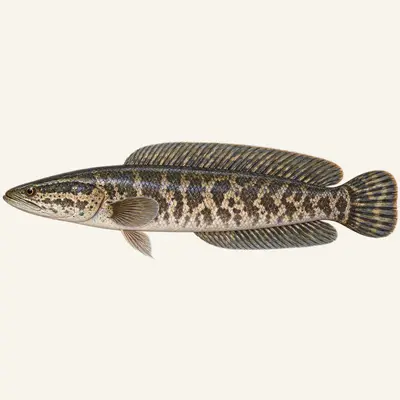
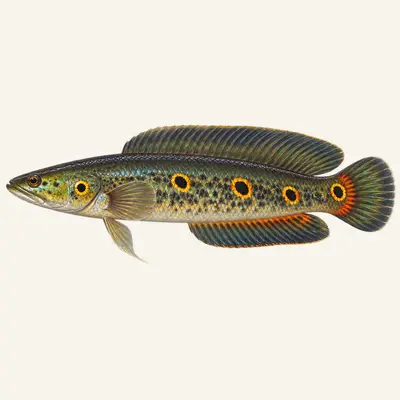
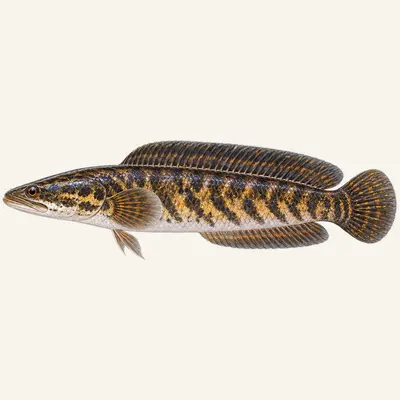
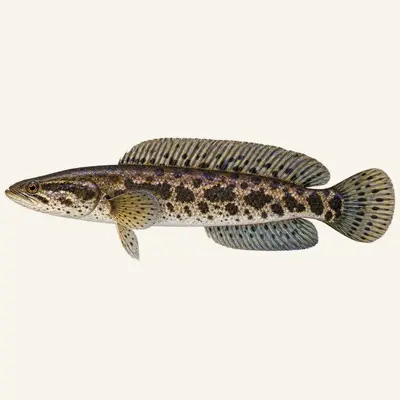
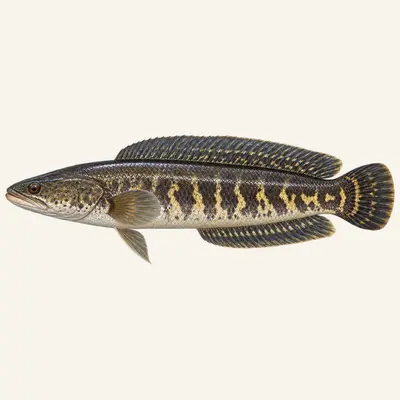
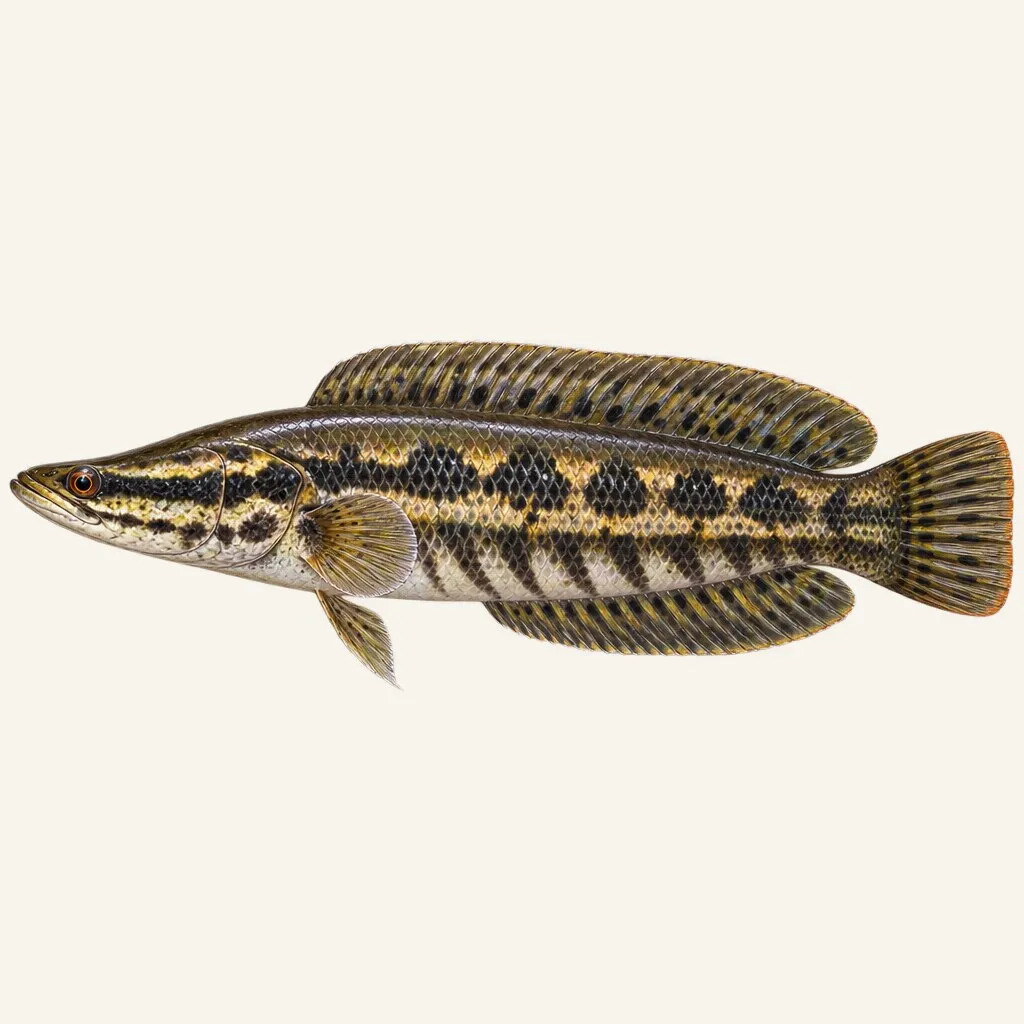
The forest snakehead is a medium-sized snakehead of tropical freshwaters in Southeast Asia, characterised by an elongated body with greenish or olivaceous flanks and a distinctly coloured anal fin. An opportunistic predator, it feeds mainly on fish, prawns, and crabs in forest streams and swampy areas.
Calendar
Recorded in 9 countries
Brunei · Cambodia · Indonesia · Laos · Malaysia · Myanmar (Burma) · Singapore · Thailand · Vietnam
GBIF occurrence records — native and introduced populations combined.
Identifying it
The pattern changes in kind between the young fish and the adult, and knowing both states prevents an error of determination. A juvenile carries two unbroken black ribbons running from the tip of the snout to the middle of the caudal fin, one along the upper part of the body and one along the lower. Growth breaks them up: they resolve into five to nine aligned black blotches, and the adult has no lines left at all.
One character does not move, and it is the decisive one. The throat bears a patch of scales on the gular region, where its congeners have it bare. A finger finds it before the eye does.
The belly is crossed by oblique bars. There are five scale rows between the lateral line and the base of the front dorsal rays, 37 to 41 soft rays in the dorsal, 25 to 30 in the anal, and 43 to 48 vertebrae.
The water it needs
This is the fish of forest streams, and the adjective earns its place. It occupies slow watercourses, quiet rivers, lakes, ponds and swamps, but it is under cover that it is common — shaded water that the canopy cools and the leaf litter colours.
Two structural elements recur wherever it turns up: dense aquatic vegetation and submerged wood. A tree fallen across a stream, a tangle of drowned roots, a bed carpeted with dead leaves are worth more to this animal than any depth of water.
Its thermal window is narrow, 22 to 26 degrees, and it explains why the species does not leave the wet tropical belt. Where its relatives tolerate considerable amplitude, this one is shut inside four degrees.
It also moves about within the freshwater network without ever leaving it: floods and drawdowns redistribute individuals between the main channel, the drowned side arms and the pools in the forest.
Areas
- Tropical forest peat swamps
- Shaded acidic streams
- Forest ponds with leaf litter
- Backwaters and flooded forest channels
Techniques
- Ultralight fishing with small soft lures
- Live shrimp fishing
- Cast and retrieve along vegetation edges
- Live bait fishing with small fish
Baits
- Live shrimps
- Small live fish
- Freshwater crabs
- Small soft lures
- Earthworms
What it eats
Decapods weigh heavily in its feeding, and that separates it clearly from its piscivorous relatives. It takes fish, but also prawns and crabs in comparable quantity, and shrimps a little less often.
A predator eating that proportion of crustaceans searches the bed and the wood rather than chasing through open water. Leaf litter and heaps of sunken branches are reservoirs of freshwater crabs and prawns, and the fish is there because they are.
How to catch it
The bait follows from the diet, and that is most of what there is to know. A live prawn or a small freshwater crab presented tight against the wood beats a fish imitation on a species that finds half its food among the crustaceans of the bottom.
The scale follows from the size. This is a modest snakehead by the standards of the genus, and the tackle comes down accordingly: small soft baits, fine hooks, light line. Rigs cut for the giant species have no business here.
The spot follows from the cover. A weed edge, a drowned stump, a heap of branches under a shaded bank: prospecting means moving from one obstruction to the next rather than covering open water. A forest stream three metres wide can hold several fish spread over as many shelters.
The fish reaches market fresh and frequently alive, which tells an angler something practical — one kept in a bucket or a well does not need the care a percid or a cyprinid of the same size would.
Regulations
Check the local regulations in force (legal size limits, closed seasons, bag limits).
For guidance only. Legal sizes, quotas and open seasons vary by location and season: always check the local regulations in force before fishing.
Other names
English has two names for this fish and they do not agree with each other. Forest snakehead describes its habitat exactly, and it is the name the field literature uses. Javanese snakehead, also current, names a single island; the map above shows how much of the range that leaves out, and a source using one of the two names may well have compiled its distribution under the other.
Across South-East Asia the fish falls under local names that cover the whole group without distinguishing species, and it is sold under those names rather than under any of its own.
The Latin epithet holds a surprise. Lucius is the word Rome used for the pike, and it now serves as the specific name of the pike itself. The comparison makes sense on sight — long body, pointed head, ambush from under the vegetation — but here it labels a fish of tropical streams and rice fields with no relation whatever to the European esocid.
Sources: fishbase.se · api.gbif.org