Blotched snakehead
Channa maculata · Channidae
- Freshwater
- Predators
- Medium
- Regulated
- Size
11–20 cm
- Weight
0.0 kg
Where to fish
- Canal
- Pond
- River
Habitat icons: Flaticon
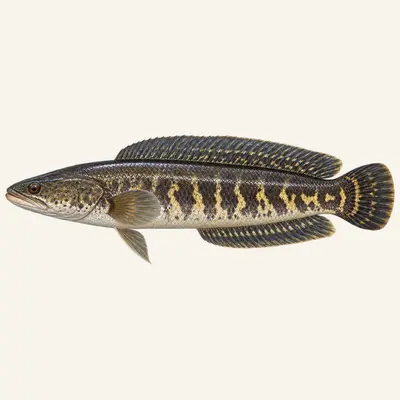
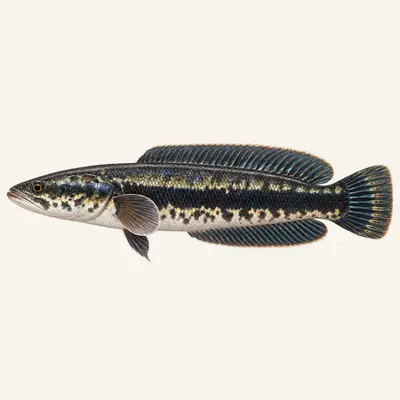
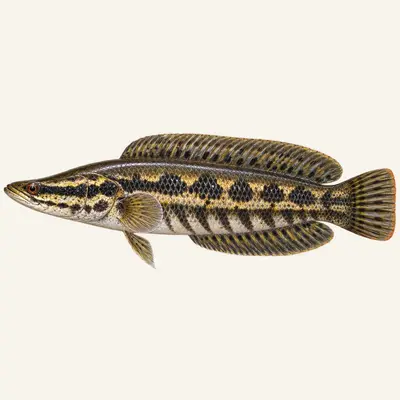
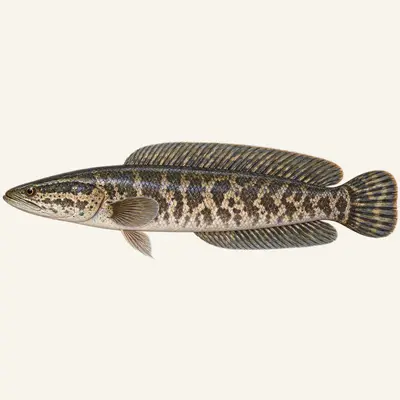
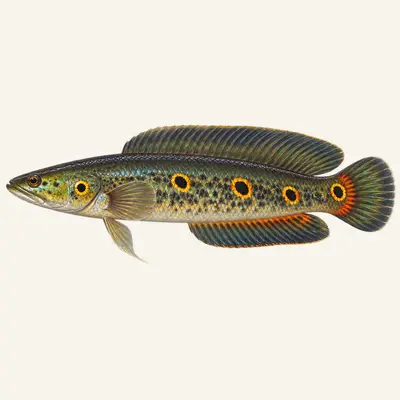
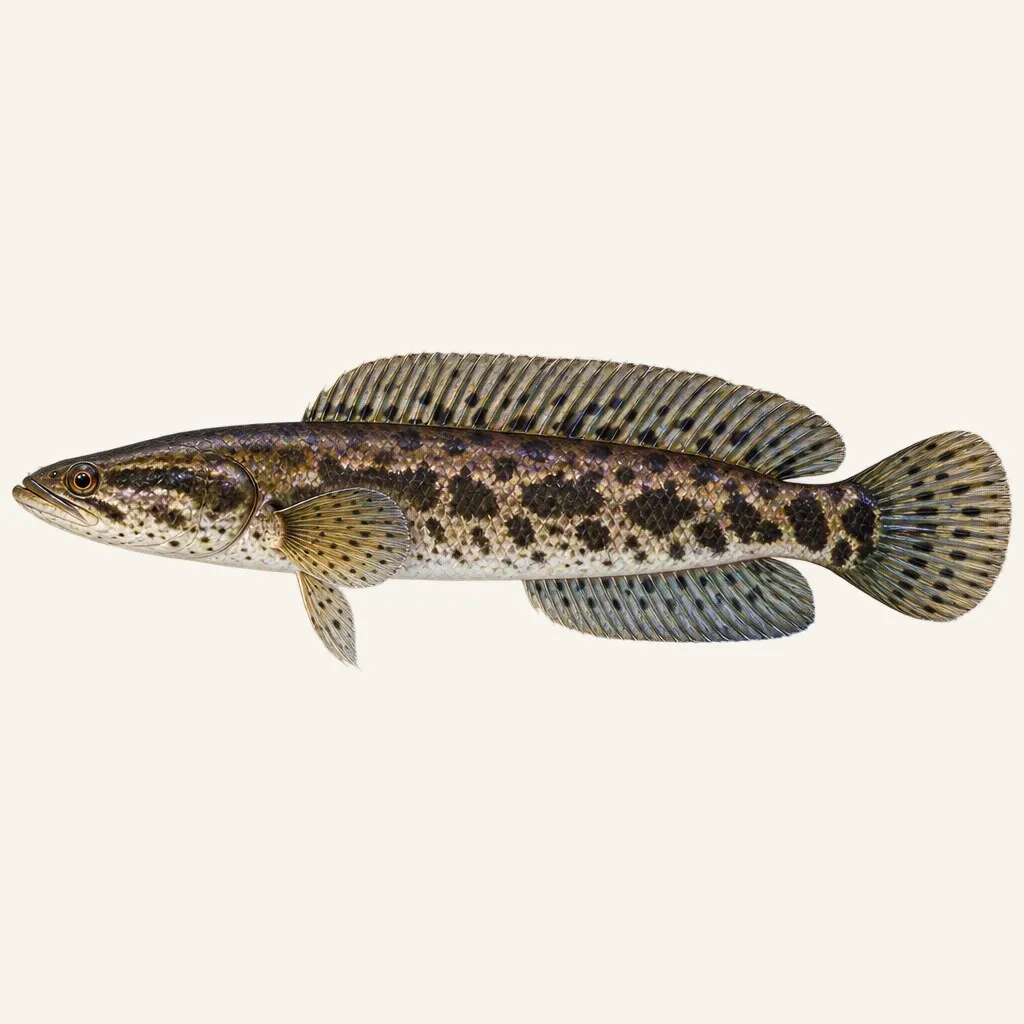
The blotched snakehead is a freshwater predator from the Channidae family, with an elongated cylindrical body adorned with irregular dark brown blotches on an olive background. Its broad, flattened head and wide gape are characteristic features among Asian snakeheads.
Calendar
Recorded in 6 countries
China · Hong Kong SAR China · Japan · Madagascar · Taiwan · Vietnam
GBIF occurrence records — native and introduced populations combined.
Its range
Japan, southern China, Viet Nam, Taiwan and the Philippines.
Part of that distribution has passed through human hands. The fish has long been raised in flooded plots, and the sources record it as a rice-field animal as readily as a wild one. An island record therefore does not say by itself whether the population is old or descended from stock, and for many points on the map that distinction can no longer be recovered. Anyone reasoning from the range of this species needs to know which of the two a given locality represents.
Breeding
The record stops at pairing. Male and female pair off distinctly through the breeding season, then move into shallow fresh water among plants, and the species is oviparous.
In a genus described mostly through its constructions and its guarding adults, that is where the documentation for this fish ends. No nest, no clutch size, no duration of care has been recorded for it, and the gap is worth stating rather than filling with what its relatives do.
The choice of site is at least consistent with the rest of its biology: a few tens of centimetres of sun-warmed water, dense plant cover, no depth whatever.
The water it needs
Adults hold over silty, weedy bottoms in slow rivers, in ponds and in lakes. Soft mud and plant beds go together here, and this is not a fish of moving water.
Those are habitats that agriculture has multiplied rather than destroyed. Irrigation channels, field-edge ditches, farm ponds and flooded plots reproduce exactly the conditions the species needs, which is close to the reverse of the relationship most freshwater fish have with cultivated land.
Areas
- Rice paddies and agricultural canals
- Densely vegetated ponds and pools
- Ditches and small streams
- Shaded banks with silty bottoms
Techniques
- Ultralight fishing with micro-lures
- Live bait fishing with small fish
- Cast and retrieve along vegetation edges
- Surface insect fishing
Baits
- Small live fish
- Live shrimps
- Micro soft lures
- Insects
- Earthworms
What it eats
The prey list is out of all proportion to the fish. It takes crustaceans, large insects, frogs and fishes — the diet of a general predator, in an animal whose recorded common length is 11 cm.
An adult frog and a fish of that length are not in the same order of magnitude. The wide gape and toothed jaws that run through the whole group are what make the difference, allowing prey that approaches a substantial fraction of the predator's own length.
Of the four items, the large insects are the operational half of the list, because they are the part that can be imitated.
How to catch it
Everything is in miniature. This is the smallest snakehead that anybody fishes for with a rod, and the first decision is to drop the tackle a size or two: micro soft baits, fine hooks, a short rod. A rig meant for the metre-long members of the genus passes over its head without being noticed.
The diet opens a route its relatives close off. A surface insect — a grasshopper, a large beetle — works on a fish that eats them regularly, so it can be fished on sight, on the fly or under a float, in the top 20 cm along the edge of a weed bed.
The ground is farmland. Ditches, channels, farm ponds and flooded plots are better than large open water, and the fish holds against the vegetation, in water that is usually coloured and always shallow.
The species moves widely outside its native range, and several territories consequently regulate the transport and the keeping of captured fish. Those provisions are set locally, and the fisheries administration for the area is the only source for them.
Regulated — Often governed by quotas, size limits, seasons, or reporting rules.
Regulations
Check the local regulations in force (legal size limits, closed seasons, bag limits).
For guidance only. Legal sizes, quotas and open seasons vary by location and season: always check the local regulations in force before fishing.
Other names
Blotched snakehead in English, after the dark brown marks that stand out on an olive flank, and maculata says the same thing in Latin.
Regional names across East Asia mostly fail to separate it from the other snakeheads that share its water and its uses. That imprecision has a practical consequence: a local mention of a snakehead in Japan or in southern China does not identify a species, and neither does a market name, so a published record without a binomial cannot be attributed to this fish.
Sources: fishbase.se · api.gbif.org