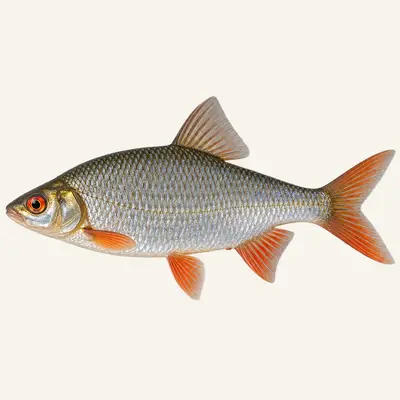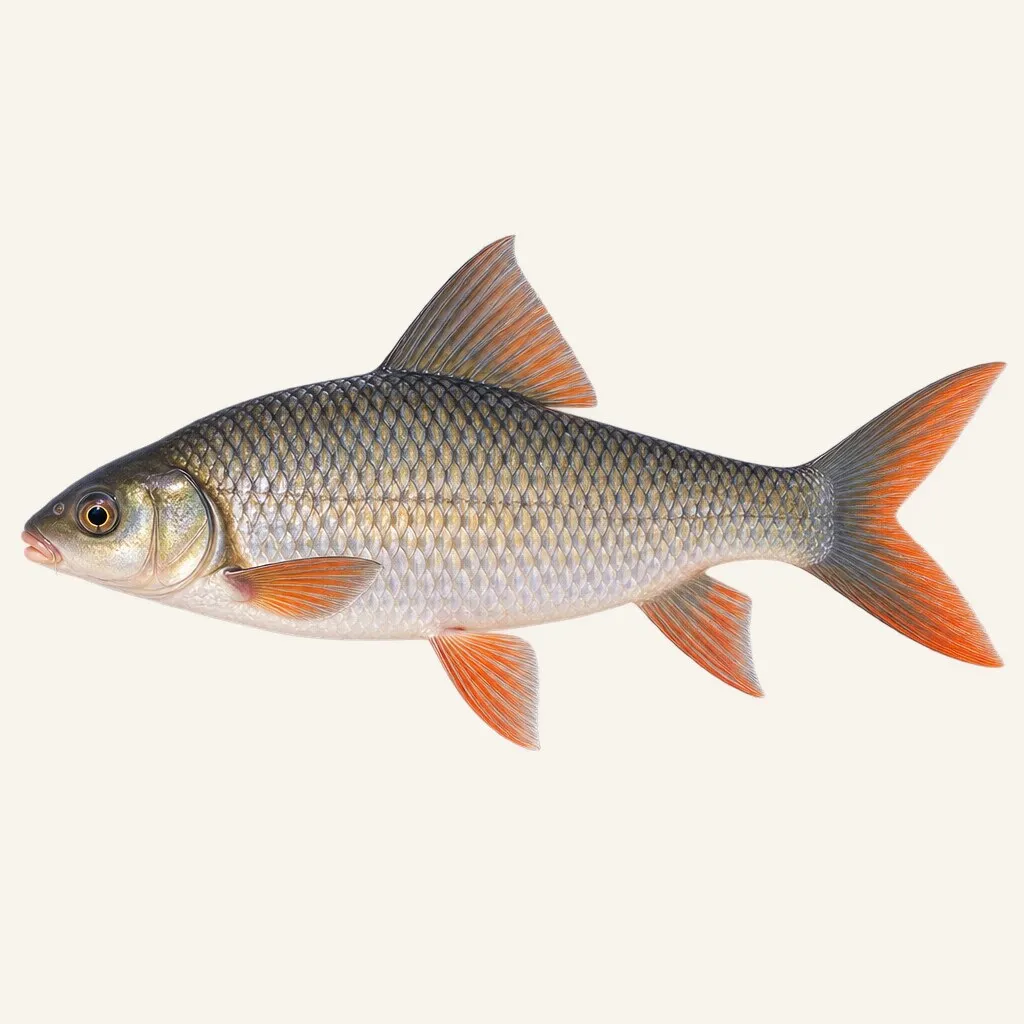
Orangefin labeo
Labeo calbasu · Cyprinidae
- Freshwater
- Carp & coarse
- Medium
- Size
90 cm
- Depth
10–10 m
Where to fish
- Lake
- River
Habitat icons: Flaticon
Orangefin labeo - coarse fish, Asia (India)
Calendar
Recorded in 2 countries
Bangladesh · India
GBIF occurrence records — native and introduced populations combined.
Its range
The native range follows the foot of the Himalaya and the plains it feeds — Pakistan, India, Bangladesh, with Nepal above them, Myanmar and Thailand to the east, and south-western China at the far end.
That Chinese terminus creates an ambiguity worth carrying. China also appears as a country of introduction, so the species is native in the south-western basins and non-native elsewhere in the same country. A record that says only "present in China" does not distinguish the two, and the imprecision passes straight into any statistic built on national totals.
Identifying it
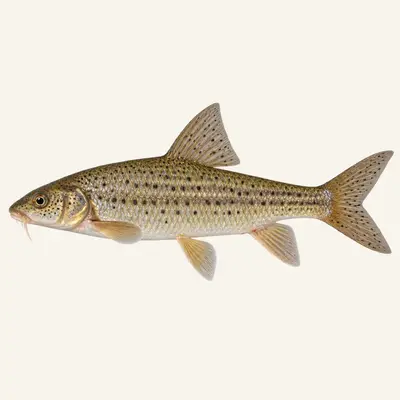
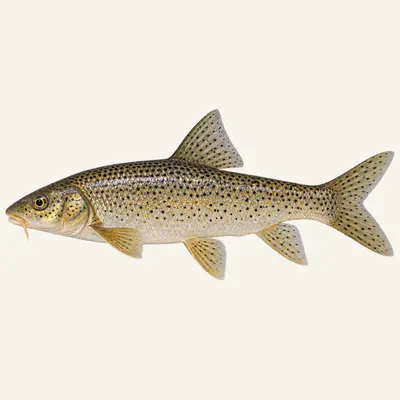
Sixteen soft rays in the dorsal, eight in the anal. Both counts are given as flat numbers with no range around them, which is unusual and useful in a genus where several species look very alike and colour settles nothing.
The mouth is small, set under the snout, and ringed with fleshy lips. It is a mouth for applying to a surface rather than for seizing anything: there is no cutting edge and no crushing structure at the front of this animal, and none is needed for what it eats.
No scale count is published for the species. That leaves the two fin formulae and the shape of the mouth as the only firm characters, with the body described simply as fusiform.
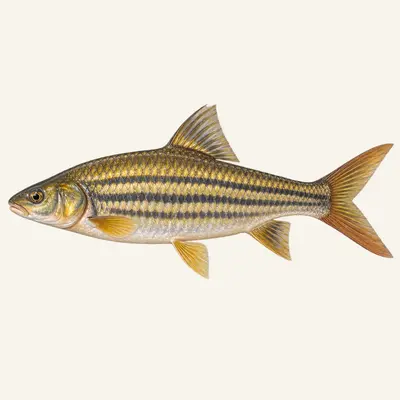
Which is where the common names become evidence. Five of the six this catalogue carries name orange fins — the English, Spanish, German, Italian and Portuguese all do, each in its own words. Five independent naming traditions settling on the same colour is a strong signal about a live fish. It is not in the published diagnosis, which records no colour at all, so it belongs in the field as a first impression and not in a determination.
Breeding
Everything published about reproduction in this species rests on two fish.
The fecundity figures, 193,000 to 238,000 eggs, were counted in two females measuring 38.8 and 40.5 centimetres. That is a pair of measurements presented as a range; it is not a distribution, and nothing can be inferred from it about variation in the population.
Maturity is recorded at 32.8 centimetres. Both counted females were therefore only a little above that threshold, and no figure exists for what a large fish carries.
No spawning month, no spawning ground and no trigger appear anywhere in the record.
The water it needs
Two settings, one level: the slow-moving stretches of rivers, and ponds. In both the fish is demersal, meaning it lives against the bottom rather than in the water above it.
The only depth on record is ten metres, entered as both the upper and the lower bound of the range. That is a single observation formatted as an interval, not a preference, and it should not be read as one.
The species is potamodromous and tolerant of brackish water, which lets it hold the lower parts of deltas where river water still dominates. Its latitude band is narrow — 25 to 16 degrees north — so this is a fish of hot plains with no temperate population anywhere.
Areas
- Rocky river bottoms
- Reservoirs with submerged vegetation
- Moderate current zones
- Dam surroundings
Techniques
- Bottom feeder fishing
- Pole fishing
- Bolognese fishing
- Match fishing
Baits
- Green flour dough balls
- Dried algae
- Groundnut cake
- Fermented bran
- Corn paste
What it eats
Plants, filamentous algae and diatoms — a menu that is vegetable from end to end and runs down to the microscopic.
Those three items call for two different actions. A filament is gripped and pulled. A diatom film is not picked up at all; it is taken off a surface by contact. One mouth performs both, and it can do so without a single hard part, which is what the small inferior opening and the thick lips are for.
The consequence for anyone fishing is that nothing mobile is of any interest to this fish. Its whole feeding repertoire consists of pressing a soft mouth against something and taking what is growing on it.
How to catch it
The uses entry lists a commercial fishery and commercial aquaculture, and it does not list this species as a sport fish — a distinction its relative the rohu does receive on the same kind of page. Calbasu is a production animal, met more often on a slab than in an account of a day's fishing.
For anyone who does fish for it, the diet writes the tackle. Green flour dough balls, dried algae, groundnut cake, fermented bran and corn paste address a herbivore; hook size matters more than hook strength, because the mouth is small and carries nothing hard to set into.
The station is the bottom of a slow reach or a pond, and the rig has to reach it. A bait held above the bed is a bait this fish will not rise for — it does not leave the substrate to feed higher in the water.
Thirty-three centimetres is the practical line. A fish of that length is already a breeder, and there is no published basis for expecting more from a larger one, because nobody has counted one.
Conservation
Two things have changed for this species and neither of them has anything to do with angling pressure.
The first is transport. It has been introduced into China outside the south-western basins where it belongs — a movement inside the borders of one country, for aquaculture. That is precisely the kind of transfer national statistics cannot see: the country of record does not change, and the population does.
The second is the state of knowledge. A species whose entire published fecundity comes from two females, and for which no spawning season exists in the literature, cannot be managed by numbers. What is known about it has been learned in ponds, from an animal being farmed, rather than from any survey of the rivers it came out of.
Regulations
Check the local regulations in force (legal size limits, closed seasons, bag limits).
For guidance only. Legal sizes, quotas and open seasons vary by location and season: always check the local regulations in force before fishing.
Other names
Orangefin labeo is a reference-book name in English, coined for a catalogue rather than worn in a market. The fish is sold as calbasu, the Bengali word, which also appears transcribed as kalbasu and kalbaus, and that is the name the epithet took over unchanged.
French declines to translate at all and uses the binomial itself, which leaves the species named for its fins in five languages and named for nothing in the sixth.
The pattern is the ordinary one for a fish that reached Europe as an entry in a fisheries list rather than as an animal anyone met. The names that describe it were assembled from a photograph; the name that is actually used came with the fish.
Sources: fishbase.se · api.gbif.org