Paraná pacu
Piaractus mesopotamicus · Serrasalmidae
- Freshwater
- Carp & coarse
- Medium
- Size
45–80 cm
- Weight
2.2–20 kg
Where to fish
- Estuary
- River
Habitat icons: Flaticon
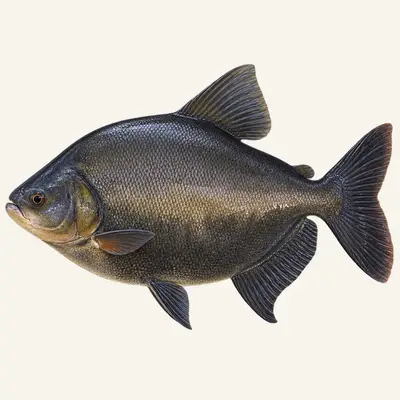
Large, deep-bodied South American characin with powerful crushing teeth suited to a largely fruit-based diet.
Calendar
Recorded in 1 country
GBIF occurrence records — native and introduced populations combined.
Its range
The coordinates published for this species draw a subtropical quadrant of the continent — 15 to 38 degrees south, 66 to 42 degrees west — and the whole of it lies below the equatorial belt.
That position changes the year. On the equator, water temperature barely moves and the flood alone makes the season. At these latitudes temperature moves as well, and there is a winter. An animal whose food falls out of trees is therefore working two calendars at once, the water's and the vegetation's, and what it needs is the overlap between them.
Movement is potamodromous. The entire cycle runs inside the river network, and no part of it approaches the sea.
Identifying it
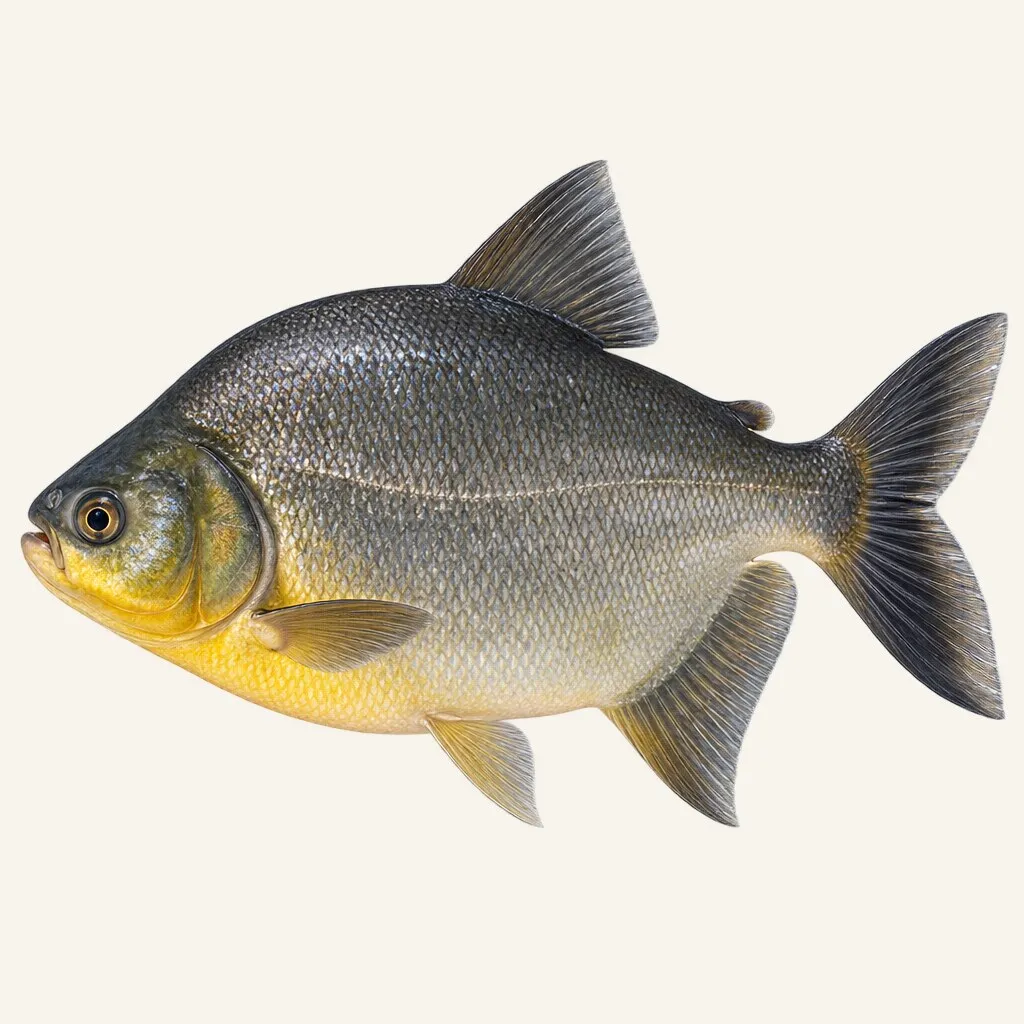
The only colour the diagnosis gives is on the chest, and it is yellow. Everything else is dark grey to silver over the back and flanks and white underneath, so a plain fish carries one bright plate at the front.
The body is short and deep, compressed from the sides: a disc rather than a spindle. That is a hull for thrust and tight turns rather than for running, and it suits an animal that works between drowned trunks and submerged branches instead of chasing anything down in open water.
Areas
- Paraná basin
- Paraguay River
- Pantanal
- Lagoons and backwaters
- Flooded forest zones
Techniques
- Bottom legering
- Float fishing
- Feeder fishing
- Stalking near wooded banks
Baits
- Fruits and seeds
- Corn
- Boilies
- Tropical fruit chunks
- Vegetable paste
What it eats
Adults go into the flooded forest to eat the nuts and seeds that fall from the trees.
That one sentence sets three conditions, and all three have to hold at the same time. There have to be trees at the water's edge, in a state to fruit. The water has to rise high enough to get underneath them. And the flood and the fall have to coincide.
Each condition fails on its own. A cleared bank produces nothing for this fish, even under two metres of water. A low flood leaves the same forest out of reach. So the animal does not depend on an aquatic habitat at all: it depends on a meeting between an aquatic habitat and a terrestrial one — and at these latitudes both halves of the meeting are seasonal, which makes the window narrower than the equivalent window on the equator.
A shell also has to be opened, which implies crushing machinery. That is worth remembering with a hook in your hand.
How to catch it
This fish eats what falls. A bait that arrives from above and settles is inside that register; a bait towed, worked or retrieved is outside it, however well made it is.
Two lines of the same rubric are worth holding together here. The species is classed as demersal, and its recorded feeding happens under trees, on what drops off them. So the animal lives near the bottom and eats at the top of the water — which is why a bait is dropped through the column rather than presented at either end of it.
The lie is therefore chosen vertically — under cover that is producing, in the weeks the water reaches the trees. Outside that window the same bank means nothing, and the best presentation in the world is being made to an empty piece of river.
The shape declares itself in the fight. A deep, flat-sided fish turns its flank into the pull, sits across it and uses its area like a sail. What the rod reports has little to do with the length of the animal on the end of it.
Hooks are chosen strong for a specific reason. The crushing dentition is not aimed at hands — the source classes the species as harmless to people — but it is aimed at hard shells, and hardware sized for a soft-mouthed fish does not come back from it.
Conservation · Near Threatened (IUCN) — This species is in decline. Release your catch quickly and handle it with care — wet hands, as little time out of the water as possible.
Conservation
The species is in retreat, and the documentation available makes the response harder rather than clearer.
The rubric that ought to describe its reproduction contains no description. In its place sits an internal editorial note, recording that reproduction is assumed to follow the standard characid pattern and that this should be replaced as soon as possible. Nothing specific to the species has been published there.
For an animal that is fished commercially, farmed and declining, a missing spawning account is a concrete obstacle rather than an academic one. A spawning site nobody has located cannot be protected, and a season nobody has dated cannot be closed. Management of this fish is currently working without the one description it most needs.
The other difficulty is that its conservation is not entirely a fisheries question. Its food grows on trees along the bank and reaches it on a flood. Whatever touches the riparian woodland, and whatever regulates the discharge, reaches this animal as surely as a net does — and nothing done on the water can make up for either.
Regulations
Subject to local regulations; quotas and spawning-season closures (piracema) apply in several South American states.
For guidance only. Legal sizes, quotas and open seasons vary by location and season: always check the local regulations in force before fishing.
Other names
Paraná pacu is the catalogue's name, and the river in it is doing necessary work. Pacu on its own covers a whole set of deep-bodied South American fishes and identifies none of them, so it always needs a place or a colour attached before it means anything.
Mesopotamicus means between the rivers. It refers to the Argentine Mesopotamia, the country lying between the Paraná and the Uruguay — a Near Eastern name transposed across an ocean, and one that describes this animal's position with unusual precision.
Sources: fishbase.se · api.gbif.org