Sacramento perch
Archoplites interruptus · Centrarchidae
- Freshwater
- Predators
- Medium
- Size
30–73 cm
- Weight
0.4–1.4 kg
- Lifespan
9 years
Where to fish
- Lake
- River
Habitat icons: Flaticon
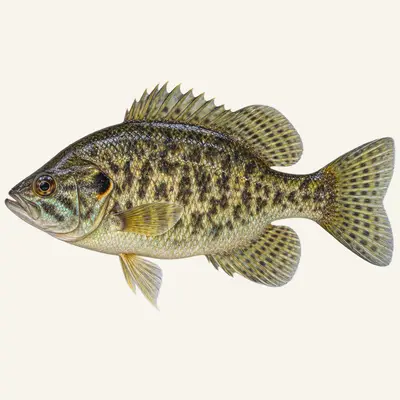
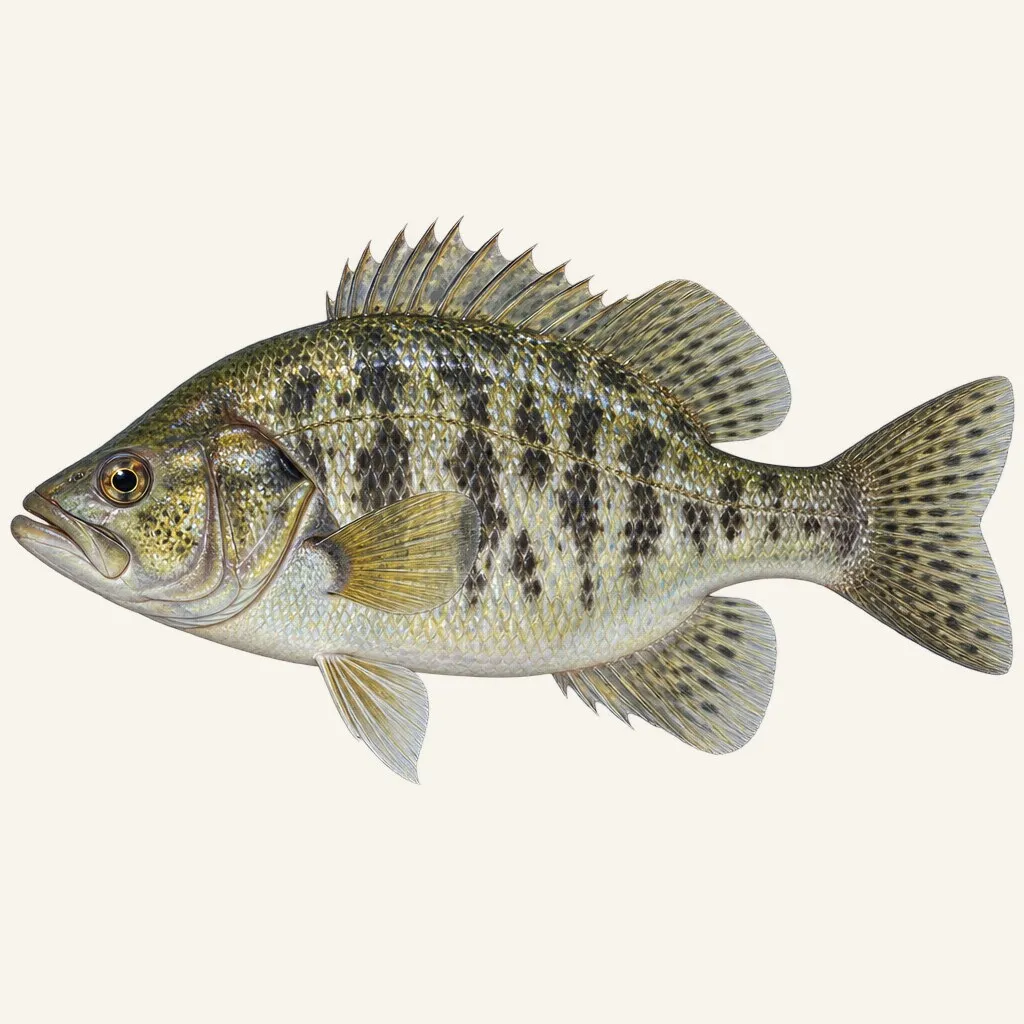
The Sacramento perch is the only centrarchid endemic to the west coast of North America, with an oval compressed body, sturdy dorsal spines, brownish-olive to buff flanks with dark mottling, and a large mouth.
Calendar
Recorded in 1 country
GBIF occurrence records — native and introduced populations combined.
Its range
This is the only centrarchid native west of the Rockies. Every other member of the family — the sunfishes, the crappies, the black basses, the rock basses — evolved on the far side of the continental divide, and every one of them now swimming in California was brought there by somebody.
Its own ground is three drainages: the Sacramento–San Joaquin, the Pajaro and the Salinas. That is the Central Valley plus two coastal rivers to the south of it, and nothing else.
Then the second half of the entry, which is where the page turns: widely introduced elsewhere in the western United States. So the map carries two ranges at once, and the introduced one is in better condition than the native one.
Breeding
Male guarding lasts nought to three days. That figure is the most consequential number anywhere on this page.
Three days at the outside is a short watch for this family. Several of the eastern sunfishes hold a nest for a fortnight or more, fanning it and driving off anything that approaches until the larvae leave of their own accord.
The record does not explain the difference, but the circumstances do. This is the one centrarchid that evolved with no other centrarchid in the water: nothing in its basin had specialised in raiding a nest of that kind, so nothing selected for a long defence. The eastern species arrived in California with two weeks of nest defence already built into them. A three-day guard is not a weakness until something turns up that guards for fourteen.
The water it needs
The wording of the record deserves to be read exactly as it stands. Adults occur in vegetated sloughs, pools of sluggish rivers and lakes; now most common in ponds and impoundments.
The habitat named first is the Central Valley floor as it used to be — slack, vegetated, soft-bottomed sloughs and the slow pools of a river system that flooded. That is precisely the water the valley no longer has: drained, embanked, straightened and farmed. The habitat named second is artificial, and much of it lies outside the native basin.
A fish whose stronghold is a stock pond has not changed its mind about what it likes. It has lost the water it liked.
Areas
- Shallow vegetated areas
- Rocky shores
- Calm lake coves
- Slow-flowing streams
Techniques
- Light soft lure fishing
- Wet fly fishing
- Live bait fishing
- Natural drift fishing
Baits
- Earthworms
- Small natural insects
- Small live fish
- Miniature soft lures
How to catch it
Where the fish reliably is, is not where it belongs. The dependable water is a pond or a reservoir, frequently outside the three native drainages, holding a population that was put there deliberately — and given the state of the native stocks, that is where a fishery exists at all.
It runs larger than the panfish it gets grouped with. A common length of 30 cm is a different animal from a hand-sized sunfish and the tackle should say so, from hook size upward.
Nine years is the oldest age reported, which for a fish reaching that length means growth is quick rather than slow. A strong year class shows up in the catch within a few seasons, and disappears from it about as fast.
Beyond that, the search image is warm slack water: still, shallow, vegetated. Current and hard structure, the two things a reservoir angler normally reads first, are the wrong things to look for here.
Conservation · Endangered (IUCN) — This species is threatened with extinction. Always release it (no-kill), handle it with the utmost care and check local rules — fishing for it may be prohibited.
Conservation
Two pressures arrived at the same time, and either one on its own would probably have been survivable.
The first removed the habitat listed at the head of its description. The valley's sloughs were drained and its rivers embanked, which took away slack vegetated water on a scale no fishery decision could match.
The second put competitors into what was left. Introduced sunfishes and black basses spawn in the same warm shallows, eat eggs and fry, and hold their nests for two weeks. A clutch left to itself after seventy-two hours in that company is a clutch on its own — which is where the guarding figure stops being a curiosity and becomes the mechanism.
The awkward part of its present situation is that the populations most likely to persist are the introduced ones, in artificial water outside the native range. Ponds and reservoirs holding a species that was never found in them are not a recovery; they are a holding operation, and the basin that produced the fish is the thing that has not been repaired. In the native drainages, any adult in the hand belongs to a small population, and the argument for putting it back is arithmetic rather than sentiment.
Regulations
Check the local regulations in force (legal size limits, closed seasons, bag limits).
For guidance only. Legal sizes, quotas and open seasons vary by location and season: always check the local regulations in force before fishing.
Other names
Sacramento perch is not a perch. It is a centrarchid, and the word records what a nineteenth-century settler called any deep-bodied spiny freshwater fish.
Interruptus is the informative half of the name: the dark bars on the flank are broken rather than continuous, which is what the epithet notices. The genus holds this species and no other — a monotypic genus, which is the taxonomic way of saying the same thing as "the only centrarchid native west of the Rockies".
The practical warning is local. In California a deep-bodied spiny fish lifted out of a slough is far more likely to be one of the introduced sunfishes than this one, and the assumption should run that way round.
Sources: fishbase.se · api.gbif.org