Rock bass
Ambloplites rupestris · Centrarchidae
- Freshwater
- Predators
- Medium
- Size
15–43 cm
- Weight
0.1–1.4 kg
- Lifespan
18 years
- Water temp.
10–29 °C
- Depth
0–21 m
Where to fish
- Lake
- River
Habitat icons: Flaticon
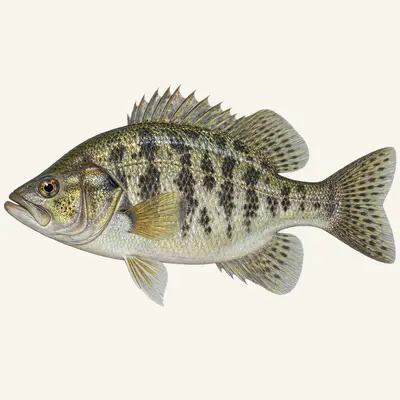
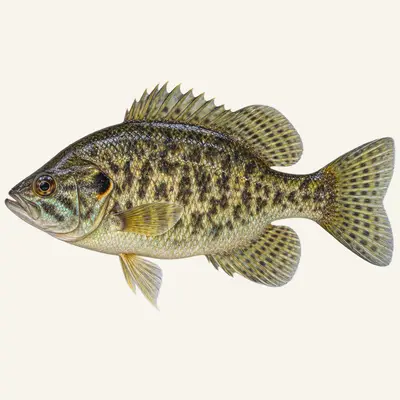
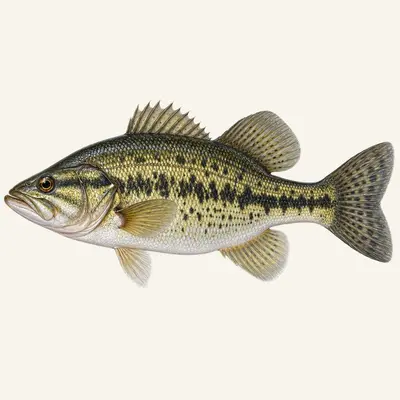
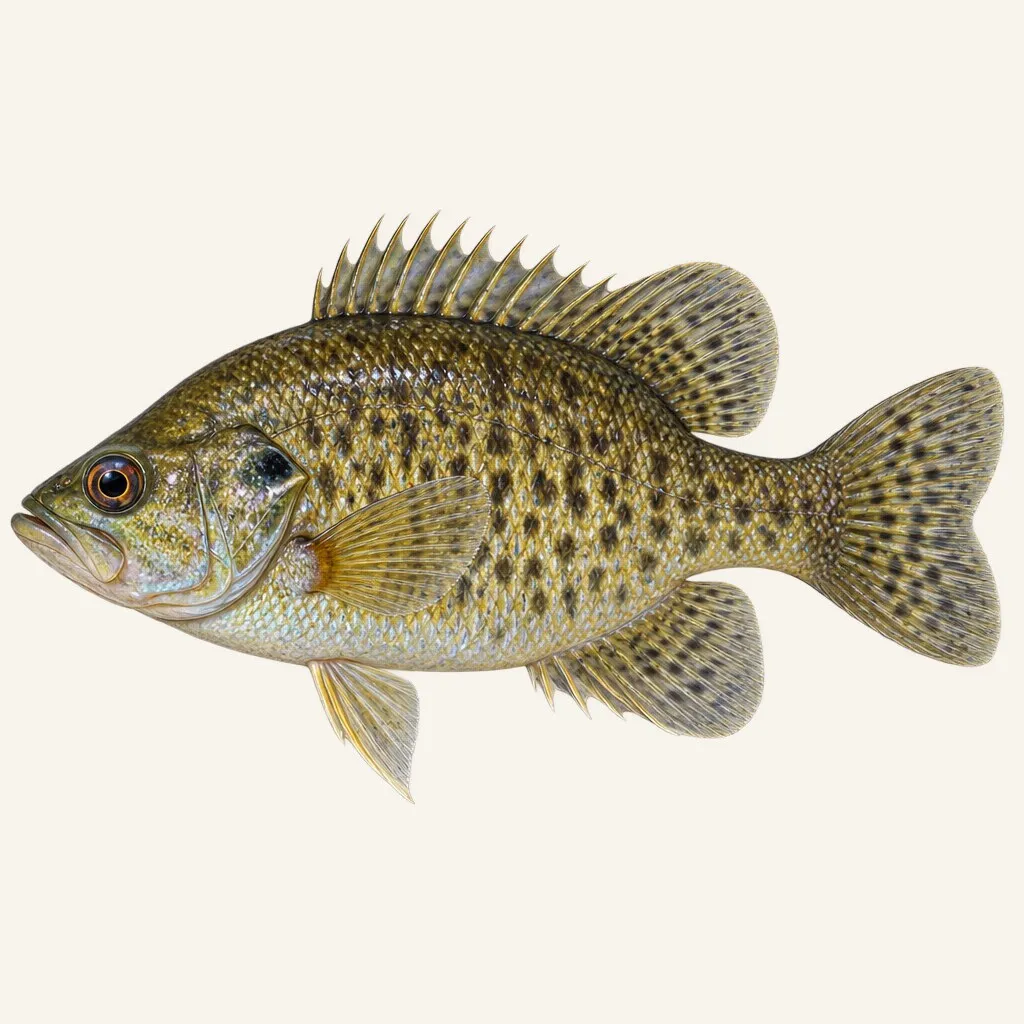
The rock bass is a stocky Centrarchidae fish with a high, laterally compressed body, displaying a brown-green to grey mottled pattern with golden reflections on the flanks.
Calendar
Recorded in 3 countries
GBIF occurrence records — native and introduced populations combined.
Its range
One clause in the record is worth more than the rest of the entry: in Missouri the species is native only to the Meramec. Somebody went to the trouble of saying that about a single river, and the reason is that inside its own native region the map already mixes original range with a century and a half of fish being moved about.
The outline runs through the St Lawrence and Great Lakes, into Hudson Bay by way of the Red River, and down the Mississippi basin — Quebec west to Saskatchewan, south to northern Georgia, northern Alabama and Missouri. Between the 34th and 53rd parallels, in water logged from 10 to 29 degrees.
And it has been introduced to Europe, where it is now well enough established to have its own habitat description.
Identifying it
Count the spines in the anal fin. There are five to seven of them, and every Lepomis sharing the same margin carries three. A short deep centrarchid with more than three anal spines is not a sunfish of that genus, and no colour argument is needed to settle it.
The remaining counts fill in the picture: 10 to 13 dorsal spines, 11 to 13 soft rays behind them, nine to 11 anal rays, and 29 to 32 vertebrae in a body that is short and deep.
Then there is the eye, which is bright red on a fresh fish and visible from a distance in clear water. It has given the species one of its names, and it is the mark most anglers use, though the anal count is the one that cannot be argued with.
Breeding
The male stays over the eggs for about 14 days, and then stays with the fry.
In European water, where the species has been introduced, the nest is described precisely: a shallow depression in sand or gravel along a shallow shore, fanned and defended, with a single male sometimes spawning several females into the same scrape and holding it until the last larvae disperse.
Two weeks is a long watch for a fish of this size, and the arrangement makes it longer. A depression in open sand has no structure to it — nothing overhangs the eggs, nothing conceals them. The guard is the nest. Every day of it is paid by the male, who is on station in shallow water, not feeding properly, and in plain view of everything that eats fish.
The water it needs
Read the two descriptions side by side and the requirement separates from the preference.
At home: rocky shallows in lakes, the lower and warmer reaches of streams, brushy vegetated stream margins, the pools of creeks and small to medium rivers, and rocky or vegetated lake edges — most typically clear, silt-free rocky streams. Down to 21 m on the record, though this is a fish of the shallow margin.
In Europe: it avoids swift water, and occupies everything from slow-flowing to stagnant. Large rivers, lakes, ponds, canals, backwaters.
The constant across both accounts is the absence of current. Clean stone and clear water are what it prefers where it evolved; slack water is what it insists on. The European description is an experiment nobody designed — turned loose in a fauna it did not grow up with, it went to the still water and left the fast alone.
Areas
- Rocky and gravelly areas
- Submerged stumps and debris
- Weed bed edges
- Rapids and riffles
Techniques
- Soft lure fishing
- Wet fly fishing
- Live bait fishing
- Drop shot fishing
Baits
- Earthworms
- Worm-type soft lures
- Small live fish
- Grubs
What it eats
Small crustaceans, insects and fish.
The last item is what separates it from the sunfishes beside it. The gape here is wider than theirs at the same length, and fry are within range of it — which means a fish that fits in a hand is working on other species' offspring, not merely competing with them for insects.
How to catch it
It reaches a bass angler's tackle by accident more often than by design, and that is the most honest description of it: the same rocky shallows, the same lures, and no hesitation.
The wider gape allows a step up in size from anything the sunfishes will manage — a worm-shaped soft plastic, a small live fish, a wet fly — and the bite arrives all at once rather than as a sequence of taps.
Clear silt-free water over stone cuts both ways. The fish can be seen, and it can see, so the approach counts for as much as the presentation.
Spring puts the males on their scrapes for a fortnight, which makes them locatable and belligerent at the same time. A male lifted off a depression in open sand leaves a clutch with nothing whatever between it and the rest of the lake, and since that is exactly the fortnight when the fishing is easiest, the trade is worth deciding before the season rather than at the net.
The last figure is the one that changes how a good fish reads. Eighteen years is the oldest age reported, against a common length of 15 cm. A heavy rock bass is not a fast-grown fish, it is an old one, and there is no quick replacement waiting for it.
Conservation
In its native range the thing to watch is clarity. The species is described most often in clear, silt-free rocky streams, and its nest is a scrape in open sand or gravel: fine sediment coming out of suspension fills the spaces in that bed and settles over eggs that have nothing above them. Siltation therefore acts on this fish at its single most exposed moment, in water that still looks perfectly fishable from the bank.
In Europe the question inverts. A nest-guarding centrarchid that takes fry, tolerates canals and ponds and lives up to 18 years does not need many releases to become permanent, and its tolerance abroad is visibly wider than its native habitat description would suggest. The same trait — two weeks of defence over a clutch in warm shallow water — is a liability at home and an advantage where it was introduced.
Regulations
Check the local regulations in force (legal size limits, closed seasons, bag limits).
For guidance only. Legal sizes, quotas and open seasons vary by location and season: always check the local regulations in force before fishing.
Other names
Rock bass is the accepted name and rupestris says the same thing in Latin. Bass here means a centrarchid: nothing about this animal is related to the temperate basses of fresh water or to the sea basses that share the word.
Both of its familiar alternatives belong to other fish as well, which is why a survey or a regulation uses the binomial and nothing else. In Quebec French it is crapet de roche, with goujon de roche also in use.
The genus name is built from the Greek for blunt and for armed. It points at the spines — the same spines whose count, in the anal fin, is what identifies the fish.
Sources: fishbase.se · api.gbif.org