Orinoco peacock bass
Cichla orinocensis · Cichlidae
- Freshwater
- Predators
- Medium
- Size
62 cm
- Weight
6.2 kg
- Water temp.
27–29 °C
Where to fish
- Estuary
- River
Habitat icons: Flaticon
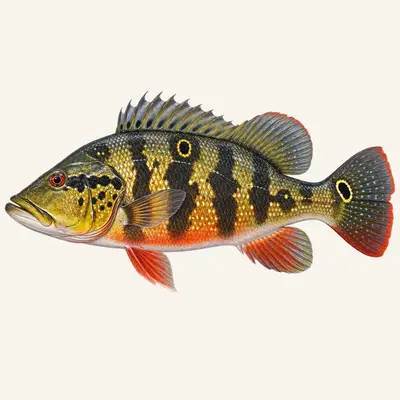
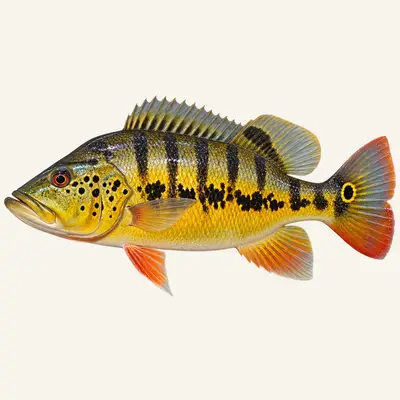
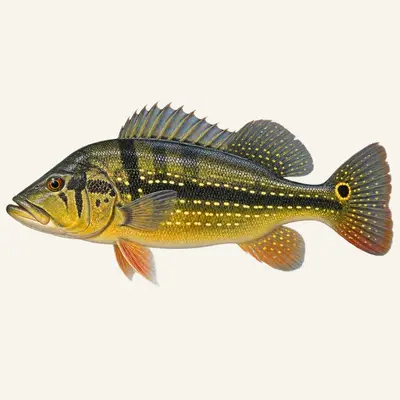
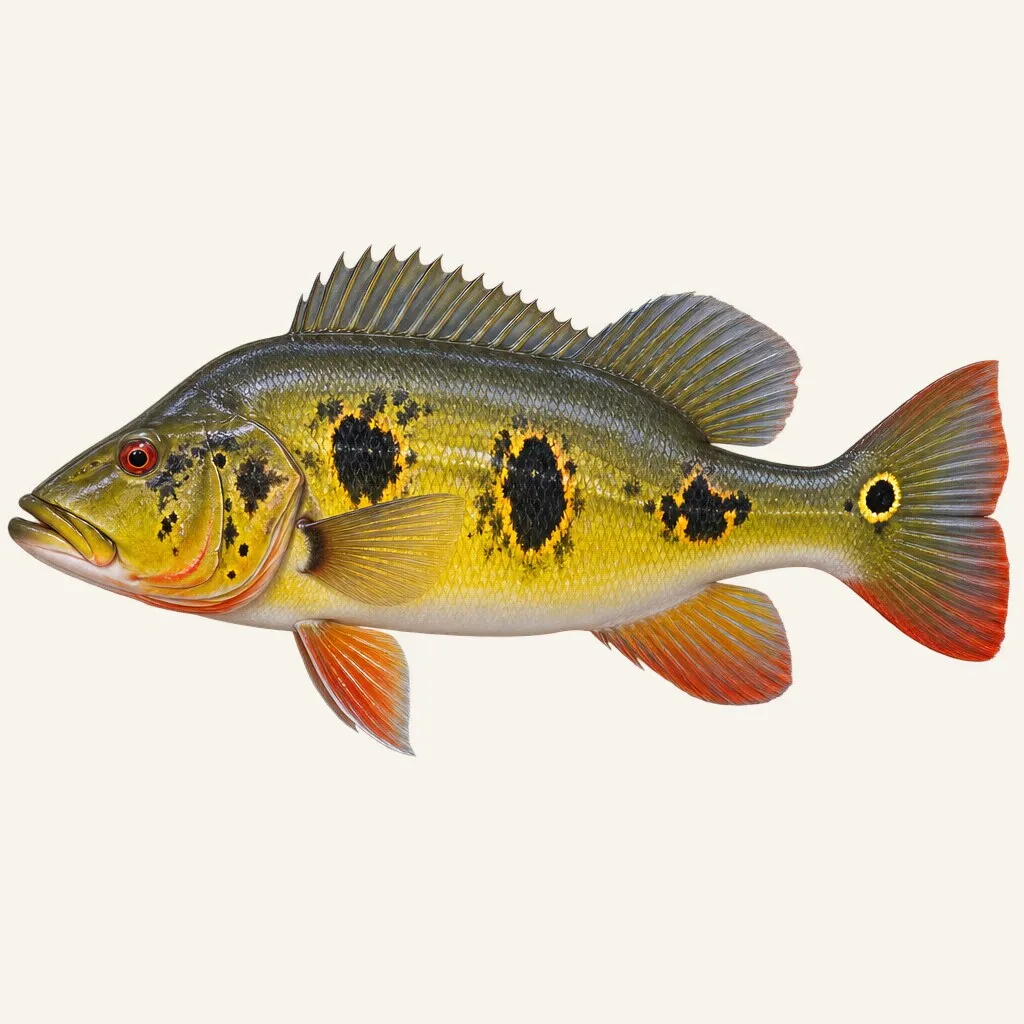
The Orinoco peacock bass is a predatory cichlid endemic to the Orinoco basin and its tributaries in South America. It is distinguished by its large, high-contrast ocellated spots on a golden to greenish background, and its preference for fast-flowing, well-oxygenated waters.
Calendar
Identifying it
Three large ringed blotches run down the flank, and there are no bars to count. In a genus keyed almost entirely on bar patterns, this is the species that dispenses with them: the adult replaces the bars with ocelli, though the second and third are sometimes irregular or lose their pale ring.
The lateral line is nearly always interrupted, in a genus where it is usually continuous. That character survives handling and can be checked on a fish at the side of the boat.
The rest of the diagnosis is a list of things that are not there. No dark patches on the belly. No bar across the nape. Neither of the intercalary bars that several relatives carry between the main ones. Behind the eye, on the other hand, there are markings, and the three-barred species have none.
The juvenile has a shortened lengthwise band, as several congeners do, which is why the interrupted lateral line has to do the work at that age.
The water it needs
Orinoco tributaries in Colombia and Venezuela, and the Negro basin in Brazil, at a pH of 5.5 to 6.5 and 27 to 29 °C.
It is caught in shallow water close to shore in lagoons, and in the slow-moving reaches of the river channel. That is worth holding onto, because it shares both rivers and water chemistry with the largest species of the genus while the two are taken in different places: this one from shallow margins, the other from deep littoral and channel banks. Same water, different depth.
Areas
- Sandy Orinoco riverbanks
- Lateral creeks
- River mouths
- Holes beneath submerged roots
Techniques
- Cast and retrieve with minnow lures
- Light jigging
- Live bait fishing
- Dead-bait fishing
Baits
- Natural-colored minnow lures
- Light jigs
- Local live fish
- Spinner baits
- Soft plastic lures
What it eats
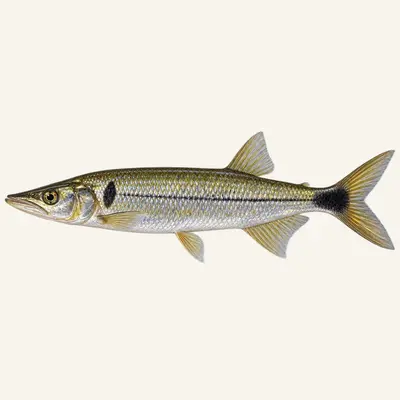
Mainly small characiform fish.
The file goes no further, and the prey lists compiled for its congeners were compiled in other rivers. Transferring them would describe the wrong fish community rather than this one's diet.
How to catch it
Shallow slack water and lagoon margins, worked rather than sounded: the depths that produce for the big blackwater species are not where this one is taken, even where both are present.
Fish imitations follow from a diet of small characiforms, and the shallow lie argues for a lure that works high in the water.
One practical advantage sets this species apart. Three ringed blotches on the flank are readable on a wet fish held over the gunwale, so a catch can be named without counting scales — and in a genus where identification usually needs a specimen and a key, a catch report that names the right species is worth more than a longer one that does not.
Regulations
Check the local regulations in force (legal size limits, closed seasons, bag limits).
For guidance only. Legal sizes, quotas and open seasons vary by location and season: always check the local regulations in force before fishing.
Other names
Pavón mariposa in Venezuela — butterfly peacock, for the ocelli — and tucunaré in Brazil, where English-speaking anglers usually meet it as peacock bass without further qualification.
The epithet is the Orinoco, the basin the species was described from and where most of its range still lies.
Sources: fishbase.se · api.gbif.org