Redeye bass
Micropterus coosae · Centrarchidae
- Freshwater
- Predators
- Hard
- Size
26–47 cm
- Weight
0.2–3.7 kg
- Lifespan
10 years
Where to fish
- River
Habitat icons: Flaticon
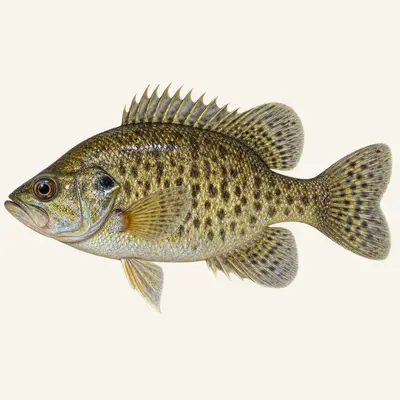
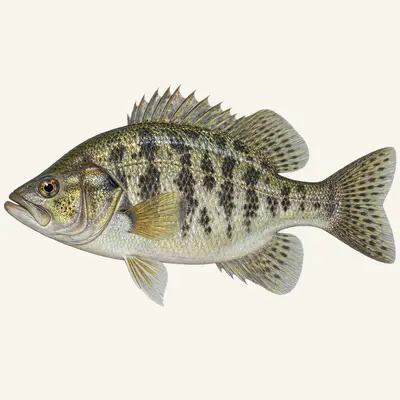
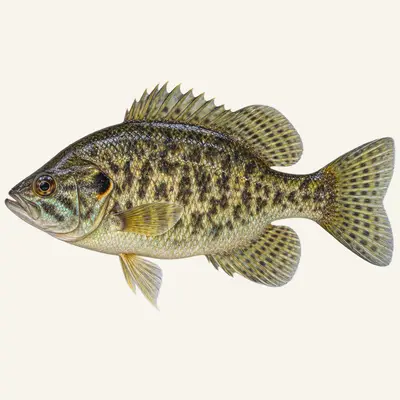
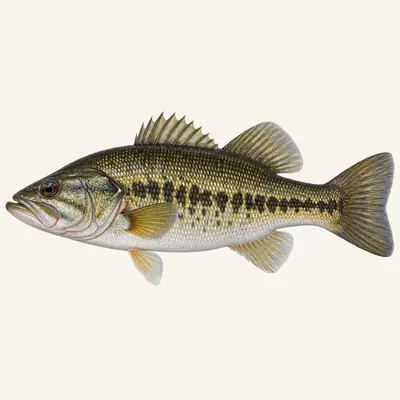
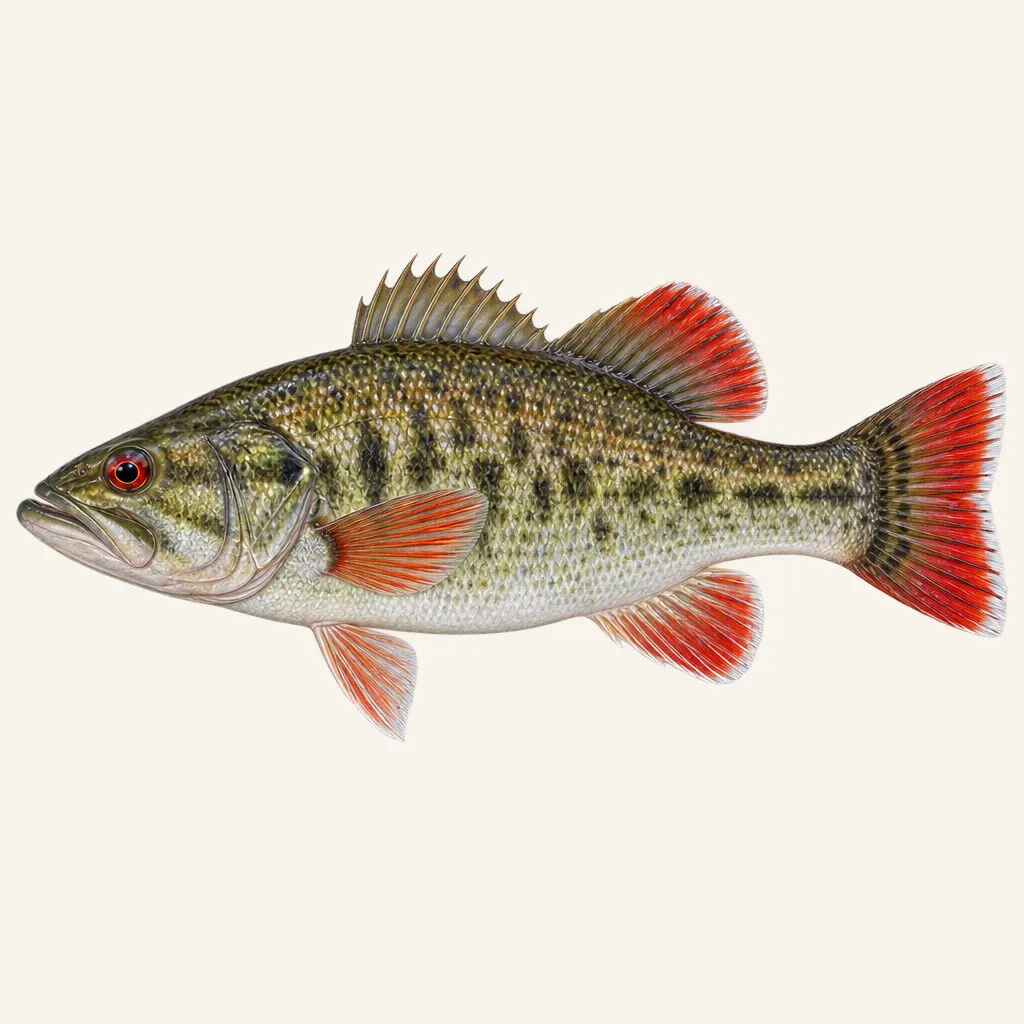
The redeye bass is a stocky centrarchid with distinctive red eyes and an olive-brown body marked with dark blotches along the flanks.
Calendar
Recorded in 1 country
GBIF occurrence records — native and introduced populations combined.
Its range
The species holds the Savannah and Chattahoochee basins and the rivers draining to Mobile Bay, across North Carolina, South Carolina, Georgia, Tennessee and Alabama.
Set against the two black bass that now swim on every warm continent, that is a very small piece of ground, and it has never been exported. What makes it smaller still is what has happened to the name since. Populations once filed under this species have been described as separate species of their own — one to the Tallapoosa, one to the Cahaba, one to the Chattahoochee, one to the Black Warrior, with the Savannah River fish still awaiting a decision. Each of those now occupies a single river system.
Identifying it
Red on the fins is what isolates this fish inside its own group. The outer half of the second dorsal, of the caudal and of the anal is red, and so is the full length of every pectoral ray. Its close relatives carry green, yellow-green or orange instead, and they carry it over a smaller part of each fin.
The second character is an absence. The midline row of dark blotches along the flank is broken or missing: three-quarters of individuals show six or fewer vertical marks towards the front of the body and nothing legible behind them, the rest too diffuse to count. In the remaining quarter the row does run the whole length, with 10 to 13 blotches. Neighbouring species keep that row continuous and readable.
Scale counts do the rest of the work when fins and blotches leave a doubt. The scales are smaller than those of the nearest relatives, 2.6 against 2.9 per cent of standard length; the lateral line most often carries 70 of them where the others carry 65 or 66; the caudal peduncle is encircled by 30 rows against 29. A tooth patch is present, which alone separates the fish from one of its neighbours, and the caudal fin is tipped more conspicuously in white than another's.
Fin counts are simple by comparison: 10 dorsal spines, 12 to 14 soft rays, three anal spines, 10 or 11 anal rays.
Breeding
Spawning takes place in shallow ponds, lakes and creeks. Pairs form distinctly and the fish is oviparous.
That is the whole of the record. There is no description of nest construction, no guarding period, no egg count. Anything more detailed that gets attached to this species has been carried across from its better-studied relatives, and the transfer may or may not hold.
The water it needs
Rocky pools and runs in creeks and small to medium rivers, and upland streams above them.
The preference for headwaters is what sets the fish apart from its relatives, which take the middle courses and the reservoirs below. This is a bass of cool, clear, small water, and the size it reaches follows from that: 25.5 cm as a common length.
Ten years is the maximum reported age. For a fish that small it indicates slow growth, consistent with cold and unproductive streams where a season adds very little.
Areas
- Small mountain streams
- Stony riffles
- Under rocks and roots
- Stream confluences
Techniques
- Fly fishing (nymph, dry fly)
- Ultra-light lures
- Finesse spinning
- Small crankbaits
Baits
- Slim soft lures
- Small spinners
- Earthworms
- Small insects
How to catch it
This is fishing done upstream and on foot. The water is small, rocky and clear, the approach is a wading approach, and none of the boat-based apparatus that the reservoir species has generated applies here at all.
Size expectations belong to the stream rather than to the genus. A fish of 30 cm out of an upland creek is a good one, and the record belongs to a fish from the largest water the species occupies. Reading it against a reservoir largemouth is reading it against the wrong animal.
Clear shallow water over stone puts the whole business on approach and cover. The fish sees the angler before the angler sees the fish, and the cast that works is the one made from further back than feels necessary.
Conservation
The taxonomic split has made every remaining population smaller than its name suggests. A fish that could once be described as ranging across five states now, in several cases, occupies one river system and nothing else, so a basin-scale loss and a species-scale loss have become the same event.
Everything that acts on small streams therefore acts on this fish directly: water abstraction from the headwaters, silt off the surrounding land, and the warming of shallow water that has no depth to buffer it. Slow growth means the recovery from any of those is slow too.
The other pressure comes from inside the genus. Where bass of other species have been stocked into these basins, hybridisation dilutes a lineage that exists nowhere else, and the fish most likely to be moved between drainages are precisely the ones anglers want more of.
Regulations
Check the local regulations in force (legal size limits, closed seasons, bag limits).
For guidance only. Legal sizes, quotas and open seasons vary by location and season: always check the local regulations in force before fishing.
Other names
Redeye bass is the English name, taken from the iris. The trouble with it is that several members of the group share that eye colour, so the name is not diagnostic and never was — the red on the fins is the character that actually works.
The name has also outlived its own boundaries. Fish called redeye bass in Alabama, in Georgia and in South Carolina may now belong to different species depending on the river they came from, and the split happened long after the common name settled. In a management document or a regulation the binomial is the only wording that resolves which fish is meant.
One further confusion is worth knowing on this side of the Atlantic: rock bass, a common fish of the same waters and the same family, is also called redeye in parts of the range. It is not a Micropterus at all.
Sources: fishbase.se · api.gbif.org