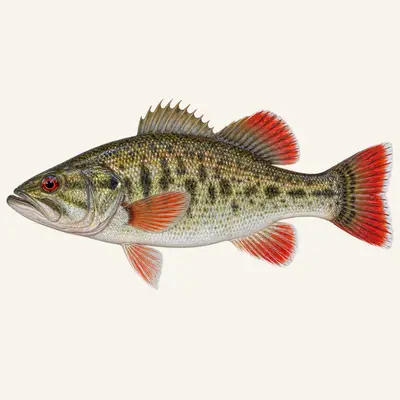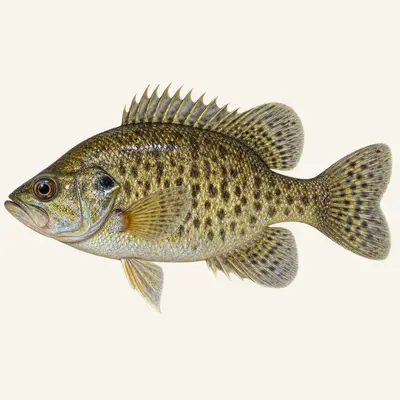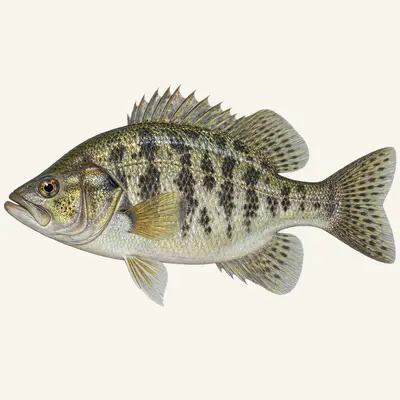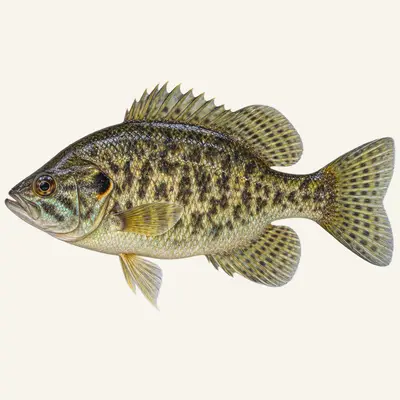
Redear sunfish
Lepomis microlophus · Centrarchidae
- Freshwater
- Predators
- Medium
- Size
19–43 cm
- Weight
0.1–0.2 kg
- Lifespan
7 years
Where to fish
- Lake
- Pond
- River
Habitat icons: Flaticon
Found in ponds, swamps and lakes, and in vegetated pools with mud or sand bottoms in small to medium rivers. Also occurs in warm, clear and quiet waters rich in vegetation and snags
Calendar
Recorded in 1 country
GBIF occurrence records — native and introduced populations combined.
Its range
The range runs from the Savannah River in South Carolina round to the Nueces in Texas, and up the Mississippi drainage as far as southern Indiana and Illinois.
That is a distinctly southern outline, tighter than the ranges of the pumpkinseed or the bluegill and set well below theirs. It corresponds to warm water, and it stops short of the Great Lakes entirely — a limit that shows up again in the fishing, since the species is at its best in the hottest part of its range rather than at the northern edge of it.
Breeding
The published account is thin: spawning takes place in shallow ponds, lakes or creeks, in distinct pairs, and the eggs are laid rather than carried.
Distinct pairing is the detail with any content to it. It sets this species apart from those in the genus where one male will take several females into the same nest in a season, and it means a bed here represents one pair's effort rather than an accumulation.
The water it needs
Ponds, swamps, lakes, and the vegetated pools of small and medium rivers, generally over mud or sand. Warm, clear, quiet water with plenty of growth and drowned timber in it is where the species is at its densest.
The soft bottom is the constant. Snails and small clams live in and on it, and a redear works over that surface rather than the water above it. The distinction is a practical one: several of its relatives hold in the body of a weed bed, feeding on what moves through the stems, and this fish is down among the roots and the silt underneath them.
Snags matter for the same reason. A drowned branch is a hard surface in a soft-bottomed pond, and hard surfaces in warm water carry molluscs.
Areas
- Hard-bottom shallows
- Vegetated margins
- Sandy lake coves
- Shallow river areas
Techniques
- Bottom float fishing with natural bait
- Ultra-light spinning
- Nymph fishing
- Small soft lures
Baits
- Freshwater snails
- Earthworms
- Zebra mussel larvae
- Small crayfish
What it eats
This is a mollusc feeder, and every other fact about the fish follows from it.
The preference is strong enough to have made the species a candidate for a job no panfish would otherwise be considered for: the biological control of the freshwater snails that carry schistosomiasis. A fish that reliably eats snails removes the intermediate host of a human parasite, and the redear has been assessed on exactly those grounds.
Living on shells requires the equipment to break them. The throat teeth of this species are broad, flat and heavy — millstones rather than the fine gripping surfaces its insect-eating relatives carry — and they sit far enough back that nothing about the small mouth at the front gives the ability away. It is a dissection character that decides what the fish will pick up off the bottom, which makes it a character worth knowing on the bank.
How to catch it
The diet writes the bait list. A fish that spends its life breaking shells responds to what resembles or replaces them — worms, larvae, a piece of snail or mussel, a small crayfish — far better than to the floating insect imitations that work well on the rest of the genus. Presented on the bottom, not in mid-water.
Look for it over soft ground with vegetation on it, in warm slack water, and around sunken wood. A redear is not usually caught in the same cast as a fish holding out in open weed, even when both are in the same pond.
The size figures need care. The record length and the record weight cannot describe the same animal: the first is large for a sunfish, and the second belongs to a far shorter one, since a fish of that length would weigh several times as much. They come from two different captures, and the useful number is the ordinary one: a good adult is around 19 cm. Seven years is the oldest reported age.
Conservation
The interesting question about this species is not what threatens it but whether to move it, and the answer is genuinely unresolved.
The case for is public health. Snail-borne schistosomiasis affects a very large number of people, the snails are the weak link in the parasite's cycle, and here is a fish that eats them by preference and is easy to raise. The case against is the record of its own genus. Sunfish introduced outside North America have produced reported harm to native fauna in country after country, they breed successfully in almost any warm still water, and nothing about them is retrievable once established. A control agent that cannot be withdrawn is a permanent decision made on partial information.
Within its native range the specialism is its own exposure. A fish tied to one food supply depends on the beds of molluscs being there, and those are the first thing lost when silt covers a hard bottom or a level is drawn down over a shallow flat. A generalist moves on to insects; this one has built its head around not having to.
Regulations
Check the local regulations in force (legal size limits, closed seasons, bag limits).
For guidance only. Legal sizes, quotas and open seasons vary by location and season: always check the local regulations in force before fishing.
Other names
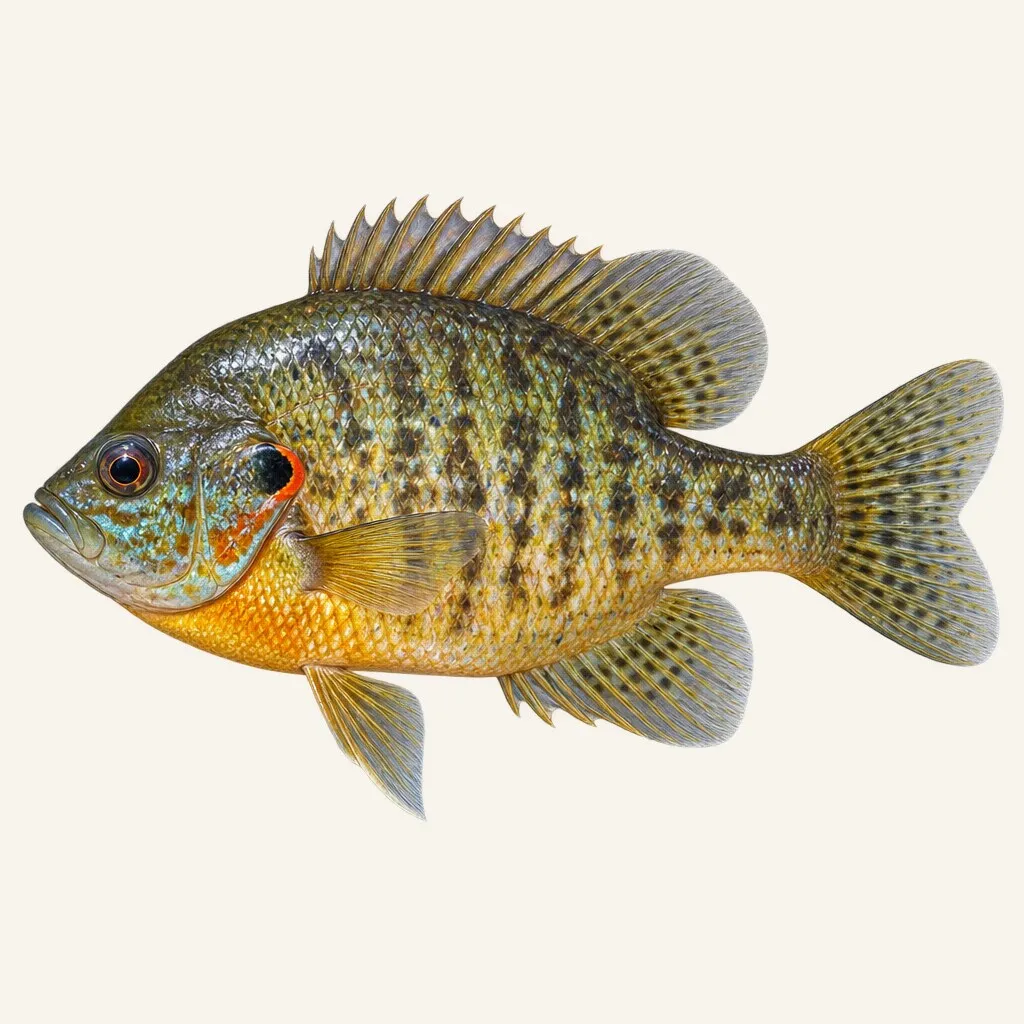
Redear sunfish is the official name and points at the orange-red edge of the opercular flap. It is not a reliable field mark on its own — a pumpkinseed carries red on the flap too — and the two species are regularly confused where they overlap.
Shellcracker is what American anglers actually call it, and the nickname does what the official name does not: it says what the fish does for a living, which is also the instruction for catching it. Microlophus, the species epithet, means small crest.
Sources: fishbase.se · api.gbif.org