Schraetzer
Gymnocephalus schraetser · Percidae
- Freshwater
- Predators
- Hard
- Size
15–30 cm
- Weight
0.0–0.3 kg
- Lifespan
15 years
- Water temp.
4–18 °C
Where to fish
- River
Habitat icons: Flaticon
A ruffe larger than the common one - Endemic to the Danube - Threatened
Calendar
Identifying it
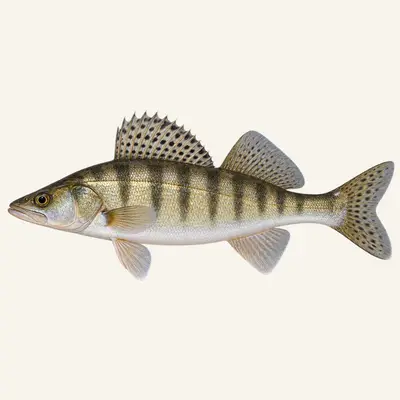
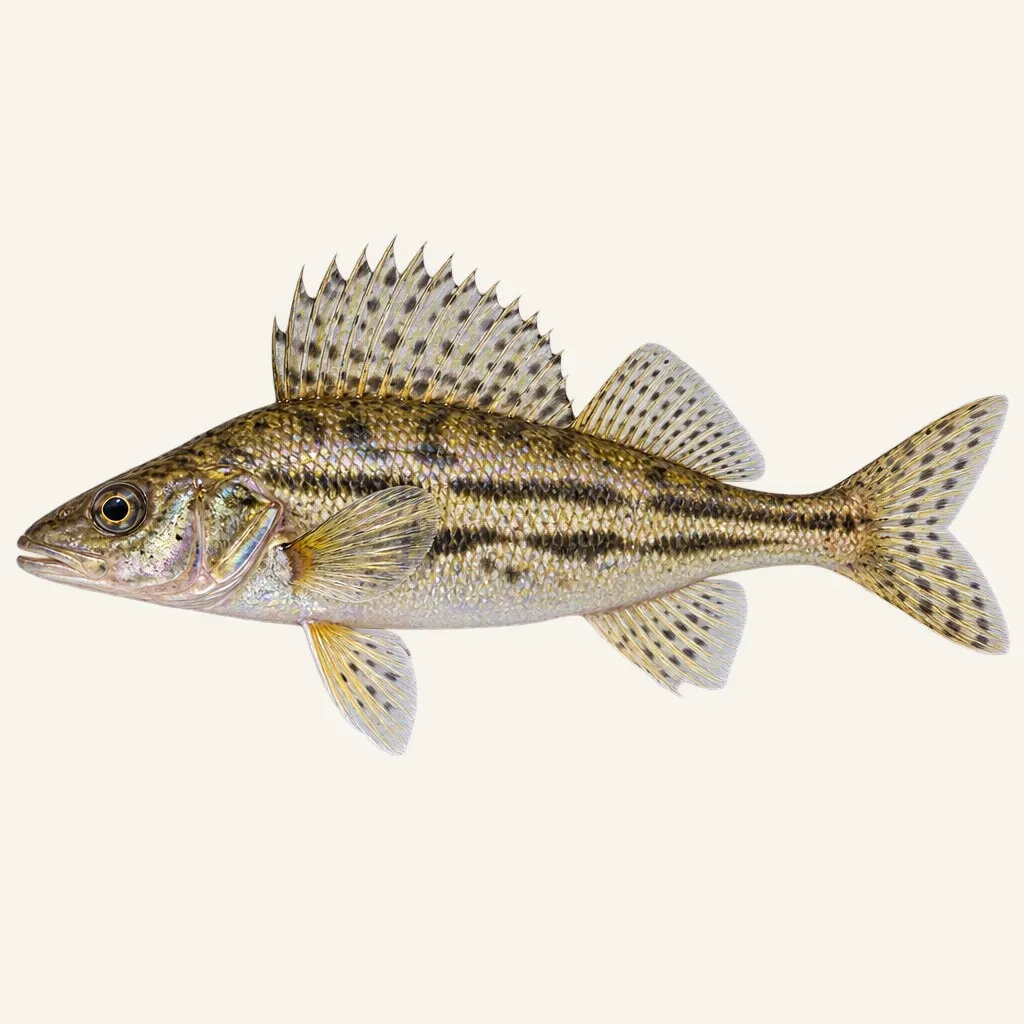
Three dark stripes run the length of the flank, and they are broken rather than continuous. That is the character which isolates the species within its genus, and it resembles nothing else: the ruffe wears an irregular mottling, this fish wears interrupted lines.
The lateral line counts 55 to 62 scales plus four or five. The dorsal fin carries 17 to 19 spines, the top of the range for the genus, and that count alone will separate it from its congeners on a preserved specimen.
The body is fusiform and noticeably more slender than the ruffe's, which shows in the hand before any counting starts.
Breeding
The eggs are attached to stones by the female.
That is the whole of what the documentation retains, and it is worth knowing before borrowing anything from the ruffe. Nothing indicates that this species divides its clutch the way the other does, and the temptation to fill the gap with a relative's biology is exactly what produces a confident error.
First maturity comes at about 14 cm, within a span of 12 to 16.
The water it needs
Adults occur in groups over open sand and mud bottoms in large rivers of moderate current.
Three requirements sit in that one sentence and they are cumulative: a large river, a moderate current, a soft bare bed. The combination describes the middle Danube as it was before it was engineered, and it accounts for a range that fits inside a single basin.
The thermal span runs from 4 to 18 degrees. The larvae are benthic from the start, which keeps the whole life cycle on the same bottom the adults depend on.
Areas
- Moderate currents
- bottoms
Techniques
- Worms
- Larvae
Baits
- Earthworms
- Bloodworms
- Maggots
- Insect larvae
What it eats
The species is nocturnal and feeds on small invertebrates, molluscs above all. Activity is usually crepuscular, though it will also feed during the day.
A mollusc specialist is unusual among percids. It implies the capacity to detach and crush shells, and it ties the fish to the mollusc fauna of sand bottoms — a fauna that is itself the first thing to go when fine sediment settles over the bed.
How to catch it
A nocturnal fish, in groups, over bare sand or mud, in a large river of moderate current. Those four conditions describe a very particular context, and searching outside it is wasted effort.
The size is modest, 15 cm as a common length, so light tackle and small baits are the whole of the tackle question. The species has no commercial value and is used mainly as bait, which is the honest description of its place.
Dusk is the reliable window. Daytime feeding happens but stays occasional, and planning around it means fishing the least productive hours of the species' day.
Conservation
The accumulation of requirements is what makes this fish fragile, and one kind of engineering works removes every one of them at the same time. A large river of moderate current, once channelised, becomes either a fast chute or a still impoundment. A bare bed of sand and mud silts up or is paved over. And the molluscs it lives on disappear with the substrate that carried them.
A longevity of 15 years, considerable for a fish this size, hides the loss for a long while. The adults persist well after the reach has stopped producing young, so a survey that finds the species may be describing a population that no longer recruits.
The contrast with its own genus is the sharpest way to put it. The ruffe gains from an enriched reservoir; this fish has no second option anywhere, because a basin endemic with three stacked requirements cannot move to what is left.
Regulations
Check the local regulations in force (legal size limits, closed seasons, bag limits).
For guidance only. Legal sizes, quotas and open seasons vary by location and season: always check the local regulations in force before fishing.
Other names
Schraetzer is the usual English name, borrowed from German for want of anything else, and striped ruffe turns up as an alternative that at least describes the fish. Neither is settled, which is what happens to a species that has never been fished commercially and lives in one river system.
The German is Schrätzer and the French keeps schraetser. The specific name is that German vernacular latinised, so the scientific name and the English name are the same borrowed word twice over.
The fish is endemic to the Danube basin, and the German name carries that better than any of the others.
Sources: fishbase.se · api.gbif.org