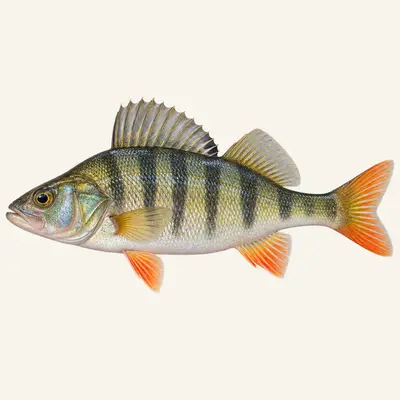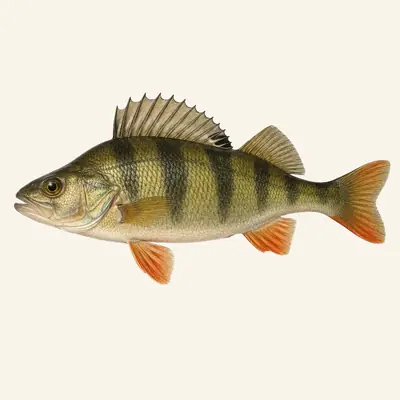
American yellow perch
Perca flavescens · Percidae
- Freshwater
- Predators
- Medium
- Size
19–50 cm
- Weight
0.1–1.9 kg
- Lifespan
11 years
- Water temp.
0–30 °C
- Depth
0–56 m
Where to fish
- Lake
- Pond
Habitat icons: Flaticon
Lakes, ponds, pools of creeks and rivers; also found in brackish water and salt lakes
Calendar
Recorded in 2 countries
GBIF occurrence records — native and introduced populations combined.
Its range
Atlantic, Arctic, Great Lakes and Mississippi drainages: from Nova Scotia west to the Mackenzie system in the Northwest Territories, south as far as Ohio, Illinois and Nebraska, and down the Atlantic slope to the Savannah River in Georgia.
The interesting question is what stops it, and the answer is not the climate. The species is logged from zero degrees to 30, between the 66th parallel and the 30th — a band more than twice the width of the one its Eurasian relative is recorded in. A fish with that much thermal room does not run out of suitable water; it runs out of connected water. The outline reads as a map of which basins drained into which as the ice withdrew, and it ends at divides rather than at any isotherm.
Identifying it
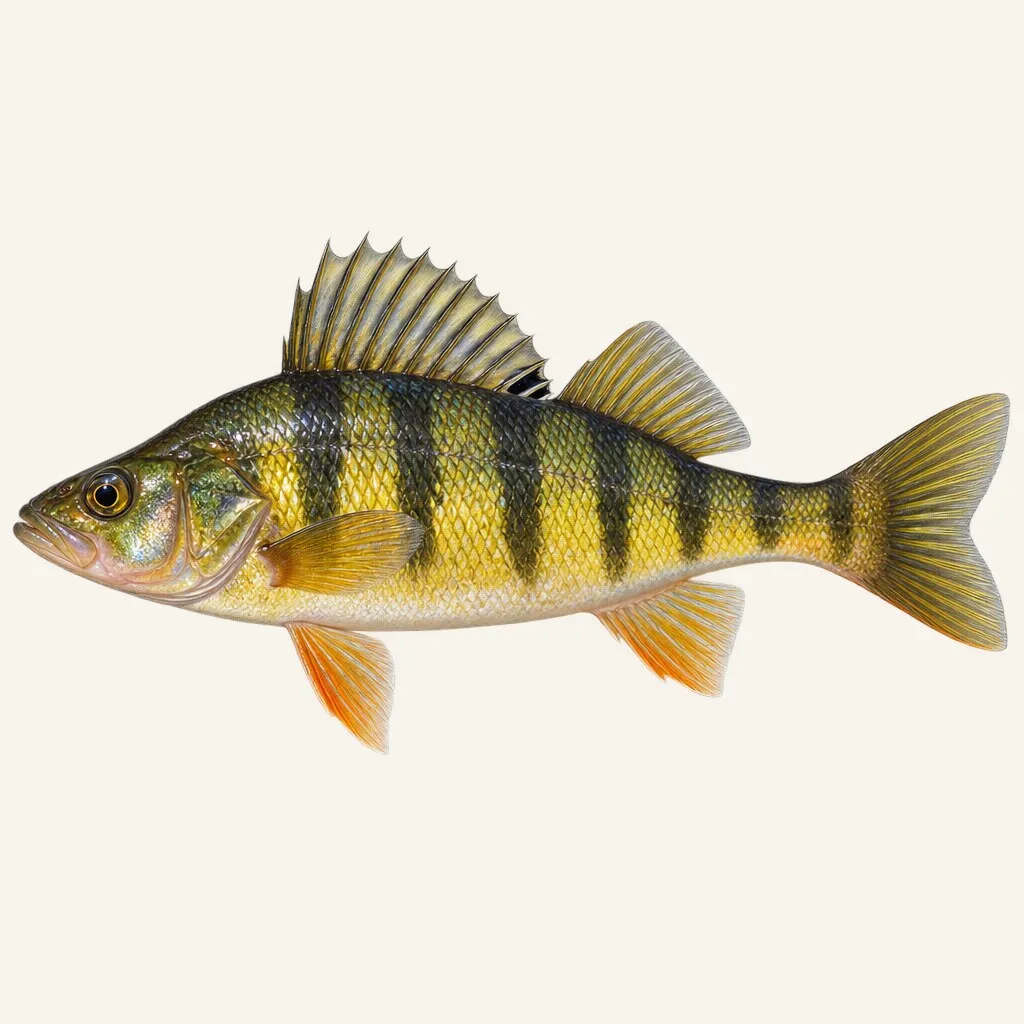
One genus, one species, one continent. There is no second Perca in North America, so the identification is over before any character has been examined: dark bars laid across a brassy flank, a body pressed flat from the sides, two dorsal fins standing clear of one another with the front one armed. Nothing in that description belongs to this fish alone — it is the family portrait, and the Eurasian congener wears it too.
Which is why the record has nothing finer to offer. No fin-ray counts, no scale rows and no vertebral figures are published for the species in the source used here, and a fish in the hand is therefore named on its colour and on the map. That is an odd gap for one of the most heavily fished animals on the continent, and it says something in itself: nobody has ever had much trouble deciding what this fish was.
Where the two perches genuinely part company is in what they do with a lifetime, and that runs through the rest of the page.
Breeding
The record files it as a non-obligatory plant spawner, and the qualifier is the whole of the interest. The eggs come out in the long gelatinous ribbon the genus is known for, but the ribbon does not have to be draped over anything living: it settles on whatever the bed happens to offer. A shoreline stripped of its weed and its drowned branchwork goes on producing perch, where the same treatment on the other side of the Atlantic takes the spawning substrate away.
Spawning runs from February to July in the northern hemisphere. The record adds August to October in the southern, and that second entry is not a fact about the animal but a record of where it has been carried: an established population, breeding on a reversed calendar.
The size figures are the ones to hold on to. First maturity arrives at 19.2 cm and the common length is 19.1. To within a millimetre, the average fish in a shoal is a fish that has only just joined the spawning stock — past the juvenile stage, not yet an established breeder. Eleven years is the oldest age reported, so there is room in the biology for a fish to spawn many times over. The size figures say that most of them do not get the chance.
The water it needs
Lakes, ponds, and the pools of creeks and rivers, most often in clear water close to standing vegetation. Brackish water and salt lakes are on the list as well, which is a strange entry for a fish otherwise associated with farm ponds, and it widens the map: salt is not necessarily a barrier between two systems here.
Depth is the second surprise. The species is recorded to 56 m while usually holding within the top nine, and that reserve is what makes it workable in the big continental lakes. When the surface warms past what it wants, there is more than 40 m of unused water underneath it and the fish takes it.
One seasonal movement is set down explicitly: in spring the shoals gather close to the shore. It is the only point in the year when this species is both concentrated and inside reach of the bank.
Areas
- Submerged weed beds
- Sandy bottoms
- Points and capes
- Shallow water at night
Techniques
- Vertical jigging
- Worm on spinner rig
- Small soft plastics
- Float fishing
Baits
- Earthworms
- Maggots
- Small jigs
- Live minnows
What it eats
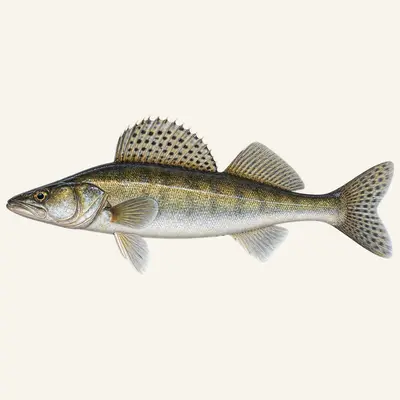
It feeds by day, on immature insects, larger invertebrates, fish and fish eggs. Daylight is the discriminating half of that sentence. The large percid that shares most of these lakes works at night, so the two divide the clock rather than the water, and on a lake holding both there are effectively two shifts.
Fish eggs deserve their own line. A shoaling animal of this size taking eggs operates on a scale a solitary predator cannot reach: what several hundred perch remove from a spawning ground over a few days is counted in next season's fish rather than in this week's stomach contents.
The traffic runs the other way too. Fishes and birds take it at every size it passes through, which makes it forage and predator at once — and it is the first role that gives it its standing in the continental lakes.
How to catch it
Daylight sets the plan. Where the walleye fishery on the same lake starts as the light goes, this one is worked while the sun is up, which is what makes the two complementary rather than competing.
Spring is the window from the bank. The shoals come in against the shore, and for those few weeks a boat stops being the price of entry. Through the rest of the open season the fish is lower down, at depths nobody associates with a perch, and finding it means reading the thermocline rather than the margin.
Winter follows directly from the thermal record. An animal that is still feeding at zero degrees is an animal that can be caught through a hole in the ice, and vertical fishing under ice carries a large share of the annual catch across the northern half of the range.
The real difficulty is calibre, not bites. With a common length of 19 cm the problem is never persuading fish to take; it is finding a shoal with size in it. Shoals grade themselves by size, so moving beats persisting — four small fish in four casts is a promise of a fifth, not a sign that a bigger one is underneath.
Handling has one point worth knowing. The first dorsal is a rank of spines and the gill covers cut, but the record registers explicitly what is absent: no anterolateral glandular groove, no venom gland. The prick is only a prick. A hand closing over the back from the head backwards lays the spines flat; a hand arriving from behind stands them up.
Conservation
Two pressures act on this species and they are rarely thought about together. It is fished commercially in its own right, and it is the preferred forage of the larger percid in the same water. The stock is worked from above and below at once.
That has a consequence for management that a single-species programme cannot see. Sustained stocking of walleye raises predation on the perch of that lake; a perch collapse then shows up a season or two later in walleye growth. Neither effect is visible in a plan written for one of the two.
Size structure is the signal to read, and it is easy to misread. When the common length and the length at first maturity coincide, removal falls on fish that have spawned once or not at all. A population in that state stays numerous and stays small, and the absence of large fish in a water that produces plenty of small ones is information rather than bad luck.
Regulations
Check the local regulations in force (legal size limits, closed seasons, bag limits).
For guidance only. Legal sizes, quotas and open seasons vary by location and season: always check the local regulations in force before fishing.
Other names
Yellow perch is the standard name. The catalogue's longer form adds the continent, which is a courtesy to readers who have the European fish in mind. In Quebec French it is perchaude, the plain perche being kept for the Old World species.
The epithet means turning yellow. In the Great Lakes trade the fillets are sold as lake perch, which is the same animal under a market name — worth knowing when reading landings statistics rather than catch reports, since the two sets of documents rarely use the same word for it.
Sources: fishbase.se · api.gbif.org