Walleye
Sander vitreus · Percidae
- Freshwater
- Predators
- Medium
- Size
54–107 cm
- Weight
1.8–11 kg
- Lifespan
29 years
- Water temp.
1–29 °C
- Depth
0–27 m
Where to fish
- Estuary
- Lake
- River
Habitat icons: Flaticon
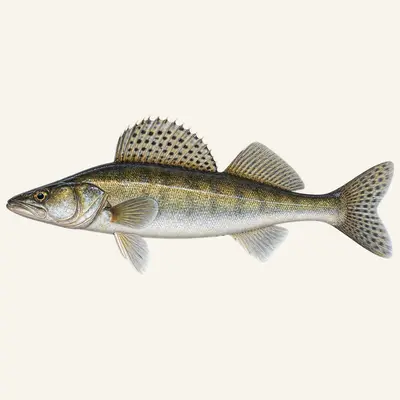
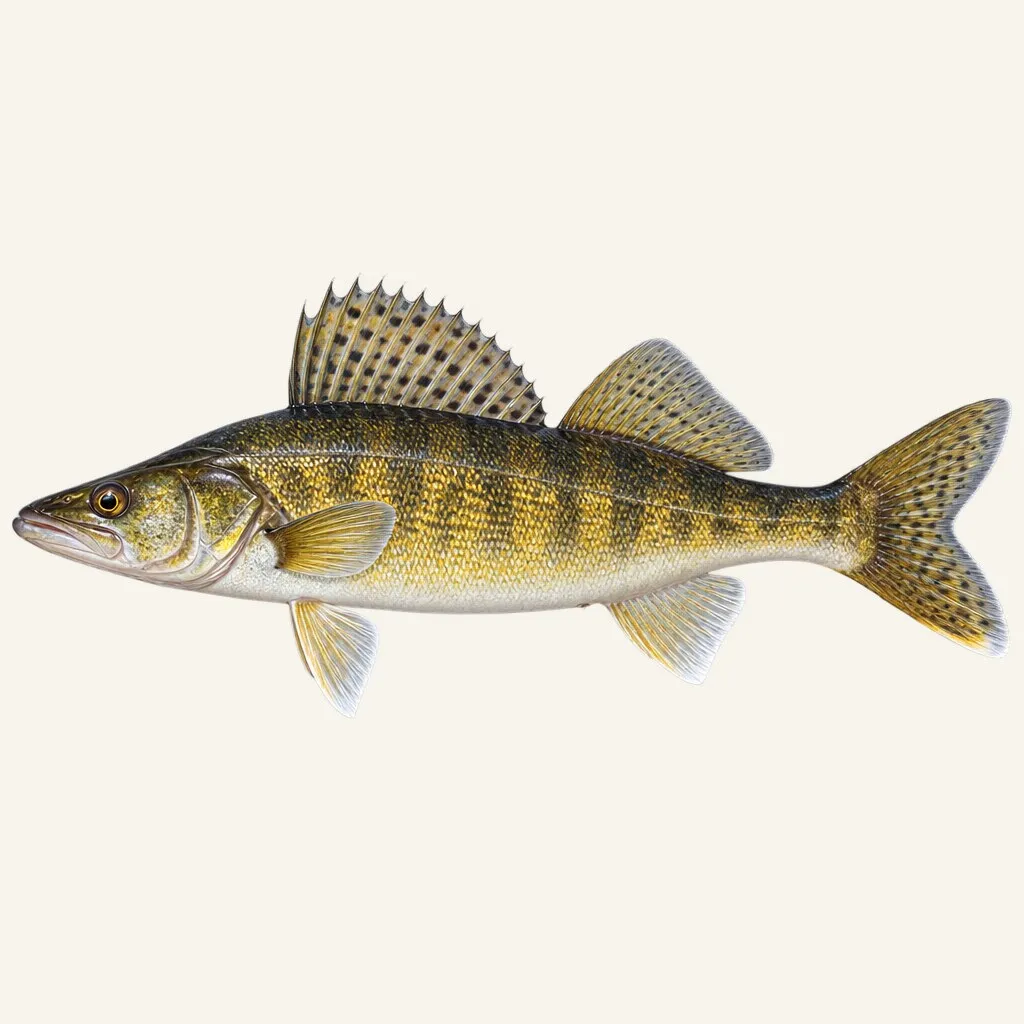
The walleye is a large North American percid with an elongated body and distinctive opalescent eyes adapted for night vision. Its golden, olive-tinged flanks and large mouth armed with sharp teeth make it a formidable predator in lakes and rivers.
Calendar
Recorded in 2 countries
GBIF occurrence records — native and introduced populations combined.
Its range
The original range covers three large systems: the St Lawrence and the Great Lakes, the Arctic basins, and the Mississippi, from Quebec to the Northwest Territories and south to Alabama and Arkansas. The Mobile Bay basin is a doubtful case, possibly natural. Northward the species reaches the seventieth parallel and holds in water down to one degree.
The rest of the map is the product of policy. This fish has been introduced very widely elsewhere in the United States, into Atlantic and Pacific drainages included, and none of that expansion is spontaneous: very large numbers of fry are produced in hatcheries every year to stock lakes for angling. The species is barely farmed for the table. It is farmed on an industrial scale to be released.
Identifying it
Nothing on this fish gives away its sex, in any season. There are no nuptial tubercles, no usable difference in build, no spring colour that belongs to one sex rather than the other, and separating the two is reported as difficult even with the animal in hand. In a percid that breeds in mixed groups that is a genuine oddity, and it has a consequence in spring: a fish lifted off the shallows may be the female carrying the entire year's clutch, and there is no way to know.
The counts are unambiguous. The first dorsal carries 13 to 17 spines and the second 18 to 22 branched rays; the anal has two spines and 11 to 14 rays; the backbone runs to 44 to 48 vertebrae and the branchiostegal rays go seven and seven, or seven and eight. The body is elongate and flattened from side to side.
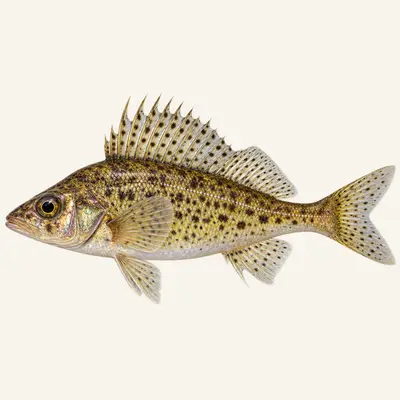
The real confusion is with the sauger, which shares the same water over most of the range. Three marks settle it. The sauger's flanks carry irregular dark blotches this fish does not have; its first dorsal is sown with separate black spots rather than carrying a dark patch low at the rear; and the lower lobe of the tail ends in a white tip here that the sauger lacks. The tail is the mark most anglers actually use, because it survives being wet and being seen at arm's length.
Breeding
No nest, no guard, no return. That is the sharpest divergence from the zander of Europe, whose male excavates a depression, defends it and drives water over the eggs for days: this fish leaves its spawn on the substrate and goes.
The whole sequence fits into one night. A small group forms — a large female escorted by two smaller males, or two females surrounded by as many as six males — and works through a routine of chasing, circular swimming and raised fins. The group then rises into shallow water, the females roll onto their sides, and eggs and milt go out together. The full spawning is normally deposited during that single night.
The larvae go straight into open water. They have no substrate, no parent and no shelter, so between the moment the eggs land and the stage at which the young fish starts to hunt, absolutely nothing stands between the year class and its surroundings.
Maturity comes late and large. It falls around 42.5 cm, within a range of 36 to nearly 45. Measured against the length ordinarily encountered, that means a substantial share of the fish in any given water has never spawned at all.
The water it needs
The literature describes it in two ways that do not obviously agree. It is reported frequently in clear water, usually close to brush, and it is credited with a preference for large shallow lakes carrying a lot of colour. Both descriptions are recorded and both are true of different waters.
What they have in common is that this fish is never found in clear open water with nothing in it. Either the water itself carries colour, or the fish is tucked against timber. On any given lake, one of those two features is where to start; bare open water is where not to.
It uses lakes, pools, backwaters and the runs of medium to large rivers, from the surface down to 27 m. It only exceptionally enters brackish water, which separates it from several coastal percids. The temperature band runs from 1 to 29 degrees, and that amplitude is what carries the range as far north as it goes.
Areas
- Rocky shoals
- River mouths
- Points and capes
- Deep sandy bottoms
Techniques
- Lead-head jig
- Spinner rig
- Soft plastic drift
- Slow trolling
Baits
- Nightcrawler
- Live minnow
- Soft jigs
- Spinner rig
What it eats
Feeding happens at night, and the ordinary diet combines two things rarely put together in a predator of this size: insects and fish. The insects are not a juvenile supplement — they are on the adult menu.
Among the fish, two names recur more than the others, yellow perch and freshwater drum, but opportunism is the rule and whatever is available will do. When neither fish nor insects are abundant the diet swings across to crayfish, snails, frogs, mudpuppies and even small mammals.
The mudpuppies deserve a note. A fully aquatic salamander taken off the bottom is not the prey of a fish working the open column, and it says that this predator hunts the bed as readily as the water above it.
That breadth explains how the species holds on in poor lakes where a strict piscivore would not survive. It also explains why average size varies so much from one water to another: a walleye living on insects grows, but not at the rate of one living on perch.
How to catch it
Night activity writes off a good part of the day. The useful hours begin as the light drops and run on into the dark. In broad daylight the fish has to be looked for in whatever stands in for darkness — depth, colour in the water, sunken timber — rather than searched for on the flats.
Diet steers the size of a presentation more than its shape. A predator taking as many insects as fish answers to small offerings, and a rig scaled for a comparable weight of predator often passes above what this one is actually looking for.
Spawning opens a very short parenthesis. Deposition in one night on shallow ground concentrates the breeders into a few hours and a small area; it is the moment when an entire population is assembled and exposed, and it does not last long enough to be met by chance.
Finally, knowing whether a lake is stocked changes how the catches read. Where the stock rests on releases, abundance says nothing about the success of natural reproduction, and a good season may be no more than the reflection of a good delivery three years earlier.
Conservation
Two figures frame the subject: maturity around 42 cm and a lifespan reaching 29 years. A walleye spends several years growing before it breeds once, then may go on breeding for decades. Removing the intermediate class — the fish that have only just reached maturity — takes out animals that have not yet returned what they cost the population.
The complete absence of parental care sharpens that dependence on adults. With the European zander the male shelters the clutch and absorbs part of the losses; here nothing at all comes between the eggs and the water. A year's success therefore rests entirely on the state of the substrate and of the water during incubation, and a single night of spawning leaves very little room for recovery if it falls badly.
Large-scale stocking is finally an answer that conceals the question. A lake supported by hatcheries can hold an apparently healthy population without producing a single fish of its own, and the fragility only shows on the day the deliveries stop.
Regulations
Check the local regulations in force (legal size limits, closed seasons, bag limits).
For guidance only. Legal sizes, quotas and open seasons vary by location and season: always check the local regulations in force before fishing.
Other names
Walleye is the standing English name and it describes the eye, the same observation the specific epithet vitreus makes in Latin and that German Glasaugenbarsch makes again. Three languages, one feature, noticed independently.
Pickerel is the trap. In parts of anglophone Canada the word is used for this fish, while elsewhere in English it names the small pikes of Esox, and both usages appear in older books and in regional documents. A reference to pickerel without a scientific name cannot be assigned to an animal.
Walleyed pike is the other name in circulation, and it repeats in English the error the zander's names make in Europe: it hangs a pike label on a percid that is not related to one. Yellow pickerel does the same job with the same lack of precision.
Sources: fishbase.se · api.gbif.org