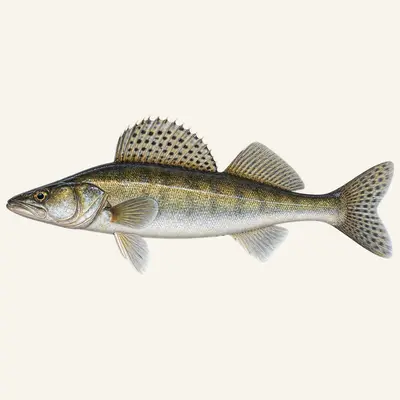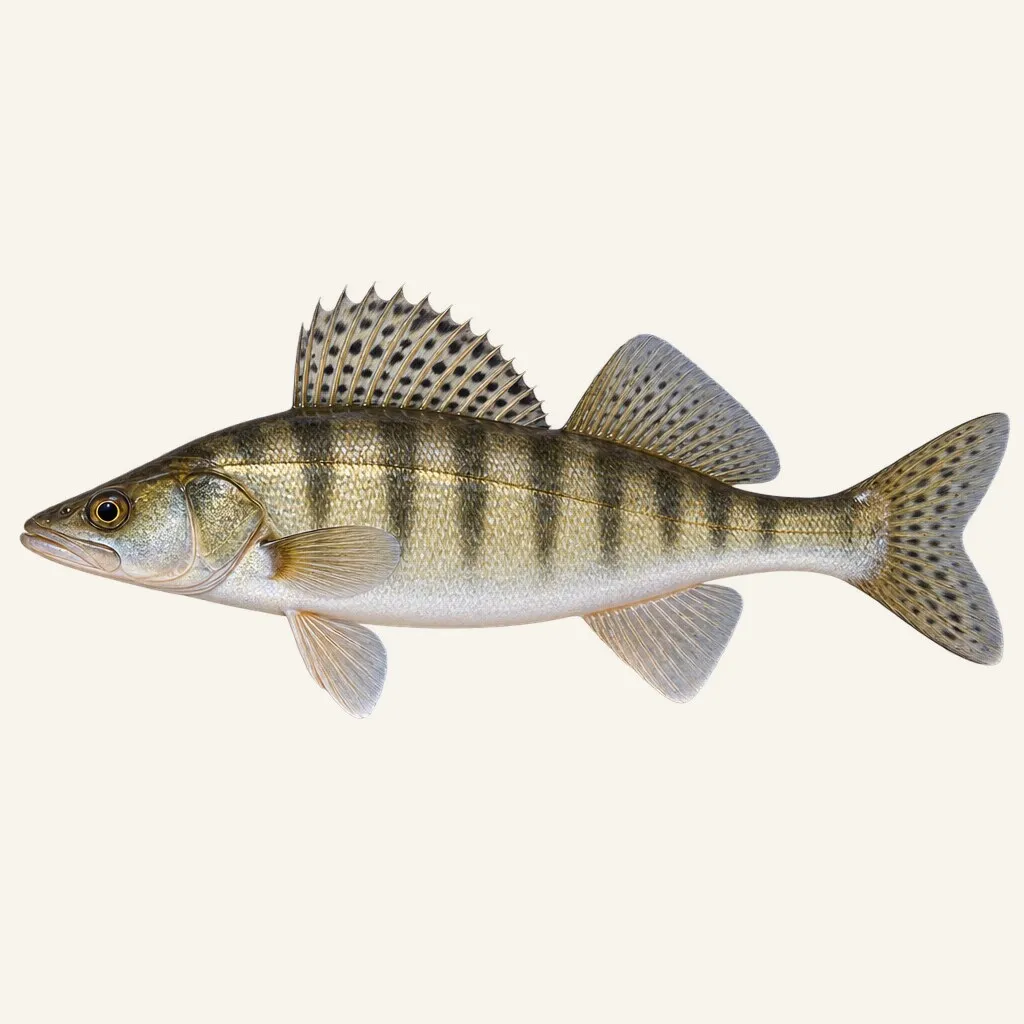
Volga pikeperch
Sander volgensis · Percidae
- Freshwater
- Predators
- Medium
- Size
40 cm
- Lifespan
12 years
- Water temp.
8–22 °C
Where to fish
- Lake
- River
Habitat icons: Flaticon
Large, turbid rivers and lakes, and coastal lakes and estuaries; most active at dusk and dawn
Calendar
Its range
The range is narrow and reads from east to west. It covers the northern Black Sea basin, from the Danube across to the Kuban drainages, and the Caspian basin by way of the Volga and the Ural.
Its upstream limit on the Danube is known precisely: the fish does not get past Vienna. That line is where a wide, slow, sediment-carrying river turns alpine. The species stops where the water becomes clear and fast, not where a border begins.
Identifying it
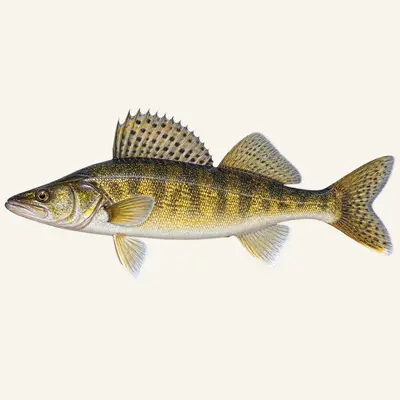
No canine teeth. That absence is what isolates this fish from every other Sander in Europe, and a finger run along the jaw confirms it: where the zander carries a pair of long fangs at the front of each jaw, there are only small, even teeth here.
The cheek is scaled, and that is the second thing to check. The second dorsal fin carries 19 to 21½ branched rays, and the lateral line counts 70 to 83 scales — a high figure, which gives the skin a finer grain than its relatives have.
A barred percid of modest size, without fangs, in the lower Danube or the Volga, can only be this animal.
Breeding
The male takes a territory and holds it. He digs a shallow depression in sand or gravel, or clears exposed plant roots down to bare material, and that is where the eggs will be laid — along shallow shores, in one to two metres of water.
The female, for her part, spawns in two or three portions. That is the clearest divergence from the zander, which empties its whole clutch in one sequence. Splitting the effort spreads it across several dates and several sets of water conditions, which counts for a good deal in rivers whose spring levels move a long way.
Spawning falls in April and May, sometimes preceded by a short run. First maturity comes at three or four years of age, between 20 and 30 cm standard length, which is roughly the ordinary size of the species.
The water it needs
It needs large volumes of coloured water. Big rivers and large turbid lakes, brackish coastal lakes and estuaries all serve; the fish is demersal and works the sand and gravel bottoms of those places, in water of 8 to 22 degrees, alkaline and fairly hard.
Activity peaks at first light and at dusk. Between the two it does not leave the bottom.
Areas
- Deep holes
- River confluences
- Channel edges
- Sandy flats
Techniques
- Soft lure fishing
- Drop shot
- Live bait fishing
- Vertical jigging
- Jigging
Baits
- Small live fish
- Earthworms
- Finesse soft lures
- Jig heads
What it eats
Small fish and invertebrates, in that order and without exclusivity. The invertebrate share is the key to reading this species: in most percids it disappears in the adult, replaced by a strictly piscivorous diet. Here it remains, and the missing canines are why.
A fish with no fangs does not impale a sizeable prey and cannot hold on to one. It is confined to what it can inhale and swallow in one movement, which caps the calibre of its prey, therefore its energy intake, therefore the length it can reach. The modest size of this species is not an accident of the water it lives in; it follows from its dentition.
Larvae and early juveniles live in open water and take zooplankton before dropping to the bottom.
How to catch it
Calibre governs everything. Fishing for this species with zander tackle amounts to offering prey it cannot get hold of, while small presentations worked slowly in contact with the bed correspond to what it actually eats.
The two windows of the day are sharp ones. A fish that lives in loaded water and stays on the bottom between them requires, outside those hours, that the bait be put in front of its nose rather than walked past it.
Spots are looked for in large slow volumes: sand and gravel bottoms, the edges of channels, the mouths of coastal lakes. In spring the shore band between one and two metres concentrates the territorial males, which are then the easiest fish to find and the worst to disturb.
Conservation
Nothing indicates a general retreat, but the range is small and confined to two basins that have been deeply reworked. The lower Danube and the Volga are among the most heavily engineered rivers in Europe, and this species depends on shallow shores with clean substrate between one and two metres — exactly the fringe that bank protection, navigation and the regulation of levels remove first.
The territorial male adds a seasonal exposure. He stays over his depression through the spawning period, and fishing the margins at that time takes fish that are holding a spawning site rather than feeding.
Regulations
Check the local regulations in force (legal size limits, closed seasons, bag limits).
For guidance only. Legal sizes, quotas and open seasons vary by location and season: always check the local regulations in force before fishing.
Other names
English calls this fish the Volga pikeperch, borrowing the compound already in service for the zander — which asserts a resemblance to a pike that the dentition is precisely what denies. Volga zander is the other form in use, and it imports the same idea by a different route.
Russian texts use берш, transliterated bersh, and it is the only vernacular name for the animal that does not go through the zander to reach it. Anyone looking for material on the species will find most of it under that word rather than under the English one.
The epithet names the Volga, which is honest enough: the river holds the core of the range and the greater part of what has been published on the fish.
Sources: fishbase.se · api.gbif.org