Sea trout
Salmo trutta trutta · Salmonidae
- Saltwater
- Salmonids
- Hard
- Size
72–100 cm
- Weight
3.7–20 kg
- Lifespan
38 years
- Water temp.
18–24 °C
- Depth
0–28 m
Where to fish
- Estuary
Habitat icons: Flaticon
Migratory form of the brown trout - Returns to rivers to spawn
Calendar
Recorded in 2 countries
Belgium · Netherlands
GBIF occurrence records — native and introduced populations combined.
Its range
Set beside a salmon's, the sea range of this fish is tiny. It feeds along the coast and in inshore water, seldom straying far from the mouth of the river that produced it, while the salmon that left the same estuary crosses to the middle of the North Atlantic.
Two consequences follow. Where the form occurs it is reachable from the shore for much of the year, which no other large European migratory salmonid can be said to be. And the populations stay compartmentalised: a fish that keeps within reach of its own estuary is not the fish that will repopulate the next catchment along.
Past that, the map is simply the map of the species. The form turns up wherever a trout stream meets salt or brackish water directly, and is missing from catchments that only reach the coast after a long warm run across the lowlands.
Identifying it
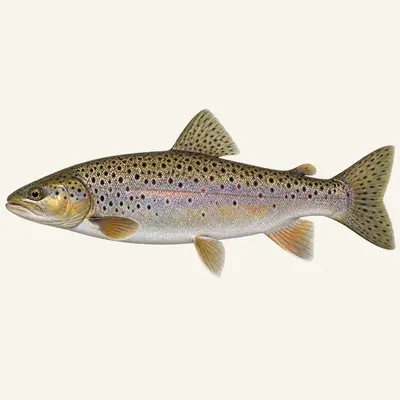
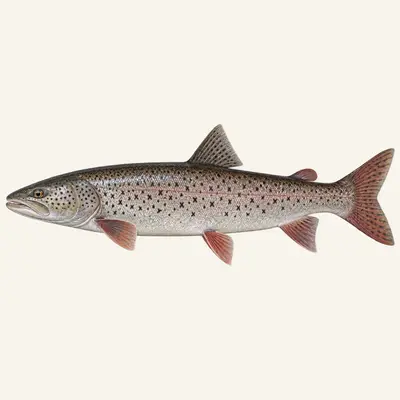
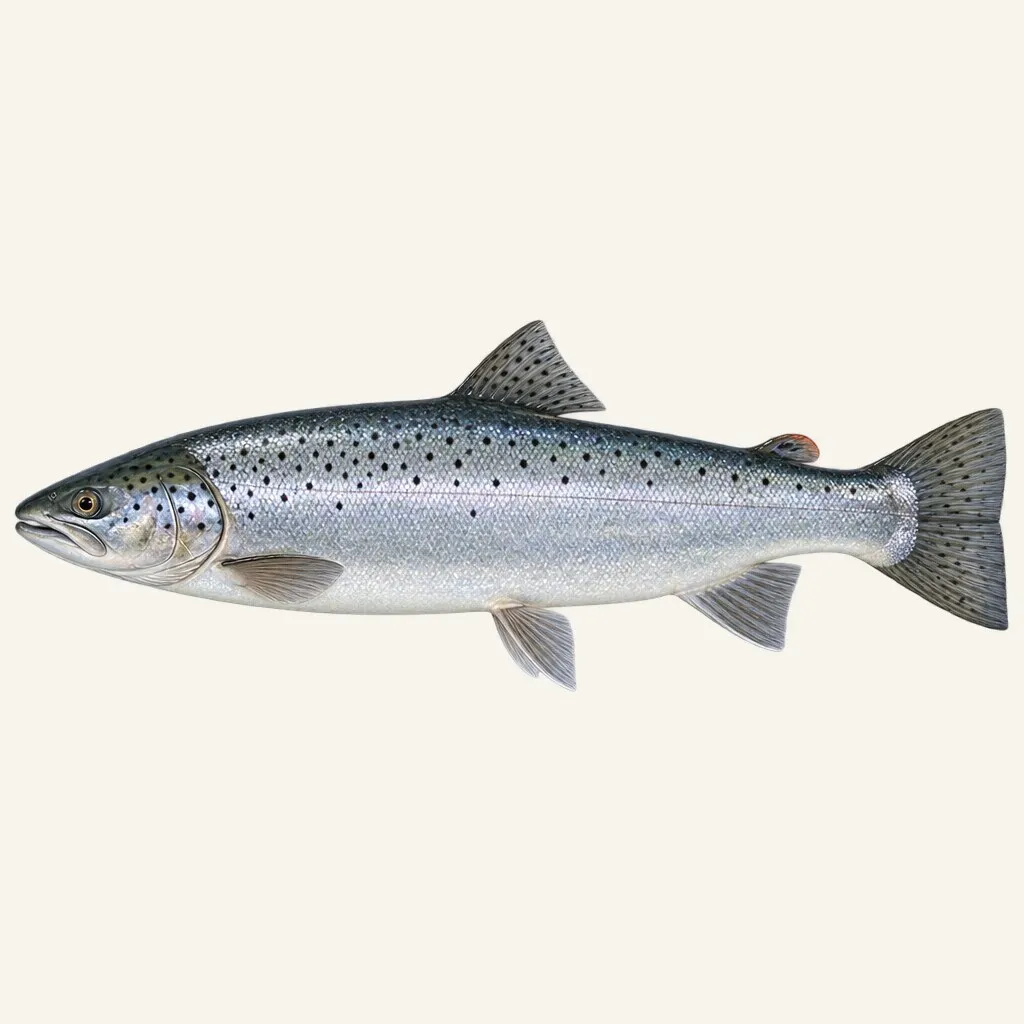
The silver is a condition, not a character. A trout back from salt water carries a hard bright flank that hides the grey-blue ground and the pale rings round its red spots; a few weeks in the river and the freckling comes back through. One individual answers two descriptions depending on the month it is caught.
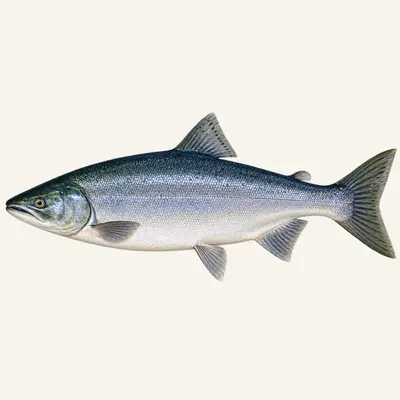
So the fish to hold it against is not the one in the headwater brook but the salmon sharing its estuary at much the same weight. Three things survive the silvering. Marks carry on below the lateral line instead of stopping there. The shaft of the vomer, down the centre of the palate, is armed along its whole length with strong teeth. And the wrist ahead of the tail is thick and rounded, so a hand closed round it slides off.
Against the stream-resident form there is nothing at all. Ray counts, vertebrae, dentition, scale size: identical, and both come out of the same redd. Running to sea is a decision taken by individuals inside a population, not the mark of a separate animal.
Breeding
The marine phase is settled in fresh water. Breeding fish come back into the river — the one interval of adult life spent out of salt water — and the spawning itself holds nothing peculiar: quick water, gravel, the female working fine material back over the eggs once they are down.
What belongs to the migratory form is the ability to repeat. It breeds more than once and returns to salt water between attempts, spreading its reproductive effort over several seasons rather than staking everything on one ascent.
The timetable is what puts wildly different fish in the same run. One to five years in the river before dropping down, then six months to five years feeding at sea: both brackets are wide, and combining them produces adults of no comparable size out of neighbouring year classes in one stream.
The water it needs
Three media in a fixed sequence: the river to hatch and grow in, the estuary to convert in, the coastal strip to put on weight in. None stands in for another, and the middle one is crossed twice.
At sea it stays shallow. The depth record runs to 28 m and the usual figure is one to two, which keeps the fish inside a cast from a beach or an estuary margin through most of its marine life.
Brackish water is a workplace rather than a barrier. The fish moves in and out of the mixing zone without the movement amounting to migration, and it is taken at salinities that change through a single tide.
Areas
- Estuaries
- river mouths
- lower reaches during the run
Techniques
- Lures
- Flies
- Worms
Baits
- Spinner
- Minnow lure
- Streamers
What it eats
Two diets, separated by one descent. In the river, juveniles and non-migratory fish live on insects, aquatic and terrestrial in roughly equal share. In salt water the menu becomes molluscs, crustaceans and small fish.
That switch is the whole return on the risk taken. The sea feeds better than a brook, and a trout that goes down grows to a weight the one that stays behind will never see. It forages both in open water and along the coastal bottom, with no sign of specialising on either.
How to catch it
At this stage the lie is a river mouth. Since the fish does not go far from the estuary it was born in, prospecting comes down to a narrow band: the beaches and shallow ground either side, the estuary margins, the first kilometres of the brackish reach. Fishing anywhere else is fishing for something that is not there.
Daylight should not be written off. The species is recorded as mainly diurnal in its marine phase as much as its river one, which cuts against the coastal habit of waiting for dusk.
Sea diet picks the lure. Out there the fish lives on small fish, crustaceans and molluscs, so slim baitfish profiles and shrimp imitations match what it is taking, where the same animal in fresh water would want an insect.
Conservation
This form accumulates chokepoints. The estuary, the lower river, every weir on the way up, then the gravel at the top: each can be closed, and one is enough to break the cycle.
The loss is hard to see from the bank. An anadromous stock vanishes while resident trout stay on in the headwaters, so the river still looks populated. What has gone is the fraction that went elsewhere to grow and carried the weight back in.
The estuary therefore matters as much as the redd. It is the most heavily engineered part of any coastal catchment and the one stretch every single fish has to pass through twice.
Regulations
Check the local regulations in force (legal size limits, closed seasons, bag limits).
For guidance only. Legal sizes, quotas and open seasons vary by location and season: always check the local regulations in force before fishing.
Other names
Sea trout is the name in Britain and Ireland, and the confusion it invites is transatlantic. In the southern United States sea trout, or speckled trout, means Cynoscion nebulosus, a drum with no connection to any salmonid, caught in warm estuaries where a real one would die. German has Meerforelle, Spanish reo, a word reserved for this form.
The doubled epithet is worth a line of its own. Salmo trutta trutta is the nominate subspecies, the repetition marking the form that was described first, and it lingers in fishery statistics and hatchery paperwork long after the systematics stopped supporting a split at all.
Sources: fishbase.se · api.gbif.org