Softmouth trout
Salmo obtusirostris · Salmonidae
- Freshwater
- Salmonids
- Hard
- Size
70 cm
Where to fish
- River
Habitat icons: Flaticon
Cold streams and small rivers, usually in deep, quiet stretches. Occurs in groups
Calendar
Recorded in 1 country
Bosnia & Herzegovina
GBIF occurrence records — native and introduced populations combined.
Its range
Five karst basins, and nothing in between them. The species occupies the Adriatic slope in the Krka, the Jadro and the Vrljika in Croatia, the Neretva in Bosnia-Herzegovina and the Zeta in Montenegro. These are short rivers fed by resurgences, separated from one another by limestone with no surface connection at all.
A sixth population exists by transport: fish from the Jadro were carried to the Žrnovnica around 1960 and established there.
The fragmentation is the governing fact. Each river holds a population that receives nothing from the others and that nothing can recolonise from outside. Losing one basin is permanent, and there is no natural process available to repair it — which is why a local decision about a small river carries a weight out of all proportion to the size of the river.
Identifying it
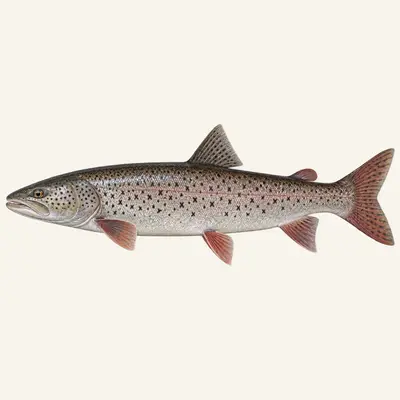
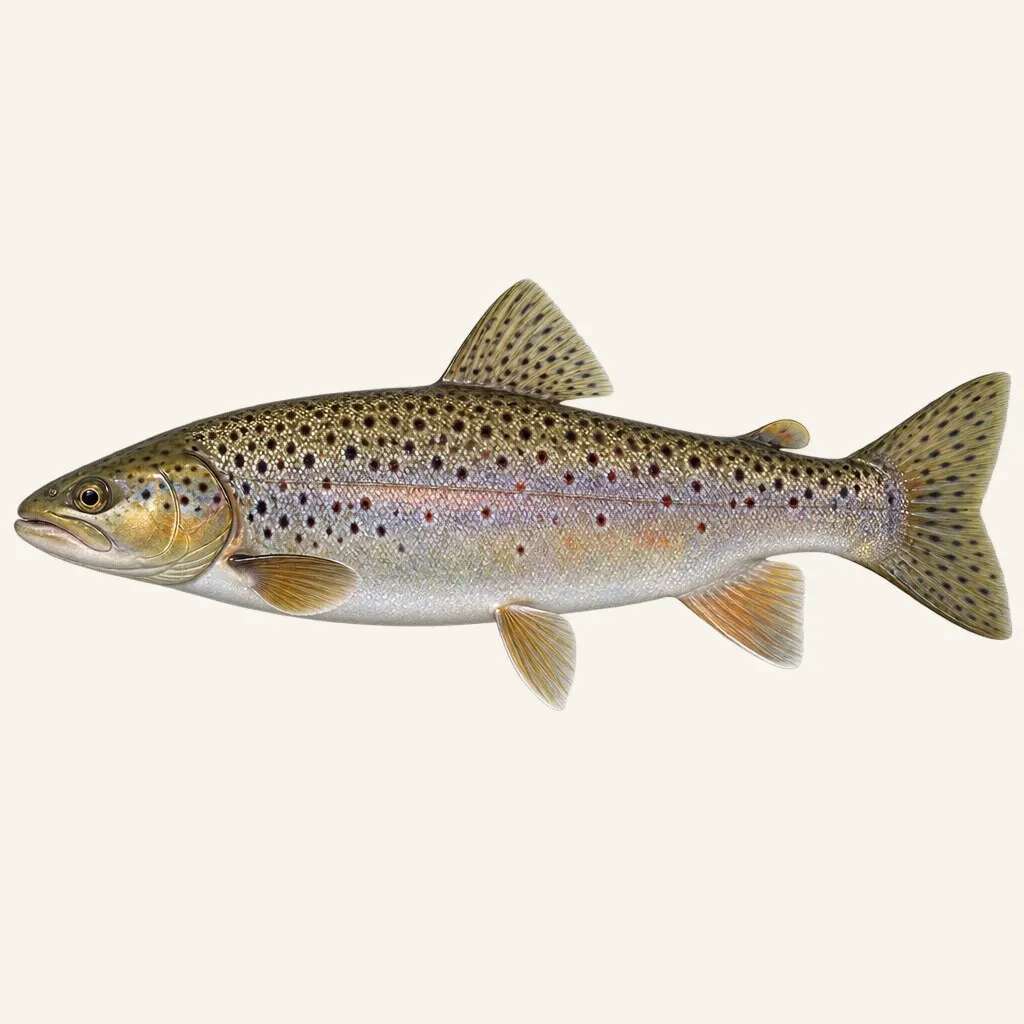
Fleshy lips, a blunt snout, a mouth set low and slightly behind the tip of the head, and jaw teeth so small they can be hard to make out at all. It is a grubber's head on a trout's body, and it registers before anything else does.
For anyone prepared to count, the lateral-line scale settles the question outright. It is elliptical, reduced to little more than the nerve tube it covers, and smaller than the scales in the rows on either side — the reverse of the usual arrangement, where the line is marked out by larger scales. There are 100 to 120 of them along its length.
The gill rakers are numerous: 26 to 32, against 13 to 18 in the brown trout. That count belongs with the mouth and the diet, and it confirms what the head has already announced. A trout built to strain and sift small food out of the bottom needs more rakers than one built to swallow fish whole.
Breeding
Laying happens in April and May. That is a complete displacement from every other Salmo in the region, the Black Sea trout among them, which spawn between October and January. The two calendars never meet, and a river holding both species is running two separate reproductive seasons in it.
A spring spawner depends on snowmelt hydrology and the discharges that follow it, not on autumn flows. So the abstractions and the releases that matter to this fish are not the ones that matter to its neighbours in the same basin, and a flow regime designed around an autumn-spawning salmonid can be exactly wrong for it.
The remainder of the cycle is not documented. Size at maturity, fecundity, incubation time: none of them is established for the species in the reference databases, which is a real gap for a fish that is fished commercially.
The water it needs
It lives high up and out of the current. That is the surprise: this trout occupies the cold upper courses and then holds in the deep, quiet places in them, not in the riffles where its relatives are looked for.
It also moves in groups, which is unusual in the genus, where the rule is one fish defending one station. A group takes a pool. The effect is that the species is concentrated into a small number of addresses per river while the rest of the length holds nothing, and a survey that samples evenly along a reach will misread the stock badly in either direction.
Areas
- Fast Balkan rivers
- Eddy zones
- Gravel riffles
Techniques
- Fly fishing
- Czech nymphing
- Toc fishing
Baits
- Artificial nymph
- Dry fly
- Aquatic larva
What it eats
It eats invertebrates, and nothing else is on record. No shift to fish is documented in the adult, which sets it apart from most trout of comparable size.
That is worth weighing, because the species builds its whole size on invertebrates alone. Doing so requires a river whose invertebrate production never stops, and a resurgence-fed river is precisely that: discharge and temperature both stable the year round, no lean season to interrupt growth.
How to catch it
The English name states the problem. The mouth is soft, the lips are fleshy and the teeth are reduced; a hook holds badly in it and tears. A hard strike, or hard pressure at the end of a fight, loses the fish. This trout is landed gently or not at all, and a barbless hook set with the rod rather than the wrist is the sensible arrangement.
The subinferior mouth and the thirty-odd rakers point down and small. Nymphs and larval imitations worked close to the bed match what the fish is actually looking for better than anything presented on the surface.
Searching follows from the group habit. The deep, slow pools of the upper courses hold the fish; a productive spot is very productive, and the water between the spots gives nothing at all. Identifying one occupied pool is worth more than covering a kilometre of river.
Conservation · Vulnerable (IUCN) — This species is threatened with extinction. Always release it (no-kill), handle it with the utmost care and check local rules — fishing for it may be prohibited.
Conservation
The species amounts to five short rivers, and each of them is a separate file. A lost population is not replaced, because no exchange exists between basins the limestone has kept apart for a very long time.
Three pressures are on record: dam construction, the introduction of new species, and overfishing. All three act on populations that each fit inside a single watercourse, so a structure of modest size can account for a fifth of everything there is.
Karst adds a vulnerability of its own. A resurgence river is the outlet of an aquifer, and what is spilled on the plateau above comes back out at the spring with little filtration and little delay. The catchment that actually feeds such a river is far larger than the surface map of it shows, and the activities that can damage it need not be anywhere near the water.
Regulations
Check the local regulations in force (legal size limits, closed seasons, bag limits).
For guidance only. Legal sizes, quotas and open seasons vary by location and season: always check the local regulations in force before fishing.
Other names
Softmouth trout is the established English name, Weichmaulforelle in German, trota dalla bocca molle in Italian, and all of them fix on the tissue that makes the fish hard to land. The Latin took the other end of the same head: obtusirostris means blunt-snouted.
Adriatic softmouth trout appears in the literature as well, and the addition earns its keep: it names the slope, which for a fish confined to five basins on one coast is most of the description there is.
Sources: fishbase.se · api.gbif.org