Sheefish
Stenodus leucichthys · Salmonidae
- Freshwater
- Salmonids
- Hard
- Size
61–150 cm
- Weight
2.3–40 kg
- Lifespan
22 years
Where to fish
- Estuary
- Lake
- River
Habitat icons: Flaticon
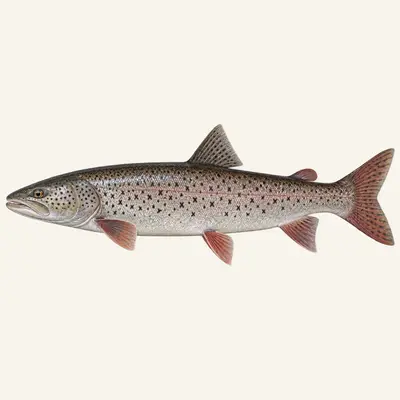
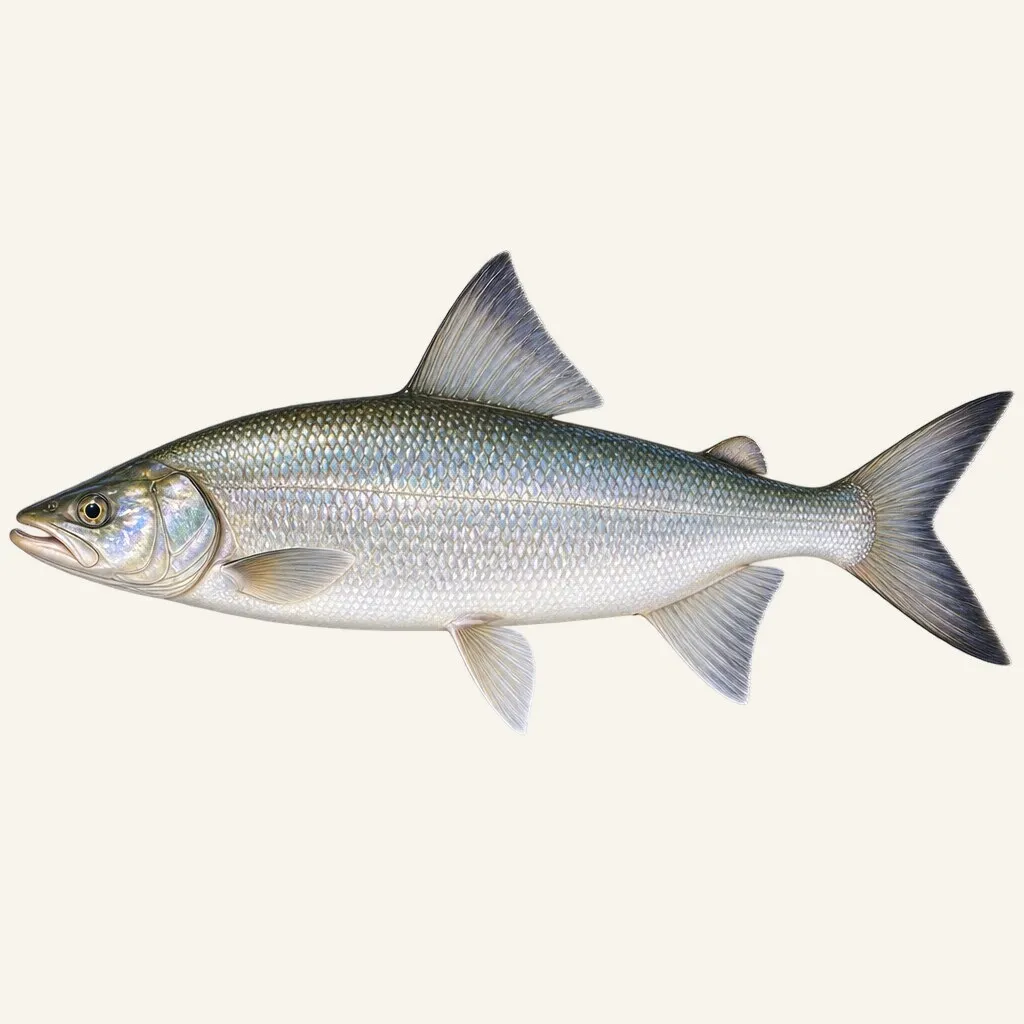
Large salmonid with an elongated, silvery body and a well-developed wide mouth, capable of reaching impressive sizes among North American whitefishes.
Calendar
Recorded in 2 countries
GBIF occurrence records — native and introduced populations combined.
Its range
The range is two blocks with nothing between them. The first is the North American Arctic: drainages from the Anderson River in the Northwest Territories to the Kuskokwim in Alaska, with penetration up the Mackenzie and the Yukon as far as British Columbia. The second is Eurasian and consists of the Caspian Sea, where the fish is common in the central and southern basin in summer, together with the Volga, Ural and Terek drainages.
The second block is the anomaly, and it is where the difficulties sit. A boreal fish whose other populations live at or above the Arctic circle occupies an enclosed sea a long way south, reached by rivers it has to climb to breed.
Identifying it
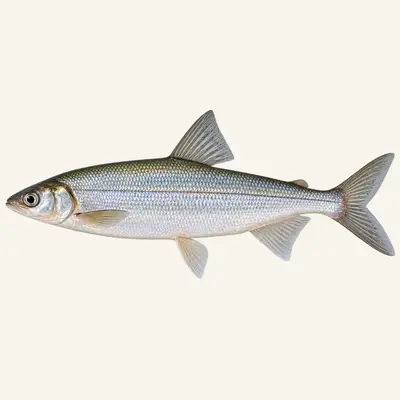
The published diagnosis separates this fish by three characters, and all three belong to the same apparatus. The mouth is large. The lower jaw protrudes past the upper. And there are only 13 to 17 gill rakers on the lower limb of the first gill arch.
Read that against the genus it sits beside. The description of the common whitefish gives a small mouth with a protruding upper jaw — the same two characters, inverted term for term. The catalogue text rendered on this page independently calls the mouth wide and well developed. Three sources, one head: this is a whitefish built the wrong way round.
The rest is family issue. The body is fusiform and silvery, the back green, blue or pale brown, the underside white. Dorsal and caudal carry dusky margins while the other fins stay pale. The dorsal fin is high and pointed, and the pelvics have a well developed axillary process at the base. Counts run 11 to 19 soft rays in the dorsal and 14 to 19 in the anal, no spines anywhere, with 63 to 69 vertebrae.
One caution belongs here rather than in a laboratory. Crosses with Coregonus nelsoni, Coregonus autumnalis and Coregonus muksun are on record, and the source attributes them to the way the gametes are released rather than to any pairing between the parents: eggs and milt go into open water over gravel, so two species using the same shallows in the same week mix without either of them choosing it. A fish on those grounds that fits neither description cleanly is a real possibility.
Breeding
Upstream movement starts at ice break-up. The first displacements out of the wintering grounds may still be feeding, but the movement soon becomes a directed run towards the spawning area, sometimes far up a large lowland river.
Spawning begins at dusk and carries well into the night, over gravel shallows. A female with a male in attendance rises to the surface at the upstream end of the ground and crosses the current quickly, shedding eggs as she goes; the male holds below her so that the milt meets the eggs on their way down to the gravel. She then drifts back downstream and either repeats the pass over the lower part of the ground or works her way up to the head of it for another. The return to the wintering grounds follows the end of laying closely.
The interval between two of those seasons is the fact that changes everything. Annual spawning is not established. Russian fish appear to spawn only every third or fourth year, and fish at Selawik in Alaska perhaps every other year. Length at first maturity is 72.5 cm, in a range of 70 to 75.
So a ripe female intercepted on the run is not one season's production. She is two to four years of it, held in one animal, at the one moment when she is concentrated, shallow and not feeding.
The water it needs
Three environments, used in sequence rather than chosen. Adults occur in coastal brackish water off river mouths, but they spend most of their time in rivers or in landlocked lakes. At sea they hold the pelagic zone of the basin, in water below 18 degrees, between 20 and 50 m.
The detail worth taking away is that wintering is not dormancy. Juveniles and adults overwinter and forage at the same time, which sets this fish apart from the freshwater predators that shut down for the cold months. The fast comes later, on the spawning run.
Areas
- Large boreal rivers
- Deep pools
- River mouths
- Northern lakes
Techniques
- Spinner
- Minnow plug
- Streamer fly fishing
- Heavy spinning
Baits
- Silver spoons
- Minnow plugs
- Large streamers
- Soft lures
- Small dead baitfish
What it eats
Adults feed mostly on small fishes. The young take aquatic insect larvae and planktonic crustaceans, then cross over to vertebrate prey and stay there.
That single line is what makes the species odd, and the oddity is measurable in the repository rather than asserted. The vendace rubric gives adults feeding on planktonic crustaceans. The cisco rubric gives plankton and large crustaceans. The lake whitefish works the sediment for insect larvae, molluscs and amphipods. Against those three, "small fishes".
The reduced raker count and the long jaw are the anatomical price and the anatomical gain. A fine, crowded comb strains small animals out of water; 13 to 17 rakers strain nothing, and the head that carries them has been rebuilt around holding something that struggles.
There is one interruption. During the spawning migration the fish feeds little if at all, which matters more here than it would in a species that spawns every year.
How to catch it
A whitefish that eats fish is fished like a predator. Spoons, minnow plugs and large streamers are what the catalogue lists, and the emergence and plankton imitations that account for the rest of the family are beside the point: what works is anything that reads as a small silver prey animal.
The window is set by appetite rather than by presence, and the two point in opposite directions. The fish is most visible and most concentrated on the run to the spawning grounds, which is precisely when it has stopped eating. It is in full feeding activity on the wintering and foraging grounds, cold water included — hence the ice fishery. Looking for the spawning aggregation is the best way to see fish and the worst way to catch them.
The size at which this animal becomes an adult also needs resetting against ordinary freshwater experience. Maturity arrives between 70 and 75 cm. A fish appreciably shorter than that has in all likelihood never spawned, and a very large one carries a great many years and a small number of actual reproductions.
Conservation · Near Threatened (IUCN) — This species is in decline. Release your catch quickly and handle it with care — wet hands, as little time out of the water as possible.
Conservation
The pressure point is access, and it does not act gradually. Spawning happens on gravel shallows a long way upstream; one structure across the route removes the whole of it in a single step, with no intermediate stage in which the fish makes do with less.
The Volga is among the most heavily engineered rivers in Europe. The Caspian fish were the ones that ran furthest up it, and the source records commercial rearing alongside a fishery that is only minor — an unusual pairing for a fish of this rarity, and one worth reading for what it implies about how the southern population is maintained.
Breeding frequency then compounds the arithmetic. A population that spawns one year in three or four replaces its adults at a third or a quarter of the rate an annual spawner manages, and absorbs removals accordingly. The gap between the speed at which fish can be taken out and the speed at which they come back is wider here than in almost any other freshwater fishery.
Regulations
Check the local regulations in force (legal size limits, closed seasons, bag limits).
For guidance only. Legal sizes, quotas and open seasons vary by location and season: always check the local regulations in force before fishing.
Other names
English uses two names for this fish and neither is quite English. In Canada it is the inconnu — a French word, left untranslated, and the story attached to it is that Francophone voyageurs on the Mackenzie had nothing to compare it with. In Alaska it is the sheefish, which is the name the catalogue carries and the one a fish counter will print.
Russian says nelma, and the Caspian form is the belorybitsa, the white fish. The specific epithet says the same thing twice over, leucichthys being built from the Greek for white and for fish, and German follows with Weißlachs, white salmon. Only the genus name looks at the head: Stenodus, narrow tooth.
The market word is the one to distrust. This species belongs among the whitefishes and is not what a fishmonger means by whitefish, which labels almost any pale fillet and settles nothing.
Sources: fishbase.se · api.gbif.org