Sockeye salmon
Oncorhynchus nerka · Salmonidae
- Saltwater
- Salmonids
- Medium
- Size
45–84 cm
- Weight
1.1–7.7 kg
- Lifespan
8 years
- Water temp.
0–25 °C
- Depth
0–250 m
Where to fish
- Estuary
Habitat icons: Flaticon
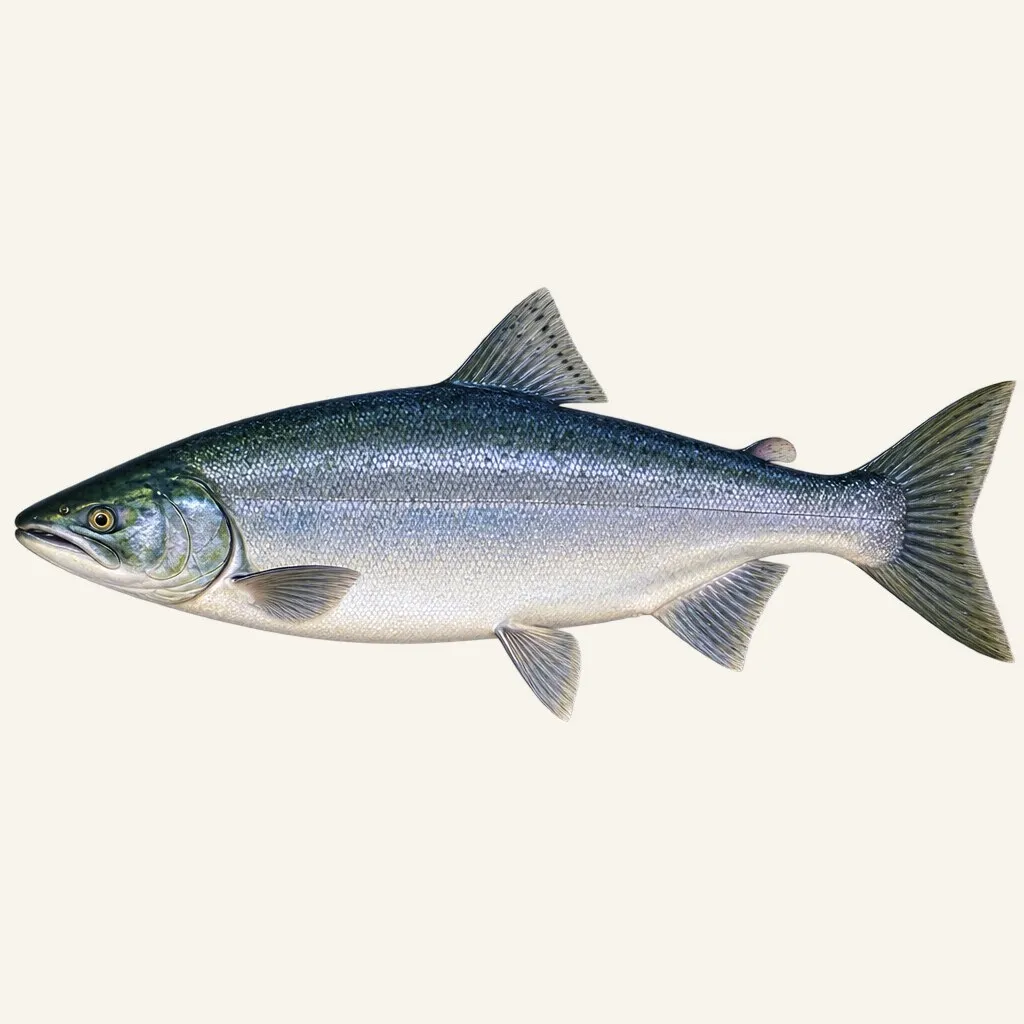
The sockeye salmon is an anadromous Pacific salmonid instantly recognizable by its bright red spawning coloration and green head. It undertakes lengthy ocean-to-freshwater migrations to spawn in rivers and lakes, and is among the most prized Pacific salmon for its firm, richly flavored flesh.
Calendar
Recorded in 6 countries
Canada · Japan · New Zealand · Russia · Sweden · United States
GBIF occurrence records — native and introduced populations combined.
Its range
One requirement shapes this range more than latitude does: a lake. Most young sockeye spend one or two years — rarely three or four — in still water before going to sea, and a drainage without a rearing lake produces few of them or none, whatever the quality of its gravel. The species is therefore built around lake-headed systems, where its congeners will take any stream with a decent bed.
A handful of populations break the rule. In some tributaries of the Copper River in Alaska the young stay in the stream; elsewhere fry drop to the sea in their first summer.
The other departure is permanent. Landlocked populations, called kokanee, hold in Alaska, the Yukon, British Columbia, Washington, Oregon and California, completing the whole cycle between a lake and its tributary and staying much smaller than the migratory form. Each of them descends from a particular anadromous run, independently of the others: the landlocking did not happen once and spread, it happened many times over, separately, and produced the same fish each time.
The boundary between the two forms leaks in both directions. Offspring of kokanee occasionally go to sea, and offspring of sea-run fish occasionally stay behind.
Identifying it
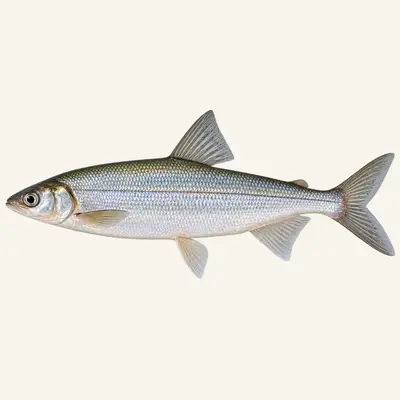
The first gill arch carries 30 to 40 rakers, long, fine, serrated and set close together. No other Pacific salmon has a comb like it. The structure is a plankton strainer, fitted to a fish that lives on plankton for most of its years, and it settles the identification better than colour does — because the colour of this species changes completely before it dies.
The second character is an absence. Neither the back nor the tail carries a definite spot. Some individuals show dark speckling and irregular marks on the dorsal fin, and nothing beyond that: the coarse ovals of the pink salmon and the fine peppering of the chinook are both missing.
The body is fusiform and laterally compressed, of moderate depth, a little deeper in breeding males. The head is bluntly pointed and conical, the snout rather pointed, the eye small with its position shifting according to sex and condition. Lateral line straight, caudal emarginate, pelvic fins with an axillary process. Counts run 11 to 16 soft rays in the dorsal, 13 to 18 in the anal, and 56 to 67 vertebrae.
A fish still in salt water, or newly into the river, is dark steel blue to greenish blue over head and back, silver along the sides, white to silvery below. What follows is the reason the fish is called red salmon over much of its range: the flanks turn red, the male's head to bright or olive green with black over the snout and upper jaw, the adipose and anal fins redden, and the paired fins and tail go grey, green or dark. Females colour less strongly. The pattern is not universal — a few populations finish dull green or yellowish, with little red on them, or none.
Breeding
Spawning is crowded, and the roles divide by sex. The female chooses her gravel and begins to dig, attended by one dominant male and a few subordinates. She drives off other females and any subordinate that presses too close, while the dominant deals with rival males. Between bouts of digging she rests over the pit and he courts her.
The act itself is short. She settles into the finished pit, the dominant comes alongside, both gape, and a shared vibration puts eggs and sperm down into the gravel; one or more subordinates may push in on her far side and add theirs. She then moves up a body length and cuts the next pit, and the gravel she throws back seals the eggs already laid.
Three to five days and three to five nests empty her. She may take a succession of dominant males over that time, and each of those males may serve other females, so the eggs under one patch of gravel carry a wider mix of parentage than the pairing on the surface suggests.
Runs arrive through summer and autumn, and as late as December at the southern end of the range. Every adult that reaches the gravel dies on it.
The water it needs
Open ocean, lakes, and coastal streams for spawning alone. The band occupied runs from the surface to 250 m, in water between 0 and 25 °C.
Fry behaviour is worth knowing before anything is read into an empty-looking spawning reach. On leaving the gravel they avoid light, hiding through the day and coming out at night, so a redd that appears deserted at noon may not be.
In the lake the young hold inshore for a few weeks on ostracods, cladocerans and insect larvae, then move out and become properly pelagic in roughly the top 20 m, where the plankton sits. The run to sea repeats the same sequence at a larger scale: the coastal strip first, open water afterwards.
Areas
- Deep freshwater lakes
- River mouths
- Deep river pools
- Pacific coastal zones
Techniques
- Fly fishing (nymphs, streamers)
- Lure fishing (gold spoons)
- Egg drift fishing
- Open-water trolling offshore
Baits
- Salmon eggs
- Shrimp
- Artificial nymphs
- Gold spoons
What it eats
Plankton, taken with the comb, is the whole of it in a lake, with insects and bottom organisms filling in around it. A kokanee eats little else in its life.
The sea-run form starts the same way and then changes. Smolts hold near the coast on zooplankton, with a few small fish and insects; as they grow and work offshore, fish take a rising share. That ocean phase is where the growth happens, and the difference in size between the two forms measures access to it and nothing else.
How to catch it
The gill comb sets the terms. A fish that strains zooplankton does not run down prey, and nothing in its feeding prepares it to attack an imitation of a baitfish. Kokanee, which never leave that diet, are for this reason the most awkward salmonid in fresh water to approach with conventional trout logic.
Two things follow. Depth first: in a lake the fish sits in the layer holding its food, and a presentation put in that band is worth more than any choice of pattern. Then the chain it sits in. Where kokanee are abundant they are themselves the forage of large trout and char, so a screen full of them marks the fish that eat them as much as the fish showing.
In rivers the anadromous form is taken during the run, on fish already committed to maturation. These fisheries are closely regulated throughout the range, with provisions that change between drainages and between seasons; the agency managing the water is the only useful reference before a trip.
Conservation
Every population rests on a link the other Pacific salmons do without: the rearing lake. Damage it, or cut the corridor joining it to the sea, and the run goes even with the spawning gravel untouched — and a lake deteriorates without anything showing on the redds.
Heavy commercial value has bought the species close attention in return. Escapement is counted every year, drainage by drainage, and the series are long. That is the scale at which the fish is actually managed. A verdict passed over the entire range, last revisited in 2010, says nothing about the state of one river.
Landlocking also manufactures diversity that no global count picks up. Each kokanee stock traces back to a separate anadromous run and forms its own lineage; losing one does not subtract a fraction from a total, it deletes an evolutionary history that will not be run again.
Regulations
Check the local regulations in force (legal size limits, closed seasons, bag limits).
For guidance only. Legal sizes, quotas and open seasons vary by location and season: always check the local regulations in force before fishing.
Other names
Sockeye is a reshaping of a Halkomelem word by English-speaking traders, and has nothing to do with eyes or with socks — the folk etymologies are persistent enough to be worth putting down. Red salmon is the ordinary name through much of Alaska, after the spawning dress; blueback appears on the Columbia for sea-bright fish. The landlocked form is kokanee wherever it occurs, which gives one species two names in daily use with no taxonomic distinction between them. German has Rotlachs, Spanish salmón rojo.
Sources: fishbase.se · api.gbif.org