Taimen
Hucho taimen · Salmonidae
- Freshwater
- Salmonids
- Hard
- Size
200 cm
- Weight
105 kg
- Lifespan
55 years
Where to fish
- River
Habitat icons: Flaticon
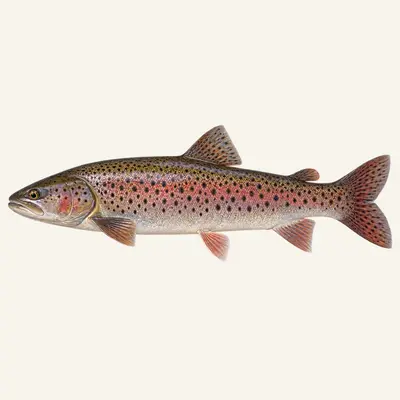
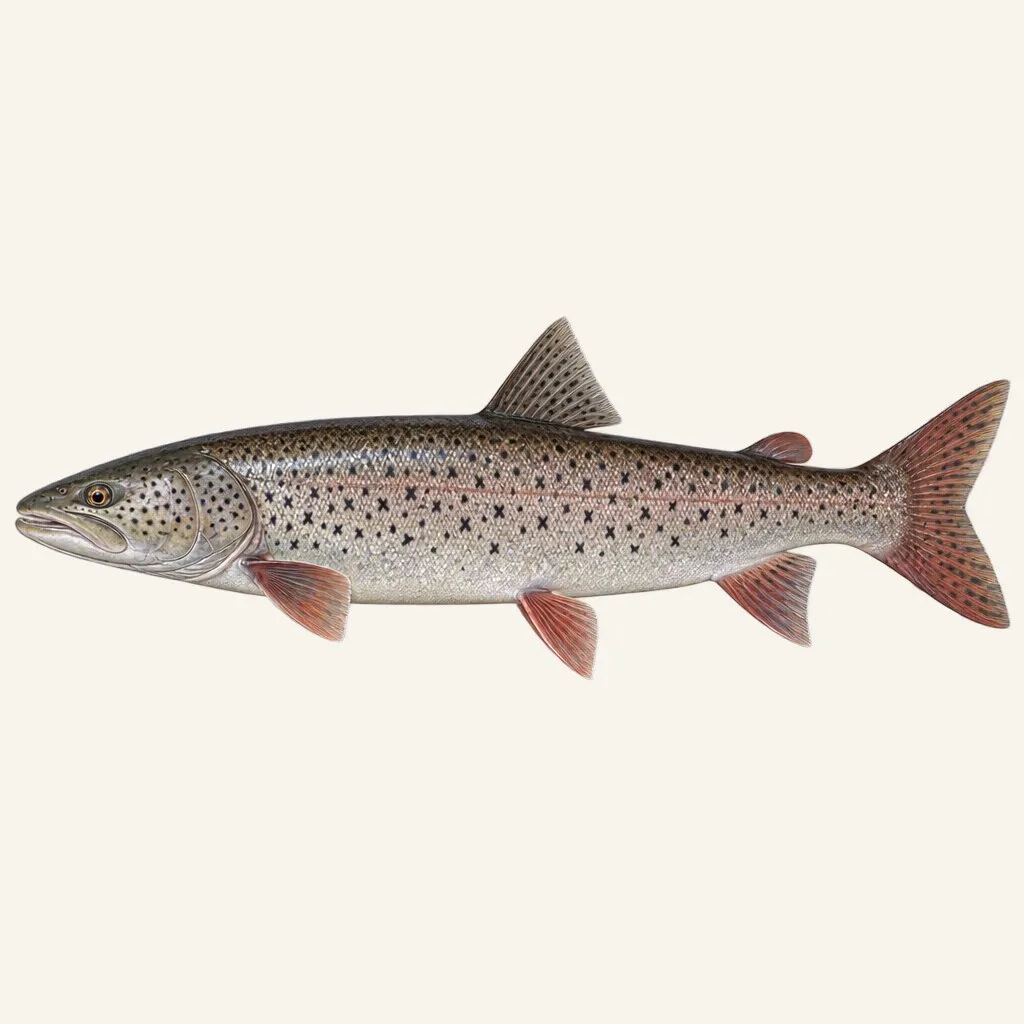
The Taimen is the world's largest salmonid, recognizable by its elongated body, wide mouth, and golden to reddish hues along its flanks.
Calendar
Recorded in 2 countries
Mongolia · Russia
GBIF occurrence records — native and introduced populations combined.
Its range
The species holds some upper tributaries of the Pechora and Kama — including the Vyatka, Belaya, Vishera and Chusovaya — in the Volga drainage; Siberia from the Ob to the Yana; and the Amur with some adjacent drainages.
One line in that record is worth reading twice: before the Kama was impounded, taimen used to enter the Volga and reach downriver as far as Samara. A dam did not reduce that range, it deleted it.
Identifying it
Small cross-shaped dark spots mark the head and sides. That shape is the character — not round spots, not vermiculation, but small crosses, and nothing else in the family carries them.
The teeth on vomer and palatine form a continuous horseshoe-shaped band, which separates the fish from the other large salmonids of central and eastern Europe. The maxilla reaches back past the rear edge of the eye. Scales are oval, minute, without radial grooves, and the growth rings are extremely clear. The adipose fin is well developed.
Two counts are extraordinary: 173 to 288 scales along the midlateral row, and 205 to 219 pyloric caeca.
Breeding
The female digs a redd a metre to a metre and a half across. The eggs are large — 5 to 6 mm — and hatch after 28 to 38 days.
Alevins stay in the gravel until the yolk sac is absorbed, 10 to 15 days, then the young hold near the spawning site before dropping downstream.
A metre-wide redd needs a patch of clean loose gravel of that size, in the right depth of water, in a river that still moves its bed. That is a more demanding requirement than it sounds, and it is the first thing regulation of a river removes.
The water it needs
Adults hold piedmont and montane cold rivers with high oxygen. For periods of reduced activity — daytime, winter — they prefer deeper holes with slow current, and they also use lower reaches, estuaries, cold lakes and reservoirs.
Both juveniles and adults are territorial, and the adult territories are specific: deep holes below rapids and waterfalls, the confluence of small tributaries, the scour below a bridge pier.
A territorial fish in a known hole is a findable fish. That is the whole of the taimen's problem as a species and the whole of its appeal as a quarry.
Areas
- Large pools in Siberian rivers
- River confluences
- Deep rapids
- Slow current zones under cutbanks
Techniques
- Large fly streamer
- Heavy spinner casting
- Surface lures
- Live bait fishing
Baits
- Large rodent imitation streamers
- Worked dead fish
- Heavy spinners
- Large surface lures
How to catch it
Every one of the lies is a named feature: the hole below a rapid, the mouth of a small tributary, the scour under a bridge. Learn three of them on a river and you have the fishery.
Daytime and winter both push the fish into the deep slow holes, so the same water produces at very different times of year for different reasons.
The scale of the animal decides the tackle, and its age decides what a capture costs: taimen live to 55 years. A large taimen predates every angler who will ever cast to it.
The fishery is controlled where it survives, and what applies is a matter for the competent authority.
Conservation · Vulnerable (IUCN) — This species is threatened with extinction. Always release it (no-kill), handle it with the utmost care and check local rules — fishing for it may be prohibited.
Conservation
Fifty-five years of life is the number to hold onto. A population of taimen is a bank of very old fish, and a bank that takes half a century to rebuild cannot absorb a bad decade.
Territoriality compounds it. A fish that occupies one known hole and returns to it is removable one hole at a time, and the holes are finite and mapped.
The Kama impoundment shows the third mechanism at its clearest: a dam did not thin the downstream population, it ended it, and the range on the map today is smaller than the range in the record.
Regulations
Check the local regulations in force (legal size limits, closed seasons, bag limits).
For guidance only. Legal sizes, quotas and open seasons vary by location and season: always check the local regulations in force before fishing.
Other names
Taimen in English, also Siberian taimen and — in fishing literature — Siberian giant trout, which is wrong on the last word since this is neither Salmo nor Oncorhynchus. Taïmen in French, and cognate forms across Russian and Mongolian, where the fish carries considerable cultural weight.
Sources: fishbase.se · api.gbif.org