Vendace
Coregonus albula · Salmonidae
- Freshwater
- Salmonids
- Medium
- Size
20–48 cm
- Weight
0.1–1.0 kg
- Lifespan
10 years
- Depth
6–24 m
Where to fish
- Lake
Habitat icons: Flaticon
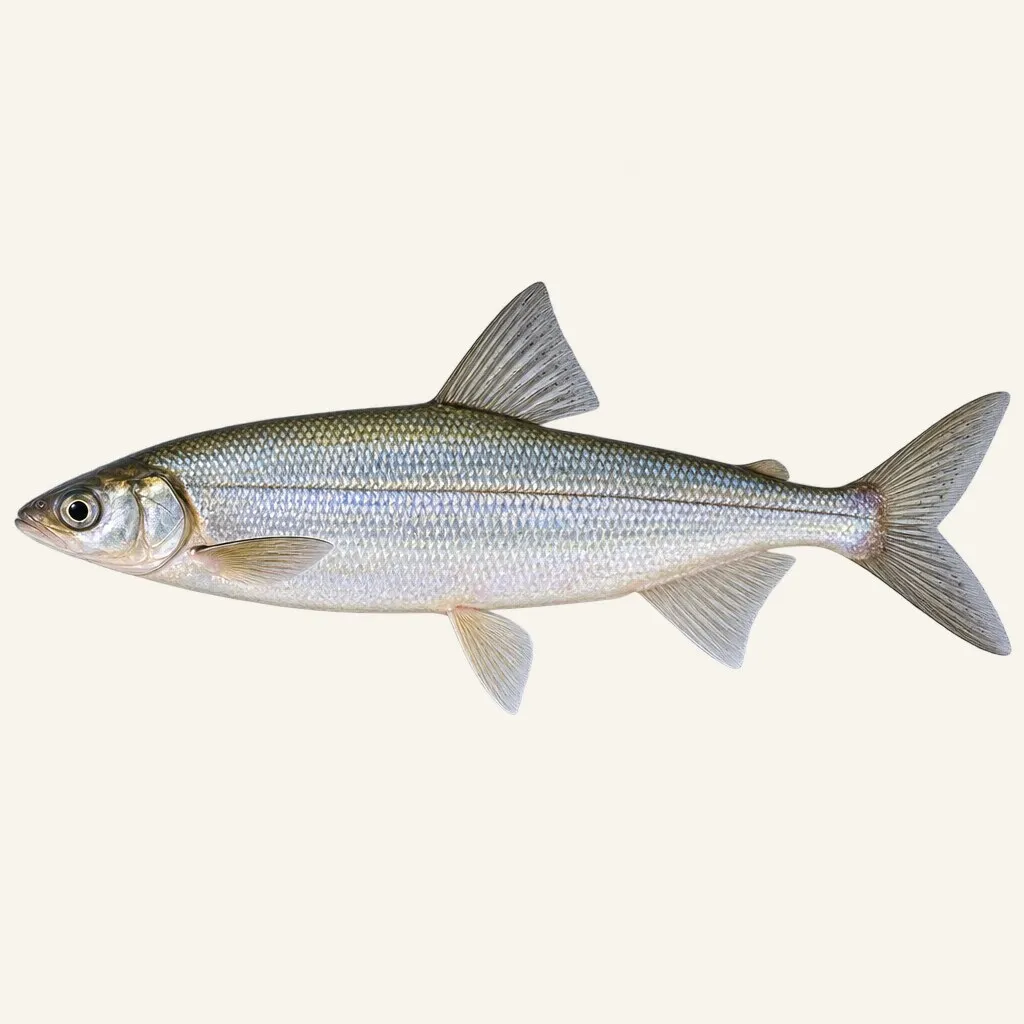
The vendace is a small salmonid with a silvery spindle-shaped body and a small downward-turned mouth adapted for catching plankton.
Calendar
Recorded in 12 countries
Canada · Denmark · Finland · France · Germany · Lithuania · Netherlands · Norway · Poland · Russia · Sweden · United Kingdom
GBIF occurrence records — native and introduced populations combined.
Its range
The range covers the Baltic basin, the lakes of the upper Volga — Seliger, Vseluga, Perejaslavskoe — and scattered lakes in the White Sea and North Sea basins east of the Elbe.
It is anadromous in the Gulf of Finland and lives as a marine fish in the freshened northernmost part of the Gulf of Bothnia, running north as far as Lake Inari at around 69 degrees. A salmonid holding station in the open sea, even a sea as dilute as that one, is not what the family is usually doing.
It has gone from the lower Rhine, where it once occurred and no longer does. Stocking into German and Polish lakes and reservoirs is frequent and continuing.
Identifying it
The fin formula separates this fish from its larger relatives: 11 to 13 soft rays in the dorsal, 13 to 17 in the anal, and no spines in either. The body is silver and fusiform, as it is throughout the genus.
Size settles the rest. A fish of 20 cm is an ordinary one, and 10 years is the maximum reported age. The common whitefish of the Alpine lakes runs to 73 cm and 10 kg, so once the two are on the same table there is no argument to be had.
Breeding
Adults run a short distance up rivers in shoals between late August and mid-October. Maturity comes in the second year, later in the purely lake-dwelling populations, and the young drop back down at the end of the following summer.
Spawning takes place along the shoreline, on shallow sand or gravel, usually between 3 and 10 m and occasionally as deep as 22 or as shallow as just under the surface.
That spread is not random. Spawning is deeper in clear lakes and closer to the surface in humic ones, where dissolved organic matter stains the water brown and cuts the light. The fish sets its spawning ground by how far light penetrates, not by a depth contour, which means the same species lays at 15 m in one lake and at 2 m in the next one along without doing anything differently.
The water it needs
Open water, in lakes and at sea alike. In marine conditions it forages close inshore; in deep lakes the adults form shoals well off the bottom. Recorded depth runs from 6 to 24 m.
The point to take from this is negative. It is not a fish of margins, of weed edges or of structure of any kind, and the reading of a bank that serves for most freshwater species is of no use here. The habitat is a volume of water rather than a place on a map.
Areas
- Open water in cold lakes
- Pelagic zones at variable depths
- Shallows during spawning period
- Ice-covered lakes in winter
Techniques
- Fly fishing (small nymphs)
- Miniature lure fishing (micro-spoons)
- Fine trotting (worms, maggots)
- Ice fishing (light jigging)
Baits
- Maggots
- Bloodworms
- Bright micro-lures
- Small artificial nymphs
What it eats
Adults feed on planktonic crustaceans, and on very little else.
The specialisation is tighter than that of the common whitefish, which switches to bottom-living crustaceans when it moves into brackish water. This one does not switch. It stays in the open water and it stays on plankton, which ties it directly to how much of that a lake is producing and where in the water column it currently is.
How to catch it
This is chiefly a netted commercial fish and the recreational fishery for it is a specialist one, built around the same constraint in both cases: locating a shoal suspended somewhere in open water, at a depth that changes with the plankton.
The tiny mouth and the small body force everything to be scaled down. Strings of very small hooks fished on one line — the standard rig wherever this fish is taken on rod and line — follow directly from that anatomy combined with shoaling behaviour: several fish from one drop, or none.
The upriver movement between late August and mid-October is the most legible window in its year. The fish concentrate, they are briefly in a defined place, and the rest of the calendar offers nothing so clear.
Conservation
The loss from the lower Rhine is the most telling line in the record. A species can be extinguished on one of Europe's major rivers while remaining abundant in the Baltic lakes a few hundred kilometres away, which is what happens when a fish depends on a specific water column rather than on a region.
Dependence on plankton ties it to the trophic state of a lake. Enrichment changes the plankton community, and the whitefish disappear from a lake that still looks perfectly healthy from the shore. Warming does the same thing from another direction by thinning the cold layer the species needs.
Repeated stocking across Germany and Poland raises the question that follows this genus everywhere: what is being mixed, given that nobody is confident about how many lineages exist or where their boundaries fall.
Regulations
Check the local regulations in force (legal size limits, closed seasons, bag limits).
For guidance only. Legal sizes, quotas and open seasons vary by location and season: always check the local regulations in force before fishing.
Other names
Vendace is the English name, and it is a borrowed one — English never coined a word for this fish because English-speaking countries have very little of it. Where North Americans meet the genus they call the equivalent fish a cisco, and European cisco is sometimes used for this species on that model.
German has Kleine Maräne, Finnish muikku, and in Finland the fish is an everyday food, fried whole, which is exactly what a 20 cm fish is for. Its roe supports a small high-value fishery in the northern Baltic.
The species epithet means whitish. In a genus where almost every member is silver and many common names contain the word white, it is not the most discriminating label ever attached to an animal.
Sources: fishbase.se · api.gbif.org