Walking catfish
Clarias batrachus · Clariidae
- Freshwater
- Catfish
- Medium
- Size
26–47 cm
- Weight
0.1–1.2 kg
- Water temp.
10–28 °C
Where to fish
- Canal
- Pond
Habitat icons: Flaticon
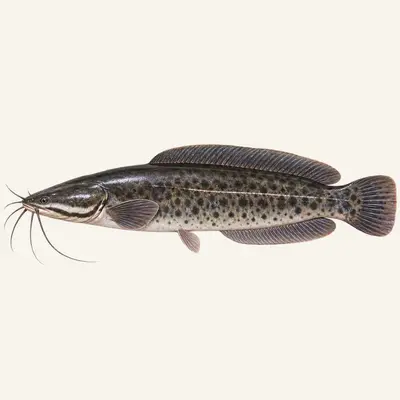
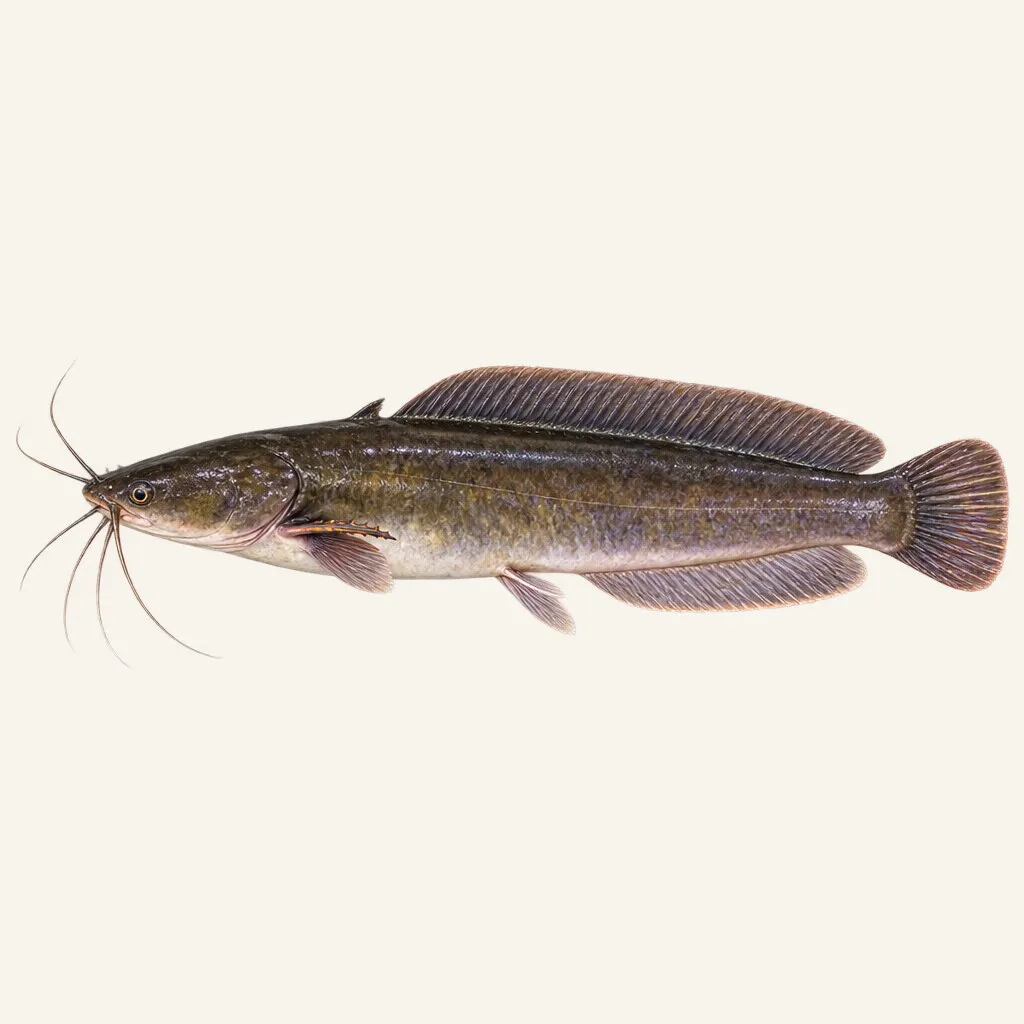
The walking catfish is a robust, elongated catfish equipped with pectoral appendages that allow it to move out of water for short distances.
Calendar
Recorded in 14 countries
Bangladesh · Cambodia · China · India · Indonesia · Laos · Malaysia · Myanmar (Burma) · Philippines · Singapore · Taiwan · Thailand · United States · Vietnam
GBIF occurrence records — native and introduced populations combined.
Its range
The name covers less than it appears to, and that is the most important thing on its map. The true Clarias batrachus is a fish of Java. The populations of Indochina and of Sundaland, long filed under the same label, belong to other species still poorly fixed. All the older literature on the walking catfish of Thailand or Malaysia therefore describes something other than the nominal species.
The rest of the distribution is owed to aquaculture and to the ornamental trade, which scattered it well beyond Asia. Several countries have recorded adverse ecological impact since: a fish that covers the distance between two waters on foot does not stay in the one it was put in, and a fish farm's fencing does not stop it.
What the introduction produced in Florida is the case usually cited. Escapes from ornamental holdings in the 1960s put the species into the canal network of the southern peninsula, where a landscape of interconnected ditches and seasonal ponds reproduced the conditions of its home range almost exactly, and where the animal's ability to cross dry ground turned every isolated water body into part of one system.
Identifying it
The pectoral spine holds the key, and it has to be read the right way round. On this fish the outer edge is rough and it is the inner edge that carries the denticles — the exact reverse of its African relative, on which only the outer face is serrated. Two neighbouring fish, two weapons mounted back to front.
The second landmark is the back of the skull. The occipital process forms a more or less distinct triangle, its length about half its width; the space separating it from the dorsal fin goes four to five and a half times into the distance from the snout to the end of that same process. Those ratios are taken on a wet fish laid flat and are enough to decide.
For the rest, an elongated body compressed towards the rear, an upper jaw projecting slightly beyond the lower, a dorsal of 60 to 76 soft rays and an anal of 47 to 58, both without spines. Sex can be read without dissection: the genital papilla of the male is elongated and pointed.
Breeding
Mating goes through an embrace, a gesture shared with several catfishes. The two partners begin by nudging each other gently in the genital region while flicking their dorsal fins, then the male wraps his body around the female, who releases a stream of adhesive eggs into the nest.
The nest is excavated, and that is what ties the spawning to the season. In South-East Asia breeding waits for the monsoon: rising water softens the mud banks and the dikes of flooded rice fields, the only material a pair can dig into. An insufficient flood does not delay laying, it makes it impossible for want of a support — and sticky eggs dropped on the bare floor of a stagnant pool are worth nothing.
The water it needs
It occupies the bottom of the scale of waters, the ones other species desert. Lowland streams, swamps, ponds, ditches, rice paddies, pools abandoned by a falling river: the common denominator is standing, loaded water over a muddy bed. It is also found in medium to large rivers and in slow-flowing canals, but dead water is where it is at home.
The annual cycle follows the flood. From the main channel of the Mekong, or from any permanent water, it moves laterally onto the inundated ground during the high-water season, then falls back to permanent water as soon as the dry season sets in.
Its auxiliary breathing organs keep it alive out of water for an appreciable time and let it cover short distances overland from one water body to another. It also tolerates slight salinity, which opens the lower deltas to it.
Areas
- Agricultural ditches and canals
- Rice paddy edges
- Stagnant ponds
- Vegetation-lined banks
Techniques
- Bottom fishing with natural bait
- Nocturnal bottom line
- Live or dead bait presentation
Baits
- Earthworms
- Small dead fish
- Shrimp
- Poultry offal
What it eats
Insect larvae, earthworms, shells, shrimps, small fish, aquatic plants and debris: this is the menu of a grubber that sorts through mud rather than one that gives chase. That absence of specialisation is what lets it subsist for weeks in an isolated puddle, where a strict predator would have exhausted its resource.
How to catch it
Size governs the tackle. The length commonly met is around 26 cm, several notches below its African relative, and a rig built for a large catfish transmits nothing of its bites.
Place counts for more than the hour. Standing water, thick and cluttered, a paddy ditch, a residual pool: such marks do not pay on lures but give regularly on a natural bait laid on the bottom, preferably at night. The animal locates by smell in water where it sees nothing.
At the capture, the pectoral spine serrated along its inner edge cuts deep if the fish is gripped in a full hand at the level of the fins: it is held higher up, behind the head. Its capacity to stay alive in air for a long time prolongs its vigour on the ground, and a fish laid in the grass sometimes leaves on its own.
Conservation
The paradox of this species is that it is becoming scarce at home while being fought elsewhere. Introduced almost everywhere, it prospers there at the expense of local faunas; across its native range it is reported in retreat, replaced by the African walking catfish that aquaculture imported.
The same trade therefore produced both effects in opposite directions. It exported a fish that unbalances the environments it reaches, and it imported into that fish's own waters a competitor taking its place. The potential-pest label attached to it describes its conduct abroad; it says nothing about its situation in Java.
That reversal has a practical consequence for the taxonomy above. A species whose native populations are shrinking, whose regional forms were never properly separated, and whose introduced populations are thriving, is a species whose global figures describe mostly the introduced part of it.
Regulations
Check the local regulations in force (legal size limits, closed seasons, bag limits).
For guidance only. Legal sizes, quotas and open seasons vary by location and season: always check the local regulations in force before fishing.
Other names
Walking catfish in English, poisson-chat marcheur in French, Wanderwels in German: the three names retain the same behaviour, leaving the water. The scientific name points the same way, batrachus meaning frog.
In Florida the fish is known simply as the walking catfish, which has made the phrase mean an invasive there and an ordinary market fish across South-East Asia. In Laos it goes into two traditional preparations, lap pa and ponne pa.
Sources: fishbase.se · api.gbif.org