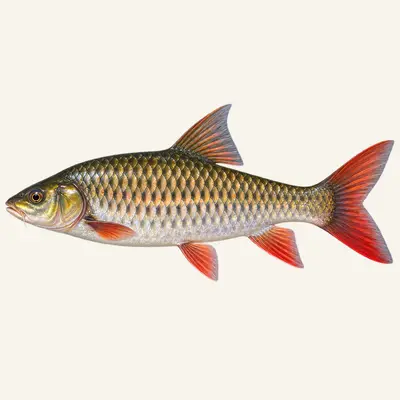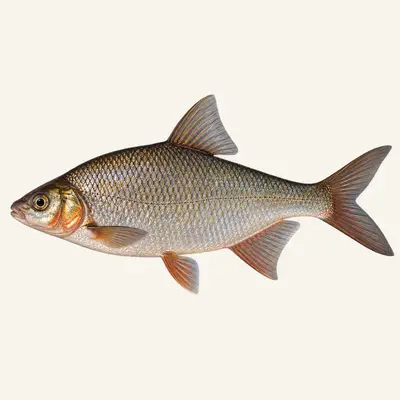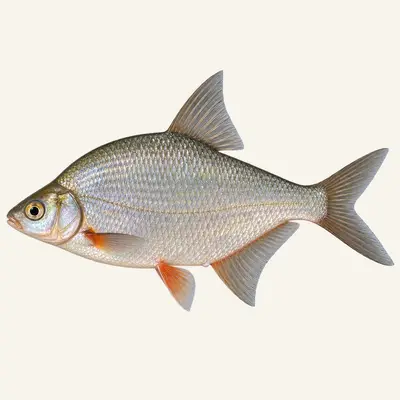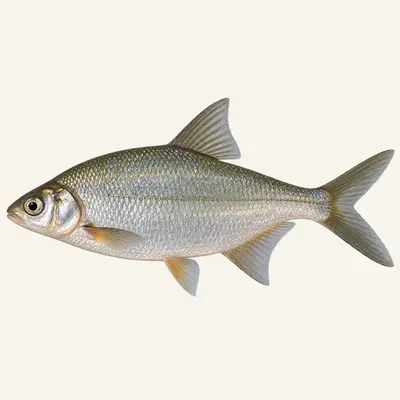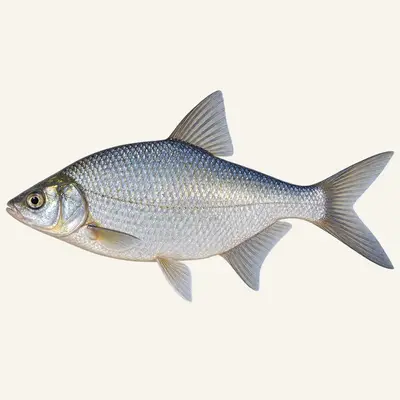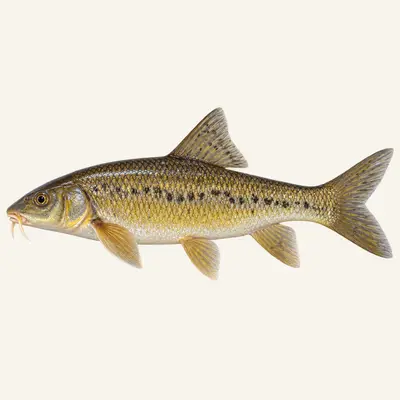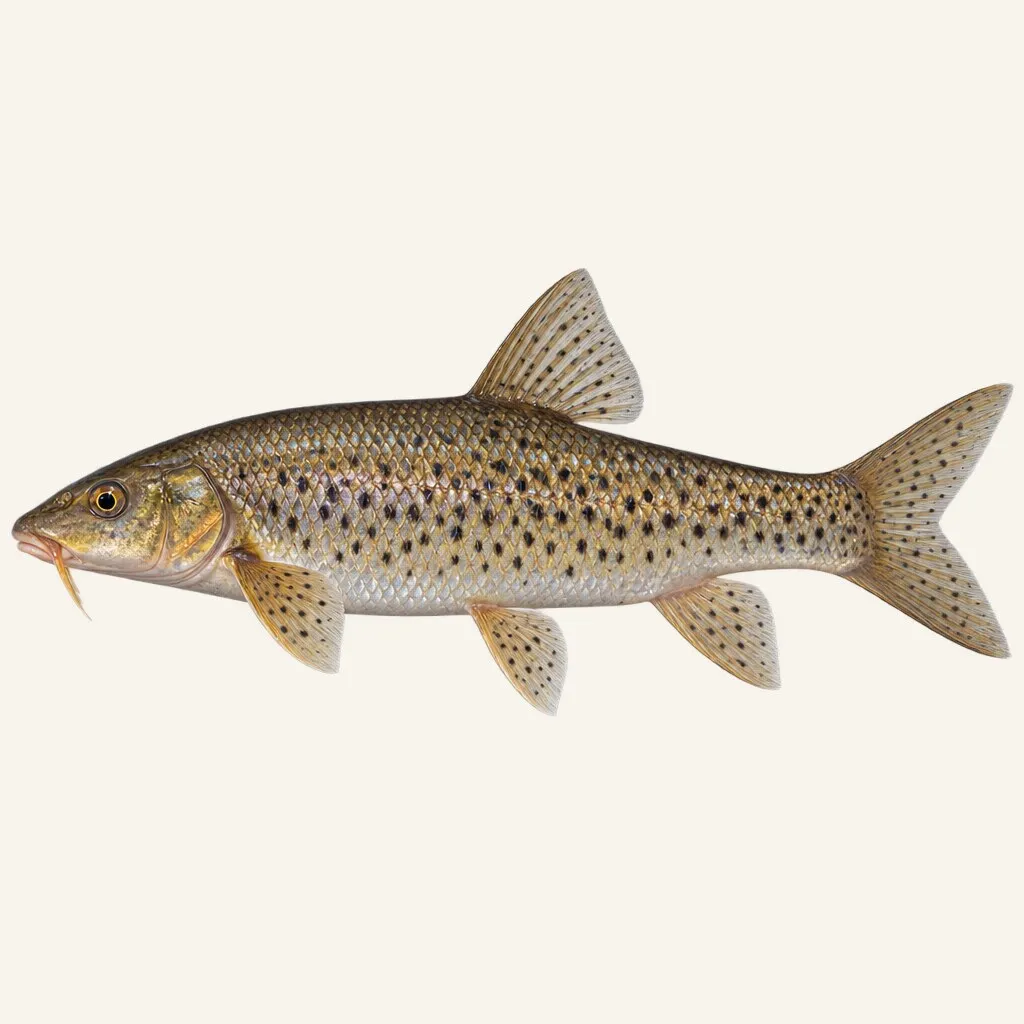
Tiber barbel
Barbus tyberinus · Cyprinidae
- Freshwater
- Carp & coarse
- Medium
- Size
60 cm
- Weight
4.0 kg
- Lifespan
9 years
Where to fish
- River
Habitat icons: Flaticon
Found in piedmont rivers and lakes. Prefers fast-running water but also occurs in the moderate flows of warm rivers and lakes.
Calendar
Recorded in 1 country
GBIF occurrence records — native and introduced populations combined.
Its range
It is endemic to Italy and it occupies both slopes. On the Tyrrhenian side, from the rivers around Genoa down to the Sele; on the Adriatic side, from the Esino to the Ofanto. Between them that covers most of peninsular Italy south of the Po plain.
For a freshwater fish, holding both flanks of a mountain chain is unusual — the Apennine divide is exactly the kind of border river species do not cross — and the resulting partition was legible until recently. The northern Adriatic belonged to one barbel, the centre and south of both slopes to this one.
Introductions have since put the species into other Italian drainages, and that legibility is going.
Identifying it
Its diagnostic character wears out as the fish grows.
In small individuals the leading simple ray of the dorsal fin is feebly spinous and finely toothed along its rear margin. Past roughly 15 to 20 centimetres standard length the ray weakens and the teeth tend to vanish. A key written around that serration therefore works on the juveniles and fails on the size class an angler most often has in hand, which is the reverse of how identification is supposed to behave.
What holds at every size is the arrangement of the markings. The back stays plain. The flanks carry conspicuous dark spots. The paired fins are spotted too, and that last detail is the one to use, because the other large barbel now sharing these rivers has paired fins washed grey and unmarked.
The remaining characters are three. The lateral line holds 47 to 62 scales, each with the free rear part rounded. The dorsal carries eight soft rays. The lower lip has a swollen pad through the middle of it. A fourth, the grey lining of the body cavity, separates this species cleanly from its two Italian congeners and requires an opened fish, which puts it out of reach for anything going back in the water.
Nine years is the maximum age reported.
The water it needs
Fast water is the preference, and the tolerance goes a long way past it.
The species occupies piedmont rivers and lakes, and it is also recorded from watercourses on low-lying plains. It holds moderate flows in warm rivers and in lakes — a warmth tolerance that lets it live downstream of where the mountain barbels of the same peninsula stop.
Two things follow. Lakes are ordinary habitat here, where for the common barbel they are an occasional address and never a typical one. And the range of water types available to this fish is wide enough that its scarcity in a given reach is a statement about that reach, not about the kind of water it needs.
Spawning stays inside the same envelope: shallow water, over sand or gravel.
Areas
- Gravel shallows
- Pool tails
- Moderate-current margins
Techniques
- Float fishing
- Light feeder
- Trotting
- Bolognese fishing
Baits
- Earthworms
- Maggots
- Bread paste
- Natural nymphs
What it eats
It eats plants first and invertebrates second, and among the barbels that ordering is upside down.
The published diet of the common barbel of northern Europe opens with bottom invertebrates — crustaceans, insect larvae, molluscs — and mentions algae as an occasional item at the end. Here the two rubrics reverse: aquatic plants lead, animal food follows.
At the water's edge that is not a nuance. Bread and cereal pastes are not fallback baits on this species; they match the larger half of the recorded diet, and they can be fished with the confidence usually reserved for a worm. Worms, maggots and natural nymphs then cover the animal fraction, which is real and second.
How to catch it
Adults present no handling difficulty. The armed dorsal ray has softened and lost its teeth long before a fish reaches a size worth photographing, so what the fish needs is speed and wet hands, not caution about its back.
The plant-led diet sets everything else. Groundbait and hookbaits that are soft, floury and neutral — paste, bread — fished on the bed in gravel riffles, at the tails of pools and along margins with moderate current, on a light feeder, a Bolognese float, a trotted line or a fixed line held in the flow.
On the question of what to do with a fish, there is not much to weigh. This barbel exists nowhere outside Italy, three barbels from elsewhere are now inside its range, and there is no reserve population anywhere on the continent to draw on. Every fish goes back.
Conservation · Endangered (IUCN) — This species is threatened with extinction. Always release it (no-kill), handle it with the utmost care and check local rules — fishing for it may be prohibited.
Conservation
Central Italy has become the place where displaced barbels are put, and this species is the one already living there.
Three separate arrivals are on record. Barbus plebejus, the larger Adriatic species, was introduced onto the Tyrrhenian slope of central Italy. Barbus caninus was introduced into the Arno and the Ombrone. Luciobarbus graellsii, an Iberian fish from another genus altogether, was introduced into the Fiora, the Ombrone and the Albegna. Three species, three unrelated introductions, one destination — and the Ombrone has taken two of them on its own.
No single mechanism accounts for the decline, because the pressure is cumulative. Each of those fish uses gravel riffles and running piedmont water; each spawns on the same substrate; and two of them grow larger than the species already there.
Movement has gone the other way as well. This barbel has itself been carried into Italian drainages it did not occupy. An endemic that has been transported stops being an endemic in one place and starts being an introduction in another, and both halves of that transaction land on the same map.
Regulations
Check the local regulations in force (legal size limits, closed seasons, bag limits).
For guidance only. Legal sizes, quotas and open seasons vary by location and season: always check the local regulations in force before fishing.
Other names
Tyberinus points at the Tiber, and every common name in this catalogue follows it — Tiber barbel in English, barbo tiberino, Tiberbarbe, barbeau du Tibre, barbo del Tíber, barbo-do-Tibre. Six languages, one river.
The Tiber is one basin out of a range that reaches from Liguria to Apulia across both slopes of the Apennines. What the epithet actually records is the place the species was described from, which is a fact about the history of the name rather than about the fish.
The practical effect is a name that misdirects in one specific way. A fish taken on the Adriatic side, several drainages and a mountain chain away from the Tiber, is still a Tiber barbel, and nothing in any of the six languages offers an alternative.
Sources: fishbase.se · api.gbif.org