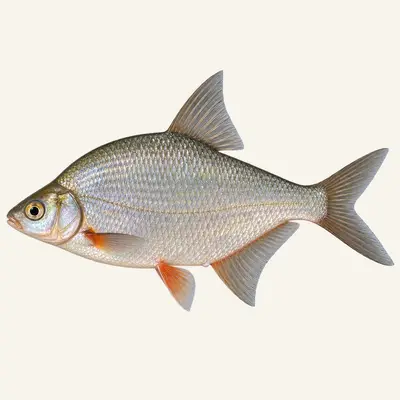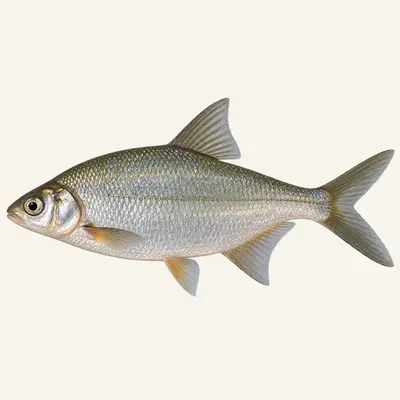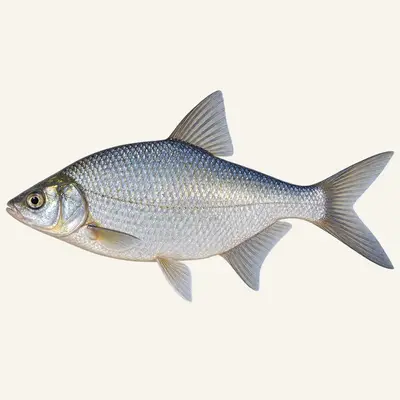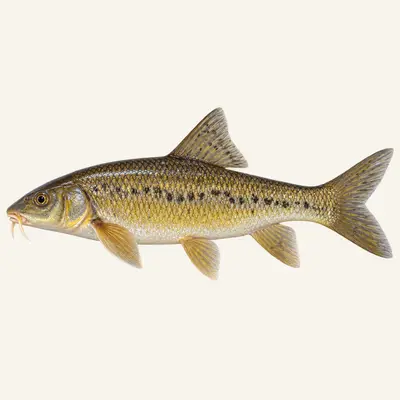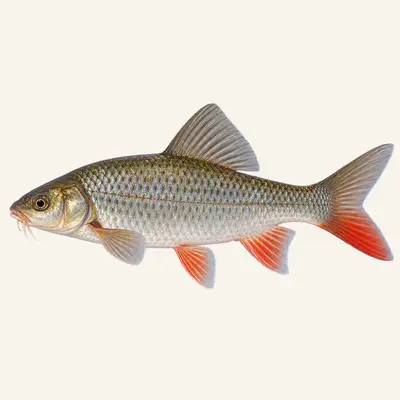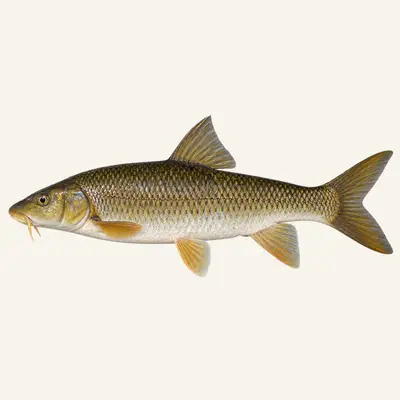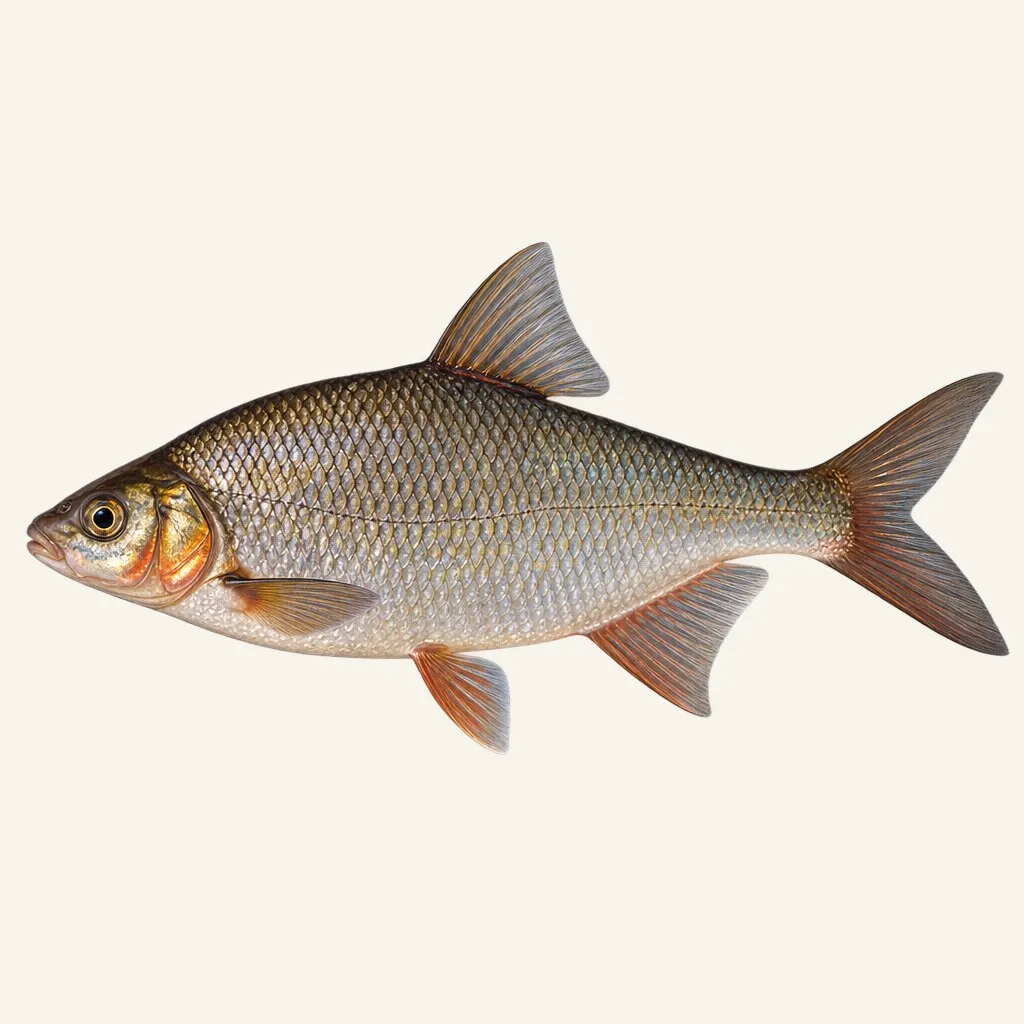
Vimba bream
Vimba vimba · Cyprinidae
- Freshwater
- Carp & coarse
- Medium
- Size
20–50 cm
- Weight
0.1–1.4 kg
- Lifespan
15 years
- Water temp.
10–20 °C
Where to fish
- River
Habitat icons: Flaticon
Protractile inferior mouth - pointed snout - resembles the nase - spawning migrations
Calendar
Its range
The Caspian, Black, Marmara and Baltic basins, with the Baltic populations running north to the 63rd parallel in Sweden and Finland, plus the North Sea basin between the Elbe and the Ems. In Anatolia it holds the Marmara basin south to the Great Menderes and Lake Eğirdir and east to the Kızılırmak, with a gap between there and the Çoruh.
Two entries change the shape of that map. The species has been extirpated in Crimea — a regional loss already completed, not a projection. And it has been introduced to the Rhine, which is west of everything native to it.
Identifying it
Run a thumb along the back behind the dorsal fin. There is a keel there — a bare ridge between the fin and the tail, sharp enough to feel — and it is the character the published diagnosis leads on. It is quick, it needs no ruler, and it works on a fish held in one hand.
The head end is the working end. The snout comes forward over the mouth, which opens underneath and is pushed out from the head to reach the bed; the fish grazes and probes rather than intercepts. A pointed snout with an inferior, extensible lip in front of a slim silver body is a bottom-working design, and the diet confirms it below.
Counts are moderate throughout and that is itself informative: 16 to 21 and a half branched rays in the anal fin, which places the fin between a roach's short one and a bream's long skirt, 19 soft rays in the tail, and a scale formula of 49 to 64 along the lateral line with six to ten rows above and below.
In the spawning season the male is unmistakable. The body goes blackish brown and the cheek turns orange, sometimes the belly with it. Nothing else in this group of rivers wears that combination, and one fish in that dress dates the season for the whole reach.
Breeding
Six or seven years pass before a female spawns, and she produces 15,000 to 20,000 eggs when she does. For a cyprinid of this size that is late — a lifespan reaching 15 years spent mostly in preparation — and it means a population is slow to rebuild after anything removes a run of year classes.
Spawning takes place on riffles: shallow, quick water over gravel in streams and rivers. Fish spawn in several successive years once they have started.
Getting there is the species' defining behaviour, and it takes three forms. Semi-anadromous populations feed in the freshened parts of the sea and travel long distances upriver. Lake populations run into fast tributaries. Sedentary populations, which live in medium and small rivers in the barbel zone, move barely at all. Spent adults drop back to wherever they feed.
The timetable of the long runs is the striking part. On the Dnieper and the Kuban the migration begins in September, slows through the winter and picks up again between March and May. Seven months elapse between leaving the estuary and spawning on the gravel, which is a demand of a completely different order from a spring run: the corridor has to be open for three quarters of the year, not for a fortnight in April.
The water it needs
Brackish estuaries, medium to large rivers, and a few large subalpine lakes. Sedentary populations manage in small rivers, in the reach a European typology calls the barbel zone — clear, moderately fast, gravel-bedded water in the middle course.
That spread of addresses is the reason the species is difficult to generalise about. An estuary fish, a lake fish and a small-river fish are all Vimba vimba, and they differ in movement, in size at age and in the season at which they can be found in any given place.
Areas
- Moderate currents
- gravelly bottoms
Techniques
- Feeder
- Waggler
- Bolognese float
Baits
- Maggots
- Worms
- Bread
What it eats
Small molluscs and insect larvae.
The molluscs are the informative half. Taking snails and small bivalves means detaching them from stone or sediment and then crushing them, which is work for the pharyngeal teeth and for a mouth that can be applied hard against a surface. It also fixes the fish's position: this is not an animal that intercepts drifting food in mid-water, it is one that works a substrate, and that is where a bait belongs.
How to catch it
The spring riffles are the readable window. Migrating fish concentrate on shallow, fast gravel, in numbers, at a predictable time, and a male in his orange-cheeked spawning dress confirms the timing with the first fish landed.
Outside that period the search depends entirely on which kind of population is in front of you. Estuaries and lower rivers hold the semi-anadromous fish, fast tributaries hold the lake fish, and the middle river holds the sedentary ones. Three different pieces of water for one species, and choosing wrong is the usual reason a stretch appears empty.
Bait and rig follow the diet: small offerings hard on the bottom, on a feeder or a running leger, or trotted under a float in the current with the bait tripping the gravel. Common length is 20 cm and the mouth is small.
One caution on naming. This species hybridises regularly with the white bream where the two share water, so an intermediate fish from a lowland river holding both is worth checking against the keel behind the dorsal fin rather than against a general impression.
Conservation
The documentation gives water obstruction as the threat, and the seven-month migration is what makes that ordinary phrase severe here. A fish that leaves the estuary in September to spawn the following April must pass every structure on the way up, and pass them again coming down. A single impassable weir on that route does not reduce the semi-anadromous population of a basin; it removes it, while the landlocked survivors upstream carry on as a separate and smaller thing.
Late maturity closes the trap. At six or seven years to first spawning, a population that loses its access to gravel cannot rebuild inside a decade even if the obstruction is later removed, because there is no reservoir of young fish waiting to take over.
Crimea shows the outcome at regional scale: an extirpation, already recorded, in a range where the species was once ordinary. The Rhine introduction shows the other direction, and it is worth noticing that moving a fish into a new basin has proved easier than keeping it in an old one.
Regulations
Minimum size 15-20cm depending on the country
For guidance only. Legal sizes, quotas and open seasons vary by location and season: always check the local regulations in force before fishing.
Other names
Vimba bream in English, and zährte is used as well, borrowed from German. Neither is native English usage — the species has never occurred in Britain, so the language has no word of its own for it and imports whichever one the writer's source used.
German offers Zährte and also Blaunase, blue nose, after the snout of the spawning male. Blue bream turns up in English too, but that name is already taken by the zope in other texts, so it should not be relied on without a binomial beside it.
The genus name comes from a Baltic vernacular for the fish and was carried into zoology unaltered, then repeated as the species name, marking the fish the genus was raised on.
Sources: fishbase.se · api.gbif.org