White-eye bream
Ballerus sapa · Cyprinidae
- Freshwater
- Carp & coarse
- Medium
- Size
15–35 cm
- Weight
0.0 kg
- Water temp.
10–25 °C
Where to fish
- River
Habitat icons: Flaticon
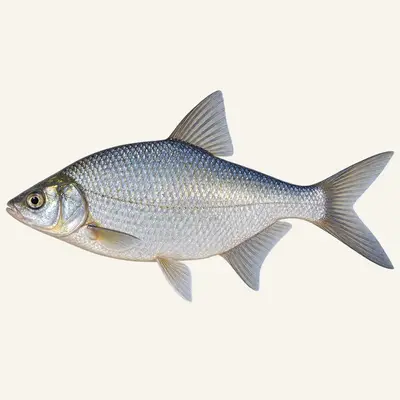
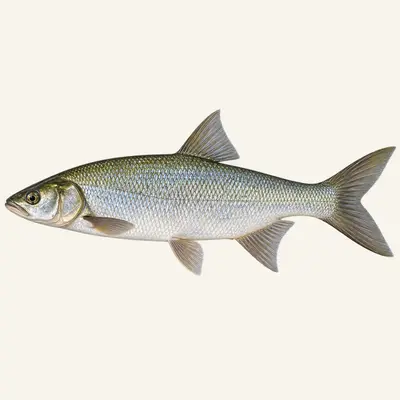
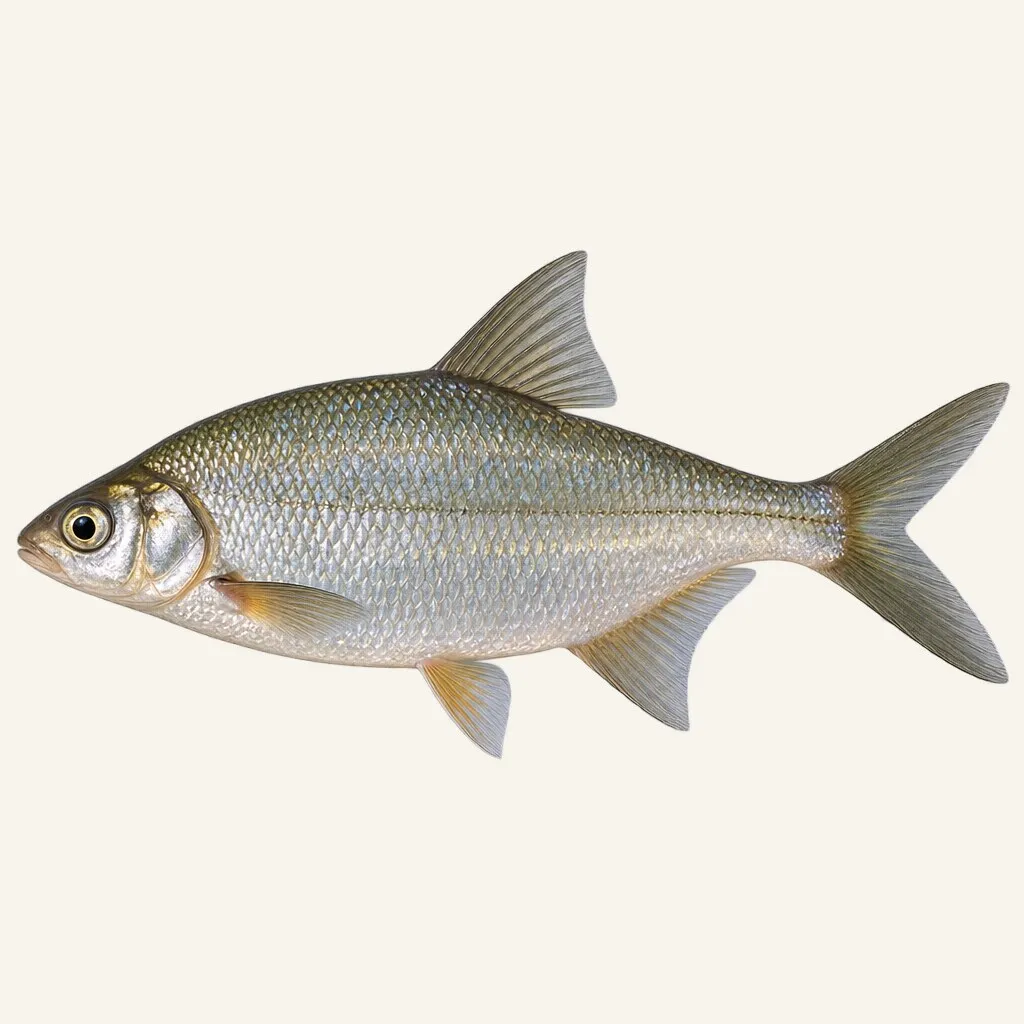
A laterally compressed and elongated cyprinid with a characteristic curved ventral profile and an inferior mouth well suited to bottom feeding.
Calendar
Its range
Large rivers draining to the Black, Azov, Caspian and Aral Seas hold the native populations. What has happened since is a study in how a freshwater fish crosses watersheds.
In the Northern Dvina it is spreading northward under its own power, out of the warmer upper reaches of the Vychegda system, on a range that may or may not be native there. It was introduced into the Volkhov, a tributary of Lake Ladoga, and into the Rhine in 1995. And it is invasive in the Vistula, having arrived from the Black Sea basin through the Prypet-Bug canal.
That last route deserves to be named for what it is. A channel cut for barge traffic joined the Dnieper and the Vistula drainages, two basins with no natural connection, and the fish used it. Introductions can be stopped and stockings can be regretted; a canal stays open.
Identifying it
The eye is large — as long across as the snout is long — and on a fish of 15 cm that reads immediately, because nothing else of this shape in these rivers carries an eye of that proportion. It is the character the common name was built on and it is the one to use.
The mouth is small and set underneath the head. The other member of the genus has a superior mouth, an eye about two thirds of the snout, and 62 to 77 scales along the lateral line; this fish reverses all three, with 47 to 54 scales. The two descriptions were written against each other, so the comparison is not a deduction but the published diagnosis itself, and any one of the three points settles a specimen.
The body is elongate and flattened, with the curved belly profile and the long low anal fin the group is known for.
Breeding
Spawning happens in dense aggregations, in fast water, over gravel or over submerged plants, and the adhesive eggs stick to whatever they land on, stone or stem.
The timing is the extraordinary part. Semi-anadromous fish in the Kura begin their spawning migration in November, months ahead of the event itself. A journey that starts in late autumn for a spring spawning requires a river that stays passable for a large part of the year, not just for the few weeks anyone would think to protect. Everything between the estuary and the gravel has to remain open across a winter.
The water it needs
Current. This is a fish of fast-flowing rivers and of the big lowland channels below them, and it is active at night, which are the two facts that place it in the water and in the day.
Eastern populations run their lives across the boundary between fresh and salt. They forage in the large brackish habitats of the estuaries around the Black Sea and enter the lower reaches of the rivers to breed, so the same species is an estuary fish in one basin and a river fish in another. Water temperature between 10 and 25 degrees covers both.
Areas
- Silty shallow margins
- Deep river pools
- Calm areas downstream of obstacles
- Oxbow lakes and river backwaters
Techniques
- Feeder fishing
- Waggler fishing
- Pole fishing
- Bolognese fishing
Baits
- Bloodworm
- Maggot
- Small boilie
- Flavoured paste
- Sweetcorn
What it eats
Bottom invertebrates, worked over at night.
The eye and the timetable belong together. An animal that hunts a river bed in darkness needs to gather what light there is, and a large eye on a nocturnal benthic feeder is the ordinary solution. Naming this fish after that eye therefore names its way of life as well as its face.
How to catch it
Night, on the bottom, in moving water — the three together, not one of them at a time. A nocturnal benthic feeder in current is fished with a bait held still on the bed as the light goes, and the last hour of daylight is the start of the session rather than the end of it.
Common length is 15 cm, so everything scales down: small hooks, fine line, bloodworm or a single maggot, a small paste bait or a grain of sweetcorn on the feeder. Tackle assembled for bream will be caught out by the size of the mouth.
The spawning aggregations in spring are the one time the species concentrates in a known place, which makes them easy to find and easy to damage. A shoal packed onto a gravel run in fast water is not a discovery so much as an obligation.
Conservation
Two opposite things are true of this fish at once, and they are true in different rivers.
In its native basins it is described as usually rare and under pressure from water pollution. That vulnerability has a mechanism behind it beyond toxicity: a species that spawns on clean gravel in fast current and feeds on the invertebrates of a river bed is affected twice by anything that loads a river with sediment or effluent, once through the spawning substrate and once through the food. The November migration extends the exposure across half the year.
In the north and west it is expanding — spreading up the Northern Dvina, established in the Rhine since 1995, invasive in the Vistula. It would be a mistake to read the second fact as relief from the first. These are different populations in different basins, and a canal-borne colonist in the Vistula does nothing for a polluted stretch of the Kura.
Regulations
Check the local regulations in force (legal size limits, closed seasons, bag limits).
For guidance only. Legal sizes, quotas and open seasons vary by location and season: always check the local regulations in force before fishing.
Other names
White-eye bream in English, which for once points at the right character: the eye is the diagnosis and the name records it. Sapa is used as well, taken from the species name.
German is where the trouble is. Zope in German is the other member of this genus, so a German name read straight across into English lands on the wrong fish, and the older literature compounds it by filing both species in Abramis with the common bream. Anything written before the genus was split needs its binomial checked rather than its vernacular trusted.
Sources: fishbase.se · api.gbif.org