Zope
Ballerus ballerus · Cyprinidae
- Freshwater
- Carp & coarse
- Easy
- Size
20–40 cm
- Weight
0.1–0.8 kg
- Water temp.
5–25 °C
Where to fish
- Lake
- River
Habitat icons: Flaticon
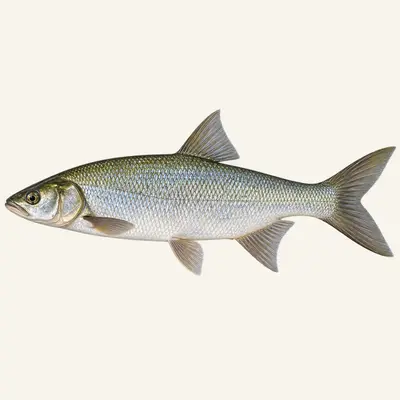
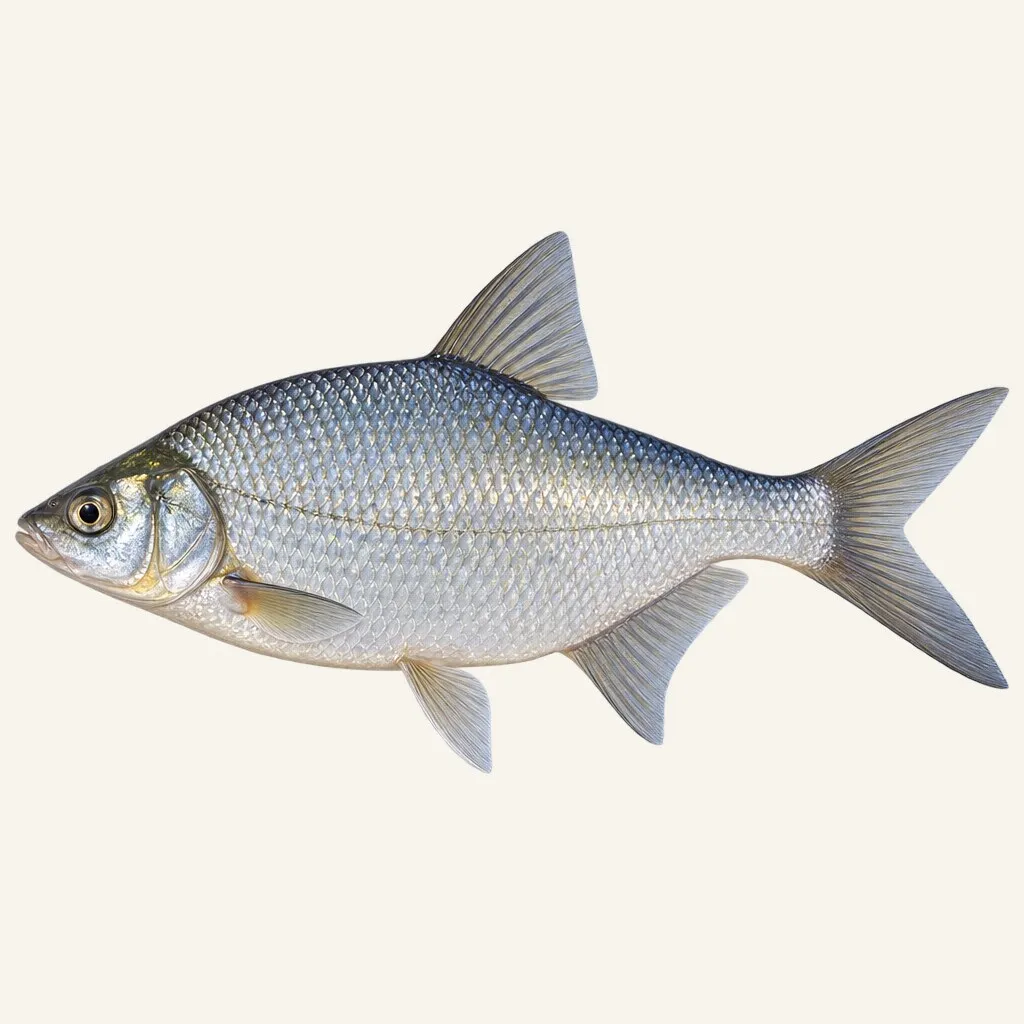
A deep-bodied, strongly laterally compressed cyprinid recognizable by its notably long anal fin, prominent eyes and bluish-silver coloration that gives it its common name of blue bream.
Calendar
Recorded in 4 countries
Germany · Russia · Sweden · Ukraine
GBIF occurrence records — native and introduced populations combined.
Its range
The range follows large rivers only, and that is the constraint that shapes it. Baltic drainages hold it as far as the 62nd parallel, with northern Sweden and Finland outside the range; the North Sea has it in the Weser and the Elbe and nowhere west of them; the Black Sea, the Sea of Azov by way of the Don, and the Caspian complete it. In the Caspian basin the distribution is lopsided — abundant in the Volga, rare in the Ural.
A fish that needs a big channel to migrate up, a floodplain to rear in and open still water to feed in cannot occupy a short steep river at all, which is why the western limit sits where it does rather than further along the coast.
Identifying it
The mouth turns up. On a deep-bodied, strongly flattened cyprinid built along bream lines, that one detail is unexpected enough to identify the animal on its own: the lower jaw leads, and the opening faces the ceiling of the water rather than the bed under it.
Three measurements carry the formal separation from its congener, and none of them is the anal fin. The scale count along the lateral line runs 62 to 77, an exceptionally high figure that gives the flank a fine-grained look in the hand. The eye is small in proportion, about two thirds the length of the snout in any fish over 10 cm standard length. And the mouth is superior, where the other species in the genus has a small one slung underneath.
That is worth spelling out because the silhouette will not do the job. Both members of this genus present the same outline — flattened, deep through the shoulder, with a long low anal fin running under the rear of the body — and the published description does not use the fin to separate them at all. It uses the mouth, the scales and the eye. Anyone sorting fish on shape alone is working with the character the source declined to rely on.
The colour is a bluish silver, which is where several of the names come from.
Breeding
First maturity arrives at 25.5 cm, with a recorded range of 24 to 27. Common length is 20. Put those two figures side by side and the consequence is uncomfortable: the fish most often met is below the size at which the species starts breeding, so the average specimen in the net has never spawned and the breeding stock is a minority of large individuals.
The spawning itself is drawn out for its group. It lasts one to two weeks rather than a few days, a female spawns once a year, and most individuals spawn in several different years of their lives. Males frequently hold and defend territories along the shoreline for the duration.
Eggs go onto submerged plants along river banks and in backwaters, and also onto gravel in moderate current — two substrates, and the second one keeps the option open where the first has been cleared away. Reaching either takes a long upstream migration; this species does not spawn where it feeds.
The water it needs
Large lowland rivers with backwaters attached, and eutrophic lowland lakes, in water between five and 25 degrees.
The word "attached" is doing real work. Adults feed in the open water of backwaters and other still waters; juveniles stay in the backwaters and the flooded ground along the river; adults run up the main channel to spawn. Three requirements, three different parts of the same floodplain, and they only function while the parts are connected to one another.
Some populations move the other way as well, dropping into the freshened parts of the sea to forage. Individuals live more than ten years.
Areas
- Large rivers
- lakes
Techniques
- Feeder
- Waggler
Baits
- Worms
- Maggots
What it eats
Zooplankton, taken in open water.
This is the fact that reorganises everything else on the page. The genus looks benthic, is shaped like a fish that works over soft bottom, and this member of it feeds in the water column of backwaters and still waters instead, straining the drifting crustacean plankton out of the free water. The upturned mouth is the tool for it. A bream-shaped animal living as a planktivore has different daily movements, different depths and a different response to a plankton bloom than anything it shares the river with.
How to catch it
Fish for it in the water column, not on the bottom. The mouth points upwards and the food is plankton, so a bait dragged along the bed is presented to the wrong animal; a bait suspended in open water over a backwater or a slack is presented to this one. That is an unusual instruction for a fish of this shape and it is the single most useful line here.
Baits stay small for the same reason — worm and maggot on fine hooks, fished on a feeder set shallow or under a waggler with the depth adjusted upwards until fish appear.
The spawning period concentrates them along shorelines in the main river for one or two weeks, which is the most readable window of the year and also the most exposed: the males are holding fixed territories in shallow water and are simple to remove one after another from a stretch of bank.
Size deserves a note at the net. Because first maturity sits above common length, most fish handled are immature, and a large individual is by definition one of the few that carry the year's spawning.
Conservation
The documented pressure is local damage to river banks, and the reason it bites harder on this species than on its neighbours is that the bank is where three separate parts of the life cycle happen. Eggs go onto shoreline plants. Males hold shoreline territories through a fortnight of spawning. Juveniles live in the backwaters and flooded margins immediately behind. Revetment, dredging and the straightening of a bank remove all three at once, and they remove them from the reach where the adults will keep on being caught for another decade.
The migration adds a second exposure. Adults travel long distances up the main channel to reach usable spawning ground, so anything blocking that channel does not reduce recruitment, it ends it for everything above the obstacle.
Neither effect shows up early. The adults are long-lived, the shoals stay visible, and the failure registers only when a generation that should have arrived does not.
Regulations
Check the local regulations in force (legal size limits, closed seasons, bag limits).
For guidance only. Legal sizes, quotas and open seasons vary by location and season: always check the local regulations in force before fishing.
Other names
Zope in English, taken straight from German Zope, and blue bream as the alternative — the second borrowed from the colour and shared, unhelpfully, with the vimba bream, which is also called blue bream in places. Where both live in the same basin, the vernacular is unreliable.
Older literature files the species under Abramis ballerus, with the common bream. The genus Ballerus was separated out later and now holds this fish and the white-eye bream, so a reference to "Abramis ballerus" and one to "Ballerus ballerus" are the same animal at different dates.
The species name is repeated in the genus, the mark of the fish on which the genus was founded.
Sources: fishbase.se · api.gbif.org