White bream
Blicca bjoerkna · Cyprinidae
- Freshwater
- Carp & coarse
- Easy
- Size
20–46 cm
- Weight
0.1–1.0 kg
- Water temp.
4–20 °C
Where to fish
- Canal
- Lake
- Pond
- River
Habitat icons: Flaticon
See silver bream (synonym) - smaller than the common bream
Calendar
Recorded in 26 countries
Austria · Belarus · Belgium · Croatia · Czechia · Denmark · Finland · France · Germany · Hungary · Iran · Italy · Lithuania · Luxembourg · Netherlands · Norway · Poland · Romania · Russia · Serbia · Slovenia · Sweden · Switzerland · Türkiye · Ukraine · United Kingdom
GBIF occurrence records — native and introduced populations combined.
Its range
The range covers the North, Baltic, White, Black and Caspian basins, reaching the Rioni at its southern limit on the Black Sea; on the Atlantic side it runs south to the Adour, with the population below the Loire possibly introduced, and it holds the Hérault and Rhône drainages on the French Mediterranean coast. In Asia it occupies the Aral and Marmara basins and the Anatolian Black Sea drainages west of Ankara.
The absences are the familiar ones for a lowland still-water fish — Iberia, Italy and the Adriatic basin, Crimea, Britain outside the south-east, Scandinavia beyond Sundsvall and the 65th parallel in Finland — and they trace the countries whose rivers are short, cold and steep. Spain, north-eastern Italy and the small coastal drainages of the Var hold it because it was put there.
Identifying it
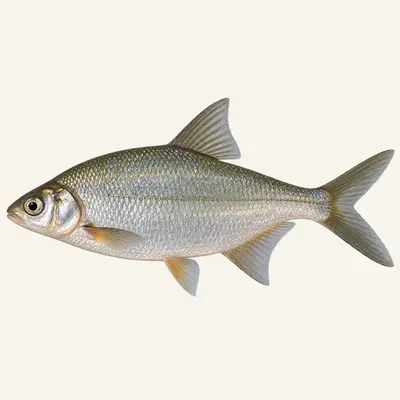
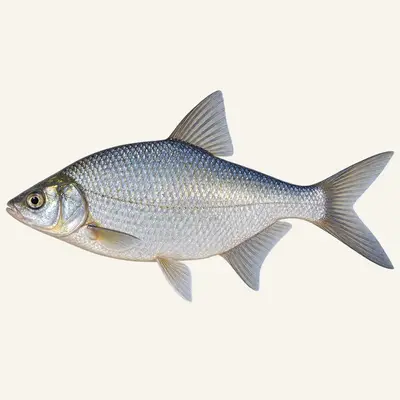
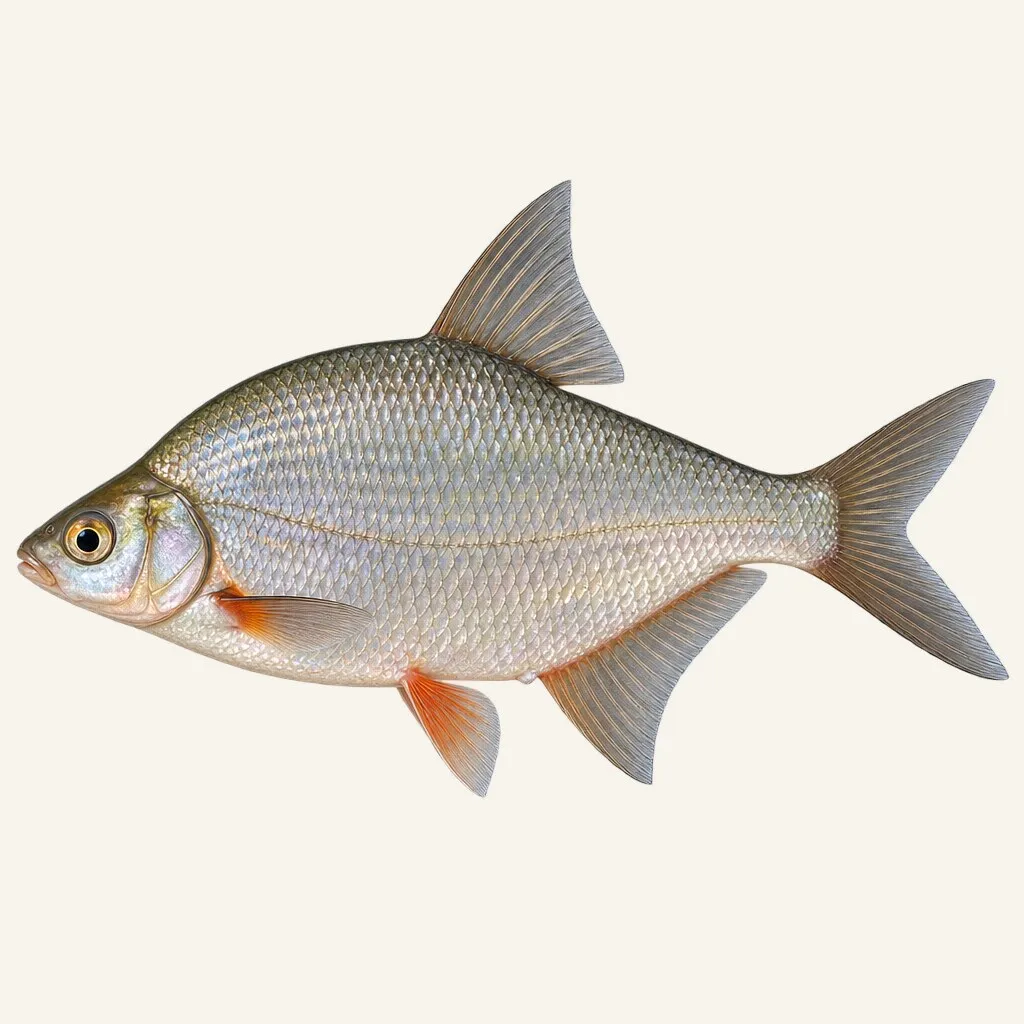
Turn the fish over and look at the roots of the pectoral and pelvic fins. On this species they are orange or reddish where they leave the body. The published description of the common bream gives the same bases as hyaline or grey. That is the whole of the field test, it works on a wet fish in a landing net, and it is available before anything has to be counted.
The mouth is the next thing, and it is defined here by what it will not do. It opens slightly below the tip of the snout and it does not extend into a tube. The common bream's own description records a sub-inferior mouth that does extend as a tube, telescoping down into silt; this one has the same position without the mechanism. In practice that means a fish taking food off the top of the bed rather than out of it.
The certain character is inside the throat. The pharyngeal teeth are set 2,5-2,5 — five in a main row on each side with a second, shorter row of two behind them. Common bream carry 5-5, a single row on each side and nothing behind. Two rows against one settles any specimen absolutely, and it is the reason a doubtful fish is worth keeping for someone with a scalpel rather than arguing about on the bank.
Proportions and counts fill in the rest. Above 10 cm standard length the eye measures about the same as the snout, where the common bream's is nearer two thirds of it. The anal fin holds 19 to 23 and a half branched rays, the lateral line 43 to 46 scales with two or three onto the tail, the tail 17 to 19 rays, the dorsal eight soft rays behind three spines, and the spine 39 or 40 vertebrae.
Breeding
Spawning runs from May to July and it is polyandrous: a female spawns with several males, and the males develop distinct courtship tactics rather than a single one. Trembling and splashing signal the moment of release over the plant substrate, and the eggs are adhesive.
The eggs go down along the shoreline, on submerged plants, on roots, or on shallow gravel. That third option matters. Species that will only use weed lose their entire spawning capacity when a margin is cleared; this one has an alternative substrate already in its repertoire, and it holds ground on hardened banks where its neighbours do not.
It hybridises regularly with the vimba bream where the two occur together, which is worth knowing in the eastern part of the range: a slim, silver, bream-shaped fish from a river that holds both is not necessarily either of them.
The water it needs
Still or nearly still water: lakes and reservoirs, and the calm reaches of rivers and canals. Shallow, warm lowland lakes suit it, so do the slow lower courses of large rivers, and it lives comfortably between four and 20 degrees.
One line in the biology is worth more to an angler than the rest of the habitat description put together — the fish is frequently very abundant on the beds of large sandy rivers. Not the weedy margin, not the silt: sand, in the main channel, in quantity. That is where to start looking for it, and it explains why so much of the catch comes from waters nobody thinks of as holding the species at all.
Larvae stay in still water bodies. Adults are gregarious in every season.
Areas
- Calm zones
- ponds
- canals
Techniques
- Pole/coarse fishing
- Feeder
Baits
- Maggots
- Worms
- Bread
What it eats
Bottom invertebrates, taken mainly at night.
The nocturnal habit is the strongest behavioural line between this fish and its larger relative, and it fits the anatomy exactly. A mouth without a telescoping tube cannot mine a soft bed to any depth; it works the surface of the sediment, which is a thinner living and enough for a smaller animal. Feeding at night over clean sand, where invertebrates come up out of the substrate in the dark, is a coherent way to make that limitation pay.
How to catch it
Sand, in a big river, after dark. Those two facts carry most of the practical fishing, and between them they explain why this fish so often arrives at the end of a session, when the bream have stopped and the swim is supposed to be finished.
A mouth that does not extend takes a bait presented on top of the bed rather than one buried in it, and takes a small one: common length is 20 cm and the gape is proportionate. Hook size and bait size come down accordingly, which usually means the tackle that was catching bream is now too heavy by a step.
They shoal, so one fish means more of them. Against that, the eastern hybrid problem above and the crossing that goes on wherever these deep-bodied cyprinids share a water mean that a single intermediate specimen may not be worth a firm name.
It is a fish nobody has ever fished for on purpose. Commercial netsmen dislike it — too small, and it competes with the species they want — and it has no reputation on the table either. That indifference is the reason so little is written about it and so much of what is written is about telling it from something else.
Regulations
Check the local regulations in force (legal size limits, closed seasons, bag limits).
For guidance only. Legal sizes, quotas and open seasons vary by location and season: always check the local regulations in force before fishing.
Other names
English cannot decide. White bream and silver bream both mean Blicca bjoerkna, they are used interchangeably in print, and "silver bream" is also what a great many anglers call a small bright common bream. The result is a name that can refer to two different species depending on who is speaking, which is a genuine nuisance in match results and in survey data alike.
German avoids the trap entirely with Güster, a word that borrows nothing from bream. The species name comes from Swedish björkna, and the genus was raised on this fish alone.
The safest habit in English is to give the scientific name once when the species is recorded, and to treat both vernacular names as ambiguous until the fin bases have been looked at.
Sources: fishbase.se · api.gbif.org