Torpedo scad
Megalaspis cordyla · Carangidae
- Saltwater
- Coastal
- Medium
- Size
45–80 cm
- Weight
0.9–4.0 kg
- Lifespan
5 years
- Depth
20–100 m
Where to fish
- Reef
- Offshore
Habitat icons: Flaticon
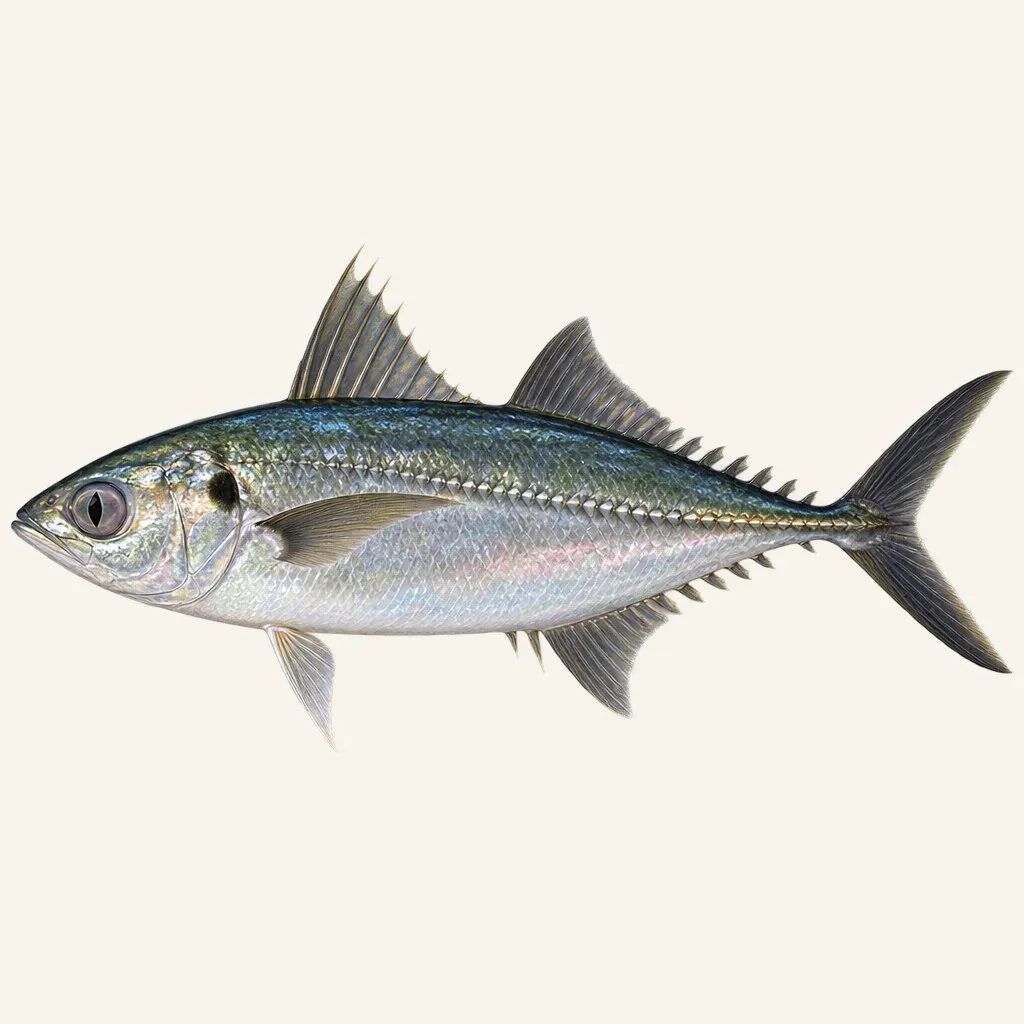
The torpedo scad is a streamlined carangid found in tropical coastal waters across Asia, Africa and Oceania, identifiable by its highly elongated silver body and deeply forked caudal fin. It hunts in fast-moving schools near the surface and is taken both offshore and in estuaries.
Calendar
Recorded in 17 countries
Australia · Bangladesh · China · India · Indonesia · Japan · Malaysia · Mauritania · Mozambique · New Caledonia · Pakistan · Philippines · Singapore · South Africa · Taiwan · Thailand · Vietnam
GBIF occurrence records — native and introduced populations combined.
Identifying it
Take the shape first: fusiform body, compressed section, and the entry above sharpens that into a strongly drawn-out silver fish ending in a deeply forked tail.
The counts are tight and they are low for the family. Nine dorsal spines and 18 to 20 soft rays; three anal spines and 16 or 17 rays. Several of the reef jacks in this catalogue carry half again as many rays behind the same number of spines, so a rough count taken from a fish still in the net puts this one in a different part of the family before any other character is examined.
The water it needs
The record disagrees with itself here, and the disagreement will mislead anyone who reads only the first line. The species is filed as reef-associated. The biology paragraph says the opposite in plain terms: adults are primarily oceanic, pelagic and gregarious, and are seldom seen on reefs. It is the second statement that holds on the water, and the classification tag is best treated as a habit of the database rather than a description of the animal.
The recorded band runs from 20 to 100 m. The fish also tolerates brackish water, which brings it in front of river mouths without ever tying it to them — the estuary is a place it passes through, not a place it belongs to.
Areas
- Coastal pelagic waters
- Passes between islands
- Upwelling zones
- Reef edges
Techniques
- Fast jigging
- Sinking metal lures
- Surface trolling
- Live bait fishing
Baits
- Small live fish
- Bright metal jigs
- Soft lures
- Shrimp
What it eats
It feeds mainly on fishes.
That is a plainer statement than it looks in this company. Several carangids in the catalogue live largely on crustaceans, some of them on crustaceans that barely move, and a great many mix invertebrates and fish through their whole lives. A clean piscivore in a family of mixed feeders means the forage is the thing to find, and it means one type of imitation covers almost everything the animal eats.
How to catch it
A school in open water between 20 and 100 m, feeding on fish: the method writes itself from those three elements. Metals and small baitfish profiles, worked fast, over concentrations that have been located rather than across water that has not. Depth in the column decides more than the choice of model does.
Common length is 45 cm and first maturity falls at 22. A fish taken in mid-water has, in the overwhelming majority of cases, passed twice that threshold before it reached the hook.
Conservation
The subject here is not status but arithmetic. The species matures at 22 cm and the oldest individual on record was five years old. Five years is the whole span of a population: it turns over in the time of a short lease.
That biology cuts two ways. It lets a stock rebuild quickly after a poor year, since one abundant year class is enough to refill it. It also removes every reserve, because there are no old fish to absorb two or three failed recruitments in a row. A bad sequence therefore shows up in the landings inside three seasons rather than after a decade of decline.
Exploitation, meanwhile, is heavy. The fishery is classed as highly commercial and the species carries a dedicated profile with the FAO, which is reserved for fish landed in volume. Short life, early maturity, industrial-scale catch: the combination does not make the animal fragile in itself, it makes the measurement urgent. A stock that rides on a single year class does not forgive two years of lag in the data.
Regulations
Check the local regulations in force (legal size limits, closed seasons, bag limits).
For guidance only. Legal sizes, quotas and open seasons vary by location and season: always check the local regulations in force before fishing.
Other names
The genus name is built on Greek aspis, a shield, prefixed with megalo-, large. Whoever named it was naming armour, and the account reproduced here never says what the armour is.
The common names ignore the shield entirely and see one thing instead. Torpedo scad in English, comète torpille in French, jurel torpedo in Spanish, Torpedo-Stachelmakrele in German, carangide siluro in Italian, xaréu-torpedo in Brazilian Portuguese. Six languages, one image, and it lands exactly on the "fusiform" box of the morphological record.
Scad is the part of the English name that carries no information. Four fishes in this catalogue answer to it — torpedo scad, mackerel scad, bigeye scad, yellowtail scad — and they sit in four separate genera. The word marks a general build, small to medium and silver and fast; everything that identifies an animal is in the qualifier in front of it.
Sources: fishbase.se · api.gbif.org