Two-spot red snapper
Lutjanus bohar · Lutjanidae
- Saltwater
- Coastal
- Medium
- Size
76–90 cm
- Weight
5.5–13 kg
- Lifespan
55 years
- Depth
0–180 m
Where to fish
- Reef
- Rocky shore
- Offshore
Habitat icons: Flaticon
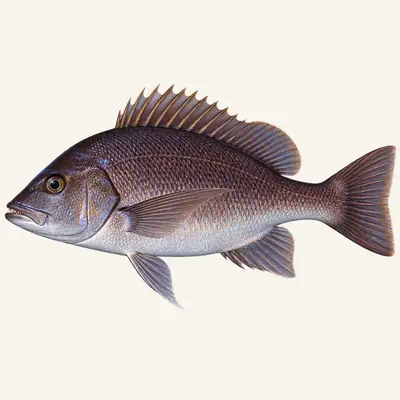
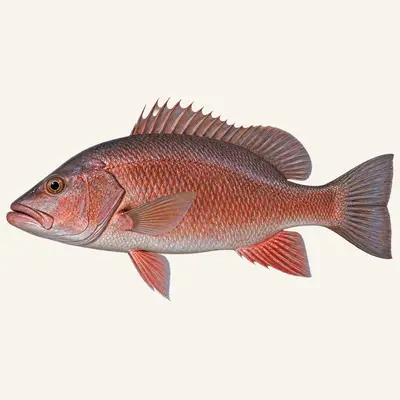
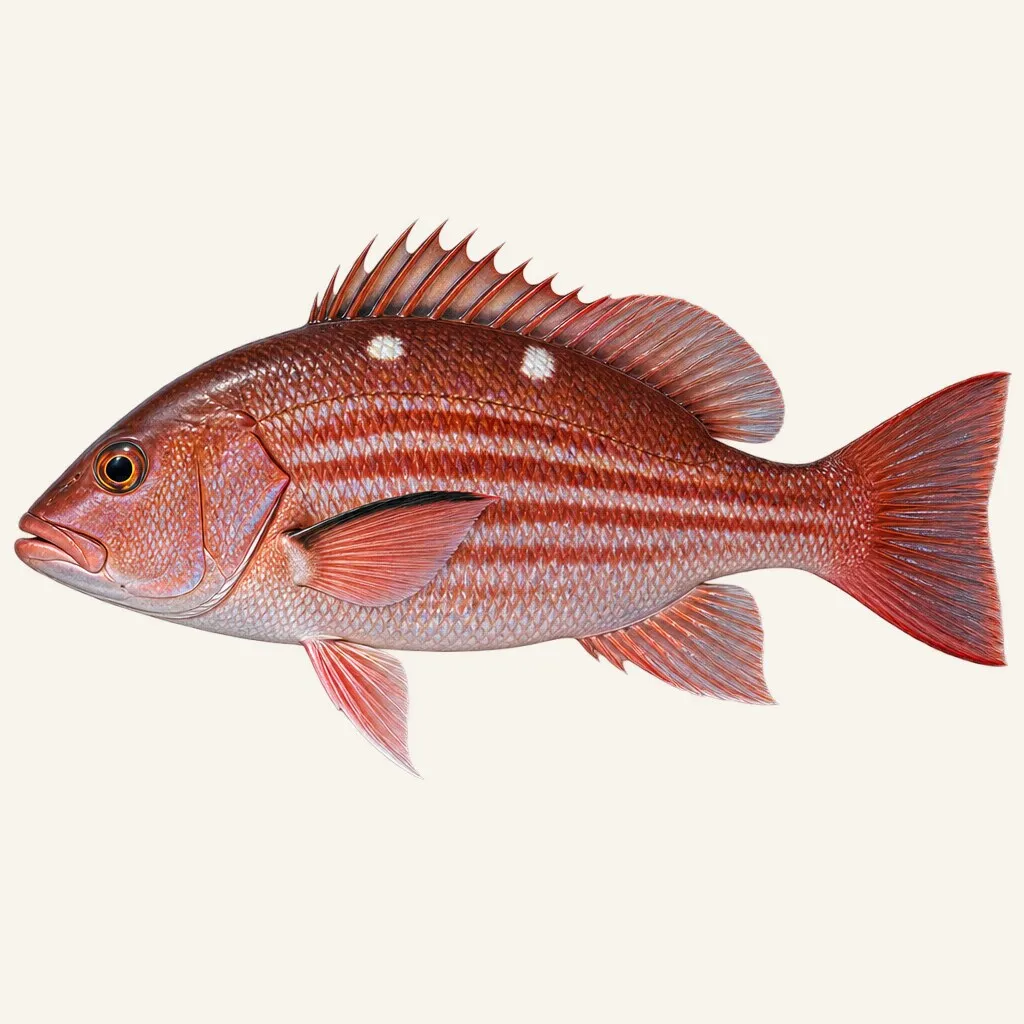
The two-spot red snapper is a powerful reef predator with a uniformly dark red body and occasional violet hues on the flanks. Its broad head, golden eyes, and visible teeth make it one of the most aggressive and sought-after snappers across Asia, Africa, and Oceania.
Calendar
Recorded in 39 countries
American Samoa · Australia · British Indian Ocean Territory · Cocos (Keeling) Islands · Egypt · Fiji · French Polynesia · French Southern Territories · Guam · India · Indonesia · Japan · Kenya · Kiribati · Madagascar · Maldives · Marshall Islands · Mayotte · Micronesia · Mozambique · New Caledonia · Niue · Northern Mariana Islands · Palau · Papua New Guinea · Philippines · Réunion · Samoa · Saudi Arabia · Seychelles · Solomon Islands · South Africa · Taiwan · Tanzania · Tonga · Tuvalu · United States · Vanuatu · Wallis & Futuna
GBIF occurrence records — native and introduced populations combined.
Its range
The range crosses the Indo-Pacific from East Africa to the Marquesas and the Line Islands, from southern Japan down to Australia. Its texture matters more than its outline.
The species is more common around oceanic islands than along continental coasts. It does not fill its range evenly: it concentrates where reef surrounds isolated land in open ocean, and thins out where a continental shelf widens the coastal band. That preference has two consequences, one for the populations and one for the health of whoever eats the fish.
Identifying it
A distinct groove, almost a pit, runs from the nostrils forward to the front edge of the eye. No other snapper in its range carries it, and it stays readable on a dead fish long after the colours have gone.
The body is dark reddish-brown with faint dark stripes. Young fish and some adults show two silvery-white spots on the back, the marks the English book name is built on, and they are absent often enough that they cannot be relied on alone. The pectoral fin is pink with a conspicuously black upper edge, which is the steadiest colour character on an adult.
Juveniles are a different animal altogether. The rear of the body and the tail are sometimes white, giving a small one the look of a Chromis damselfish. A predator coloured like a plankton-picker is not an incidental resemblance, and identifying this species young takes more care than identifying it grown.
The remainder: body depth 2.4 to 2.9 in standard length, preopercular notch and knob moderately developed, vomerine tooth patch a narrow crescent with no rearward extension, 22 or 23 gill rakers on the first arch, ten dorsal spines with 13 or 14 soft rays, three anal spines with eight.
The water it needs
The fish uses the whole coral reef, from sheltered lagoon to outer reef. It is usually found alone, close to steep outer slopes, and only occasionally in groups.
That relative solitude sets it apart from its gregarious relatives and changes what is being looked for. The target is not a school but a station — an isolated coral head, a break in a drop-off, the mouth of a pass. The usual band runs from 10 to 70 m, although the species comes right up to the surface and has been taken at 180.
Areas
- Outer reef drop-offs
- Reef passes
- Isolated coral heads
- Offshore hard bottoms
Techniques
- Metal jigging
- Live bait fishing
- Soft lure fishing
- Reef trolling
Baits
- Live fish
- Cut squid
- Live shrimp
- Crabs
- Whole anchovies
What it eats
Fish make up most of the diet, with shrimps, crabs, amphipods, mantis shrimps, gastropods and tunicates behind them.
The list describes an opportunistic carnivore on a piscivorous base. It also places the animal at the top of the coral reef food chain, and everything that follows about eating this species follows from that position.
How to catch it
The species responds to metal lures worked fast in mid-water and is taken traditionally on handlines and bottom longlines. It hunts close to the drop-off, so relief marks the spot rather than depth on its own.
Then the question that actually matters on this fish, which is a question of health rather than of technique.
This snapper is among the species most regularly implicated in ciguatera poisoning. Large individuals from oceanic areas of the western Pacific are frequently toxic, and Tuvalu is named explicitly in the literature. The toxin enters at the base of the reef food web and concentrates upward through it, so the highest burdens sit in long-lived predators at the end of the chain — which is precisely where this animal sits.
Three properties make the hazard a particular one. It cannot be detected: nothing in the appearance, the smell or the freshness of a fish reveals it. It survives the kitchen, since neither cooking nor freezing breaks it down. And its presence depends on the ground a fish came from rather than on the species in the abstract, so the same snapper is eaten without incident on one island and poisons people on the next.
The practical rule follows from all three. The question is put on the spot, to fishermen who work that reef, before a fish is kept — and the largest specimen off the most isolated reef is simultaneously the best prize and the worst candidate for the table.
Where it is eaten, the species is used fresh and dried-salted.
Conservation
Fifty-five years is the maximum reported age, and it governs how the rest reads: this fish outlives most of the fisheries that work it.
Maturity arrives at about 42.9 cm, from 39 upward. A fish of the common size — the literature gives 76 cm in standard length — has several decades behind it. A year class taken out of a population like that is not made good in a few seasons.
Then the geography. A species concentrated around oceanic islands lives in small populations separated by wide stretches of deep water. What is removed from one isolated reef is not replaced from the next reef along inside a season, which is exactly what a continuous continental stock can do.
Regulations
Check the local regulations in force (legal size limits, closed seasons, bag limits).
For guidance only. Legal sizes, quotas and open seasons vary by location and season: always check the local regulations in force before fishing.
Other names
In Queensland this fish is the red bass, and it is not a bass in any sense the word has ever had. The name matters anyway, because it is the one that carries the local warning: red bass is widely known there as a fish not to eat, and no book name carries that information with it.
Two-spot red snapper is the FAO name, and it points at two silvery marks that are not present on every individual or at every age — a diagnostic name built on an unreliable character, which is the worst kind.
bohar itself describes nothing. It is a borrowed local word that went into the binomial intact, as jocu did in the Atlantic, and it is why French and Italian simply keep it rather than translating a description that was never there.
Sources: fishbase.se · api.gbif.org