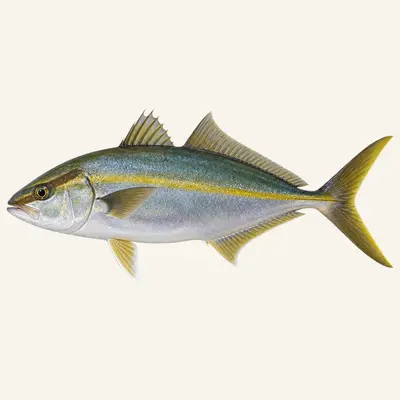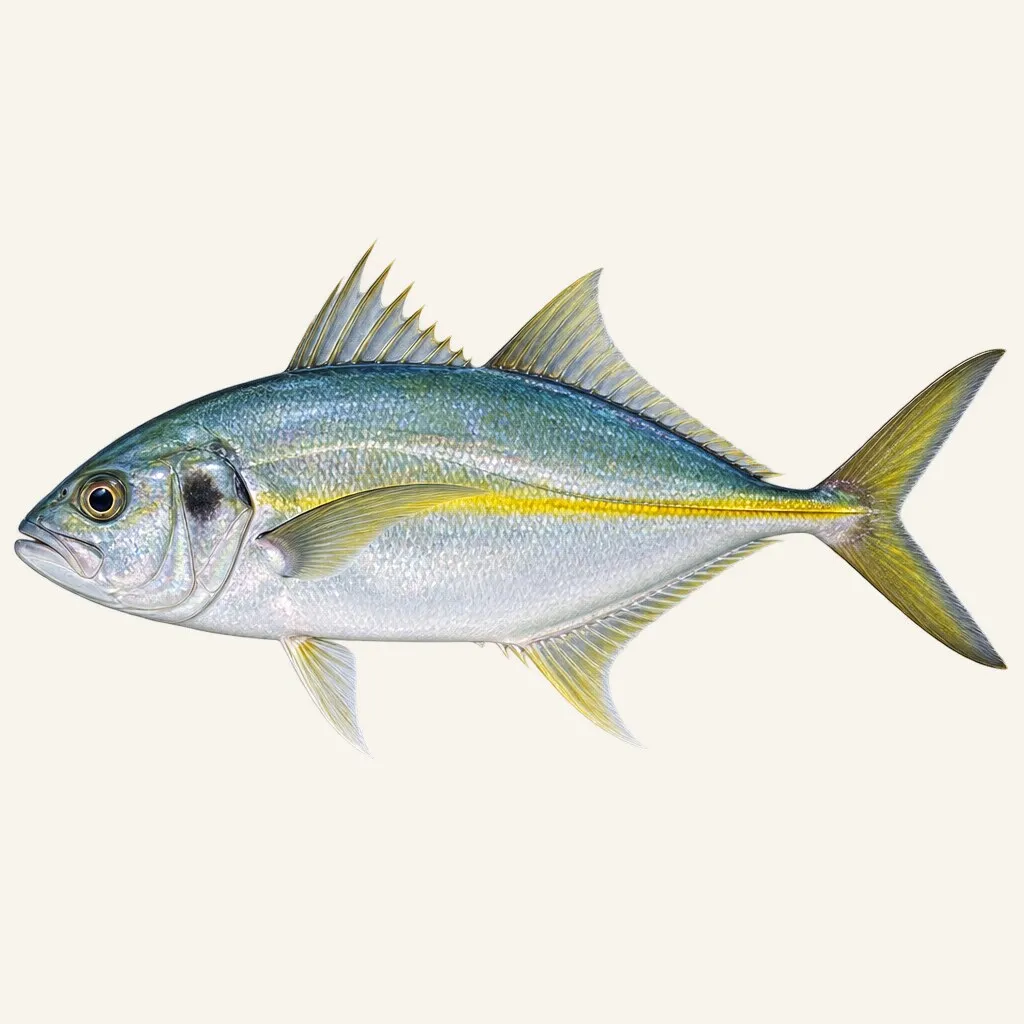
White trevally
Pseudocaranx dentex · Carangidae
- Saltwater
- Coastal
- Medium
- Size
40–122 cm
- Weight
0.8–18 kg
- Lifespan
49 years
- Depth
10–238 m
Where to fish
- Estuary
- Reef
- Rocky shore
Habitat icons: Flaticon
The white trevally is a Carangidae with a silvery oval body tinged with gold, recognisable by its slightly arched lateral line and sturdy teeth adapted to molluscs and crustaceans. Found in warm-temperate to tropical waters across several oceans, it often schools near the bottom.
Calendar
Recorded in 16 countries
Australia · Brazil · Chile · French Polynesia · Greece · Israel · Japan · New Caledonia · New Zealand · Norfolk Island · Portugal · South Africa · Spain · Taiwan · Türkiye · United States
GBIF occurrence records — native and introduced populations combined.
Its range
The record runs between 40°N and 47°S, and the localities in it are of two quite different kinds.
One kind is continental margin: North Carolina and Bermuda to southern Brazil, the Mediterranean, South Africa, Japan, Australia, New Zealand. Those coasts have what the species is described as needing — bays, estuaries, a shelf to school over.
The other kind is mid-ocean rock. The Azores, Madeira, the Canaries, Cape Verde, Ascension, St Helena, Lord Howe, Norfolk. Those have almost no shelf and no estuaries whatever, and a fish whose juveniles are recorded from estuaries and shallow shelf water is doing something different at each of them.
One name therefore covers two situations that have little in common, which matters when a description written on one coast is being applied to a fish landed on another.
Identifying it
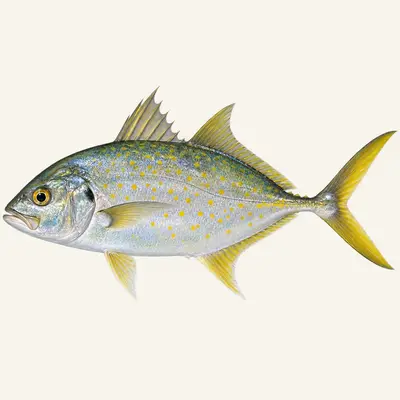
The mark on the gill cover is a blotch and not a spot. It is large, dark and diffuse, and "diffuse" is doing the work in that phrase: a patch that fades into the surrounding silver reads quite differently from a defined mark with an edge to it.
A yellow stripe runs the midside. Above it the fish is greenish blue, below it silvery white.
The maxilla is the technical character — the rear edge of the bone slopes slightly forward relative to its own main axis. The lateral line carries 57 to 78 scales in its curved part. The hardened plates behind that are given two different ways in the literature, 20 to 26 in one count and 34 to 46 in another, and the two figures do not reconcile; anyone using them as a diagnosis should know that before starting to count.
Nine dorsal spines, 25 or 26 soft rays, three anal spines, 21 or 22 rays, 25 vertebrae.
Breeding
Maturity averages 34.5 cm, inside a range of 28 to 37. The oldest fish recorded was 49 years old.
Forty-nine years is a long life for a fish of this size, and the breeding strategy is built to match it. This is a partial spawner: eggs go out in small batches, at intervals, across several weeks rather than in one release, and they are pelagic. Spread the output over weeks and then repeat it over decades, and no single bad season counts for very much. It also means there is no date on which the species spawns, so any protection organised around one is covering a fraction of the effort.
The water it needs
Adults hold bays and coastal waters, estuaries included, and school near the sea bed out on the continental shelf. Juveniles use estuaries, bays and shallow shelf water. Ten to 25 m is where most of it happens; the deepest record is 238 m.
The schools do not keep to one level. They are found at the surface, in mid-water and on the bottom, and they are often up against reef or rough ground. That vertical freedom is the unusual part, and the feeding explains it.
Schools sometimes run mixed — with Caranx koheru, a carangid like itself, and with Australian salmon, Arripis trutta, which is not one. A mark on the sounder is not evidence of a single species here.
Areas
- Coastal rocky bottoms
- Reefs and drop-offs
- Sandy-rocky areas
- Estuaries and bays
Techniques
- Horizontal jigging
- Light trolling
- Metal lures
- Live bait fishing
Baits
- Small live fish
- Soft lures
- Metal jigs
- Shrimp
What it eats
Three methods, not one. The species ram-filters plankton, swimming open-mouthed through a concentration of it. It feeds by suction, drawing in a single item. And it takes invertebrates off the bottom.
That is the explanation for schools at every height in the water. A fish with one feeding method has one place to be. A fish that can strain the water column, pick an individual animal out of it, and turn over the sea bed has three places to be, and it uses all three: the surface schools, the mid-water schools and the bottom schools are the same animal doing different work at different hours.
How to catch it
The school is the unit and it can be anywhere in the column, so the first decision is depth rather than position. Horizontal jigging, metal lures, a light trolled line and live bait all appear in local practice, and which of them is right depends on where the fish are sitting that day.
Presentation is complicated by the feeding. A fish swimming open-mouthed through a plankton cloud is not selecting a prey item, and a single lure asks it to do exactly that. Groups of small lures on one line, and chum put in to raise the school and hold it, work better than one convincing imitation — the object is to be inside the concentration rather than to be the best thing in it.
Common length is 40 cm against maturity at 34.5, so the ordinary fish is a young adult and the decades-old individuals are a small fraction of any catch.
The eating quality has been on record for a long time. FishBase carries the old judgement that it is "indeed the salmon of St Helena", a nineteenth-century way of saying it was the best fish the island had. Japan arrives at the same conclusion from another direction: as shima-aji it is a high-value sashimi fish, and it is farmed there.
Conservation
The nursery is the estuary, and that is where the pressure sits. Juveniles use estuaries, bays and shallow shelf water — the parts of a coast that get built on, dredged and reclaimed first — while the adults are out on the shelf where the fishing happens. Protecting the fishery does nothing whatever for the nursery, and the two are in the hands of different people.
The age structure is the other half of it. A 49-year fish that matures below 35 cm will accumulate decades of breeding adults if it is left to, and a fishery working the common size class removes them before they can accumulate. What comes back after a stock like this is thinned is a stock of young adults. They will breed — the batch spawning sees to that — but the reserve of old fish that made the population steady is not there any more.
Regulations
Check the local regulations in force (legal size limits, closed seasons, bag limits).
For guidance only. Legal sizes, quotas and open seasons vary by location and season: always check the local regulations in force before fishing.
Other names
White trevally in English, araara in Māori, shima-aji in Japanese.
The epithet is the joke. Dentex means toothed, and the fish it was applied to earns its living straining plankton out of open water and sucking invertebrates off the bottom. Whoever named it was working from a specimen and not from a feeding observation.
English names multiply regionally — silver trevally and skipjack trevally are both in use in Australian waters for fish of this group — which is what happens to a species recorded under one scientific name across three oceans and both hemispheres. Every English name it has is a local name, and it is worth establishing which coast a report came from before matching it against a description.
Sources: fishbase.se · api.gbif.org