Waigieu seaperch
Psammoperca waigiensis · Latidae
- Saltwater
- Coastal
- Medium
- Size
25–47 cm
- Weight
0.2 kg
- Depth
3–12 m
Where to fish
- Estuary
- Reef
Habitat icons: Flaticon
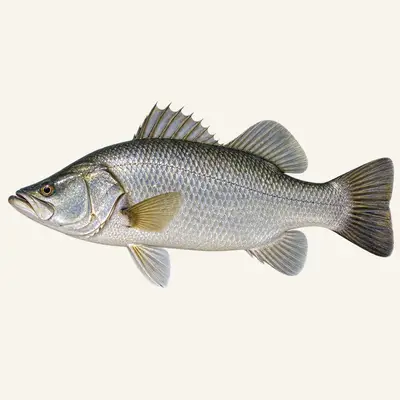
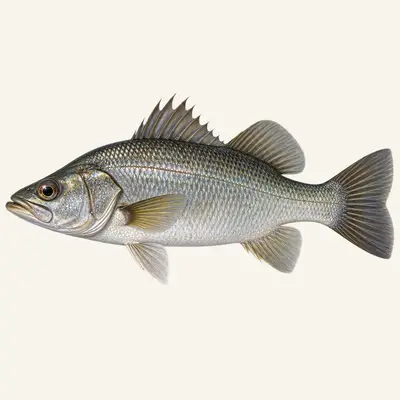
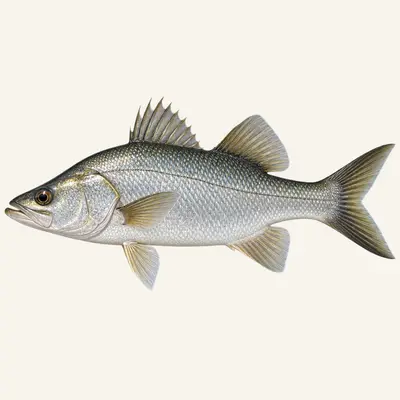
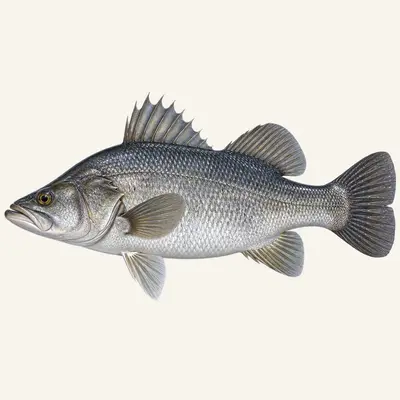
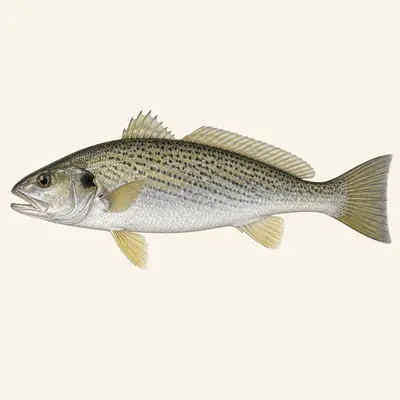
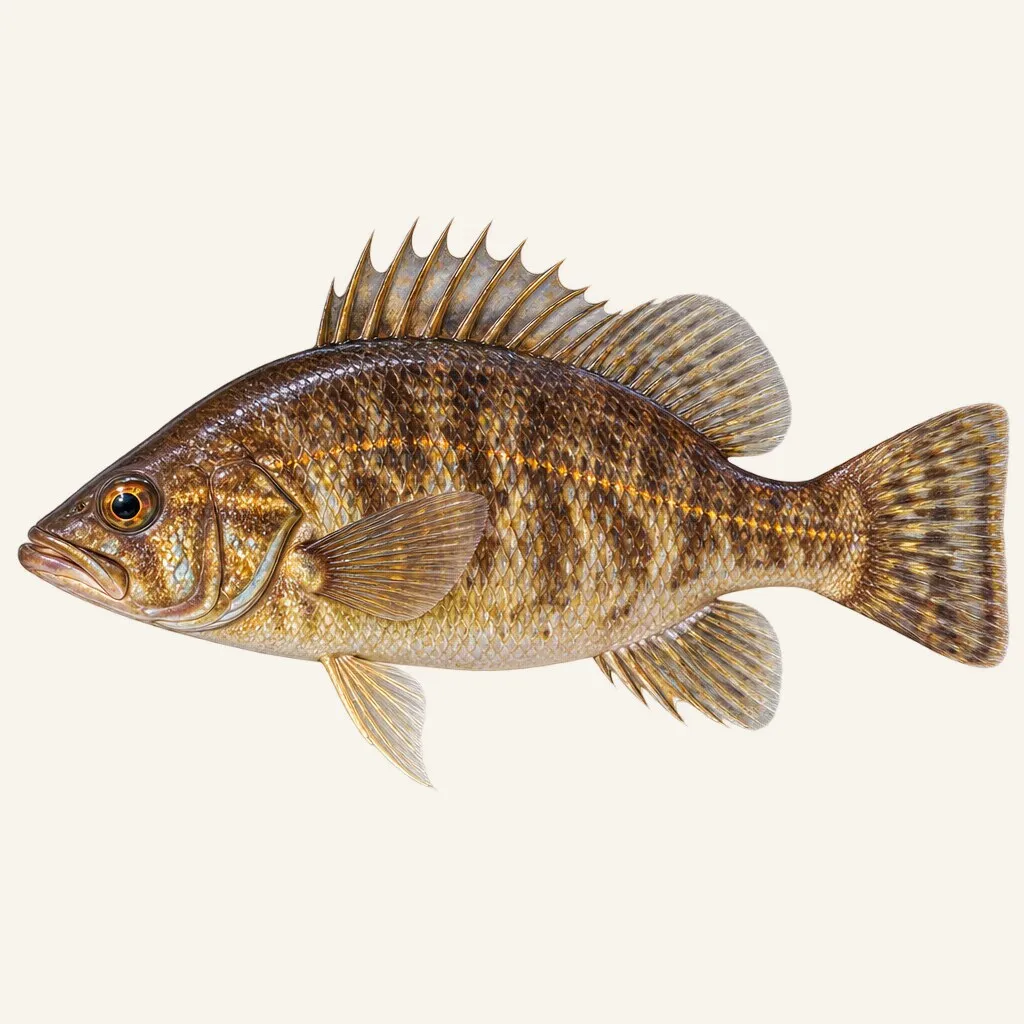
The Waigieu seaperch is a coastal marine predator of the Latidae family, found in marine and brackish waters along the Indo-Pacific coasts from Indonesia to Australia. It is recognised by its robust, slightly laterally compressed body, large ctenoid scales, and brownish-olive colouration with silvery highlights on the belly.
Calendar
Recorded in 5 countries
Australia · Indonesia · Japan · Philippines · Singapore
GBIF occurrence records — native and introduced populations combined.
Identifying it
Eight spines in the dorsal fin, 12 to 14 soft rays behind them, three anal spines and eight rays. The body is fusiform and compressed from side to side.
The rest of the identification exists because of a redescription published in 2018, and it is unusually explicit: the source sets out, character by character, what separates this fish from Psammoperca datnioides. Alive, the head and body are dark brownish and often golden, and the pored scales along the lateral line are edged with yellow — a yellowish brown that survives preservation, which is rare enough to be worth noting. Those pored scales number 46 to 48. With the mouth closed, the rear edge of the maxilla stops slightly short of the rear edge of the eye. Body depth is 32 to 36 per cent of standard length. There are 21 or 22 scales round the caudal peduncle, five and a half rows above the lateral line against seven and a half to nine and a half below, and 19 gill rakers of which nine are rudiments. The last dorsal spine is 1.5 to 1.7 times the length of the one before it.
One item on that list says what kind of separation this is. Among the diagnostic characters are scales on the upper rear part of the maxilla so small that the source records them as invisible to the naked eye and visible under a binocular scope. Two species of one genus are held apart, in part, on features that need a lens.
The water it needs
Rocky and coral reefs, frequently in weedy ground, between 3 and 12 m. By day the fish is inside the structure, in holes and crevices. It enters estuaries, and the recorded range includes the Mekong delta.
Two lines of habitat, then, describing two different addresses used at different hours — a shelter and a hunting ground — with the fish's whole day organised around moving between them.
The range itself runs from the Bay of Bengal through the Indo-Australian archipelago and northern Australia to the Philippines, the China seas and Japan. It is a shallow, reef-and-estuary ribbon, and there is nothing oceanic about it.
Areas
- Coastal coral reefs
- Mangroves and estuaries
- Sandy littoral bottoms
- Submerged harbour structures
Techniques
- Cast and retrieve with hard lures
- Coastal live bait fishing
- Light jigging
- Coastal trolling
Baits
- Small live fish
- Shrimps
- Hard lures
- Soft plastic lures
- Metal lures
What it eats
It forages at night, on fishes and crustaceans.
Put that beside the daytime refuge and the day is fully accounted for: inside the rock while it is light, out of it in the dark. What matters for the fishing is not so much what this predator eats as when it agrees to look for it. The prey list is unremarkable; the timetable is the fact.
How to catch it
Low light is the window, structure is the mark. Dusk, night and first light are when the fish is out of its hole, and a lure or a live bait has to be worked in contact with the cover rather than past it — a reef edge, a weed margin, a submerged harbour structure, in three to a dozen metres of water.
Two figures deserve to be set side by side. The common recorded length is 25 cm; the length at first maturity begins at 28. As the numbers stand, the fish ordinarily encountered is one that has not yet bred. Common length is drawn from landings rather than from angling, so it describes what the nets take, but the gap is the right way round to be worth thinking about before keeping a fish.
Conservation
The documented pressure on this species is a counting problem before it is anything else. It was redescribed in 2018, in the same paper that re-established the validity of its congener, and the characters that separate the two include scales invisible without a lens. Landings recorded before that work — and landings recorded since by anyone without a microscope — cannot safely be assumed to concern one species.
The market adds the second half. The fish is sold fresh, and in Hong Kong it is sold alive, a trade that pays a premium for an undamaged animal taken from reef structure. Demand of that kind does not scale with abundance, and it falls hardest on exactly the shallow, weedy, crevice-rich ground the species cannot do without.
Set against that, no assessment of its populations has ever been published, so there is no baseline to measure a decline against.
Regulations
Check the local regulations in force (legal size limits, closed seasons, bag limits).
For guidance only. Legal sizes, quotas and open seasons vary by location and season: always check the local regulations in force before fishing.
Other names
Waigieu seaperch, after Waigeo, the Indonesian island where the species was described. The catalogue places it in the Latidae, alongside the barramundi.
In English the word seaperch is where the trouble starts. It has been attached to unrelated fish across three oceans, and the barramundi itself is exported as giant sea perch — so a market label carrying the words sea perch narrows nothing at all. Sand bass circulates too, and it collides with a different set of species again.
Psammoperca is Greek for sand perch, which is the odd part: the recorded habitat of the animal is rock, coral and weed. The genus is named after the one substrate the diagnosis does not mention.
Sources: fishbase.se · api.gbif.org